
Company-Sponsored Executive MBA in India: Sponsorship, Bonds and NOC
Employer support for an executive MBA in India takes three forms: full fee sponsorship, partial tuition reimbursement, or a No Objection Certificate (NOC) and study leave while you pay the fee yourself. This guide explains which IIM, IIT, FMS and ISB courses require an employer NOC, how service bonds are enforced under the Indian Contract Act, and how to calculate the cost of leaving before a bond ends.
Key takeaways
- Employer support comes in three forms: full fee payment to the institute, partial reimbursement after passing, or a No Objection Certificate (NOC) with leave support.
- FMS Delhi, IIT Delhi, IIM Bangalore (PGPEM), ISB PGP PRO and ISB PGP MAX require an employer NOC or consent letter even when the participant pays the full fee personally.
- Under Section 74 of the Indian Contract Act, 1872, courts enforce reasonable compensation for documented training costs, so candidates planning an immediate job switch should self-fund rather than sign a full-sum bond.
A company-sponsored executive MBA is a management degree or diploma where the participant’s employer pays all or part of the tuition fee. The employer may also grant study leave for campus modules or issue a formal No Objection Certificate (NOC) so the employee can attend classes while remaining on the payroll. In return, most employers require a service bond that obliges the employee to remain with the company for one to three years after completing the course.
Should you take employer sponsorship for an executive MBA? Full sponsorship works well when you plan to stay with your employer for at least two years after graduating and the course opens an internal grade or leadership track. If your goal is to change companies immediately after the degree, self-funding with an education loan is usually cheaper than breaking a full-sum service bond.
| Item | How employer sponsorship works in India |
|---|---|
| Three models | Full fee paid directly to the institute; partial tuition reimbursement on passing; or leave-and-NOC support without funding |
| NOC vs sponsorship | Several weekend and evening courses require an employer NOC even when the student pays the entire fee personally |
| Placement rule | One-year residential MBAs exclude company-sponsored or sabbatical candidates from campus placements |
| Bond recovery law | Under Section 74 of the Indian Contract Act, 1872, courts enforce reasonable compensation for training costs actually incurred |
| Loan vs bond | Self-funding preserves the right to switch employers at any point during or after the course |
This guide explains the three sponsorship models used by Indian and multinational employers and lists which IIM, IIT, FMS and ISB courses demand a mandatory employer letter. It also shows how to calculate the exit cost of a service bond before signing and when an education loan is better than company funding.
Three Forms of Employer Support: Full Sponsorship, Reimbursement and NOC Only
Employers in India support executive education through three distinct arrangements, and each one carries a different tax, cashflow and bond obligation for the employee.
| Arrangement | Who pays the institute | Typical bond length | What happens to campus placements |
|---|---|---|---|
| Full corporate sponsorship | Employer pays the institute directly by company cheque or wire transfer | 24 to 36 months after course completion | Excluded from campus placements at 1-year residential courses; returns to sponsoring firm |
| Partial fee reimbursement | Employee pays instalments first; employer reimburses 25% to 75% on passing each year or term | 12 to 24 months from the date of reimbursement | Employee carries the initial cashflow and interest cost until reimbursement |
| NOC or leave support only | Employee pays 100% of the fee from savings or an education loan | No financial bond, though leave approval is required | Eligible for placements at 1-year courses only if the employee resigns before joining |
Some institutes apply stricter payment rules to sponsored candidates. For example, SPJIMR’s Post Graduate Executive Management Programme (PGEMP) FAQ states that fully sponsored participants are not eligible for the instalment payment facility and their sponsoring company must pay the course fee in a single lump sum.
Courses accepting applications
Sponsored

Which Executive MBA Courses Require an Employer NOC or Support Letter?
Many applicants assume an employer letter is needed only when the company pays the fee. In practice, several Indian institutes require a No Objection Certificate or employer consent letter from every working applicant, because the class schedule or campus residencies overlap with working hours.
| Course | Format | Is an employer NOC or letter required for self-funded applicants? | Official rule and source |
|---|---|---|---|
| ISB PGP MAX | 15 months, 12 week-long residencies | Yes, compulsory for all | PGP MAX FAQ: employer support letter required even if self-funded, because the course needs up to 12 weeks on campus |
| FMS Delhi MBA Executive | 2 years, weekday evenings | Yes, compulsory for all | FMS Information Bulletin: No Objection Certificate from the current employer is mandatory |
| IIT Delhi Executive MBA | Weekday evenings on campus | Yes, compulsory for all | DMS IIT Delhi EMBA page: NOC from the employer must be submitted |
| IIMB PGPEM | 2 years, Friday & Saturday on campus | Yes, employer approval required | IIMB PGPEM page: applicants must be employed full-time and provide employer consent |
| IIM Kozhikode EPGP | 2 years, classroom centres + 3 × 6-day modules | Not mandatory for self-funded applicants | IIMK EPGP-19 Admission Policy: self-funded candidates submit experience proof; leave for 18 campus days is arranged by the participant |
| ISB PGP PRO | 18 months, alternate weekends + residencies | Employer support letter required before enrolment | ISB PGP PRO eligibility page: consent letter from current employer is required |
Source: official admission pages and FAQs of ISB, FMS Delhi, IIT Delhi, IIM Bangalore and IIM Kozhikode, checked 10 November 2026.
How Service Bonds Work Under Indian Law and What It Costs to Leave Early
When an employer pays ₹15 lakh to ₹40 lakh for an executive MBA, the employee signs a training bond agreeing to serve the company for 24 or 36 months after graduation. Under Section 27 of the Indian Contract Act, 1872, an employer cannot force an employee to stay against their will. However, under Section 74 of the Act, Indian courts uphold reasonable financial compensation when the employer has spent verifiable money on external degree tuition.
Before signing a sponsorship agreement, check whether the recovery clause is pro-rata (reduced in proportion to the months already served after the course) or full-sum (the entire tuition fee plus interest remains payable until the final day of the bond). The calculator sheet below models both clauses using the IIM Kozhikode EPGP-19 fee of ₹16,87,000 as an example.
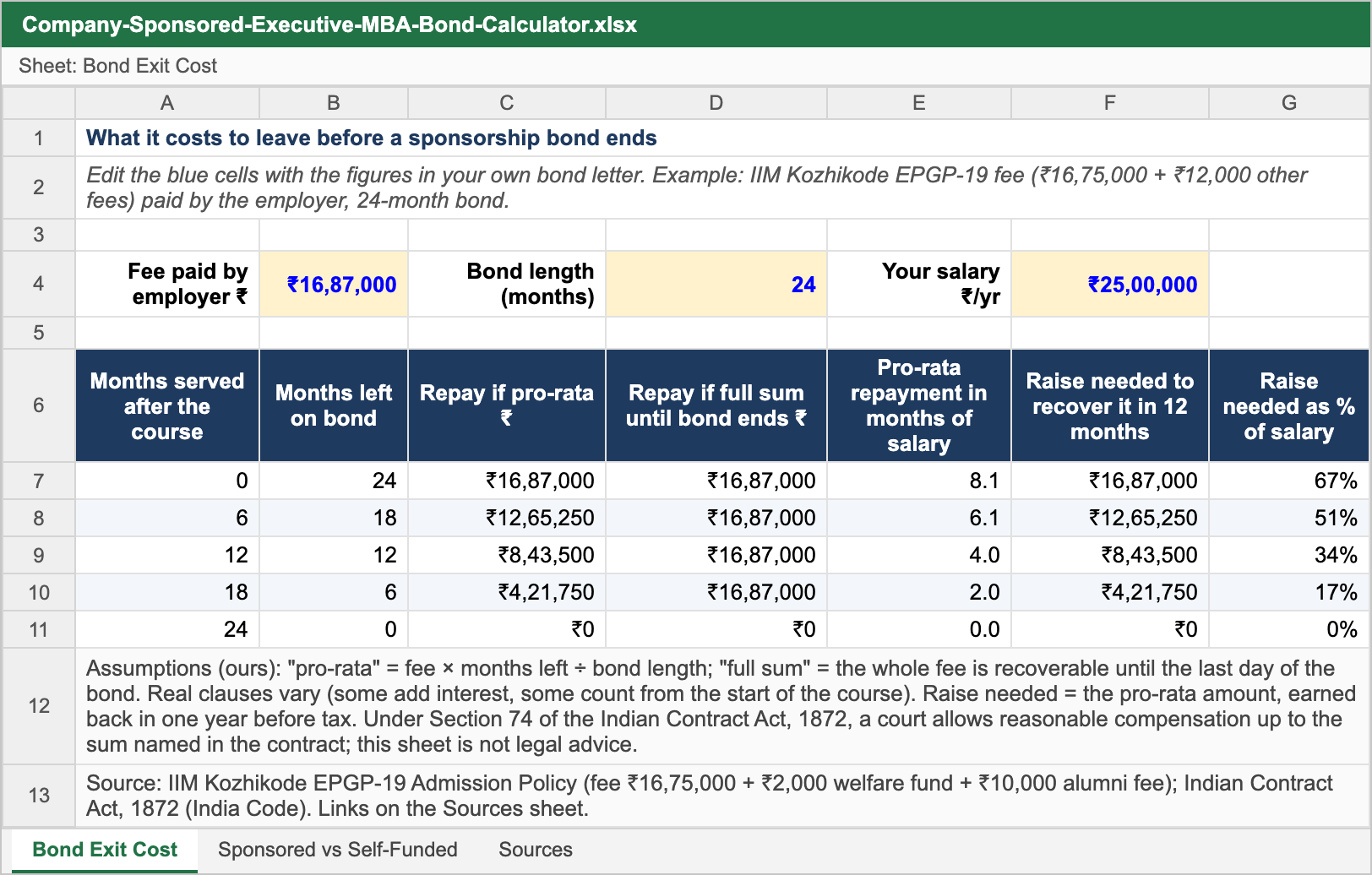
As the sheet shows, leaving 12 months into a 24-month bond on a ₹16,87,000 course costs ₹8,43,500 under a pro-rata clause, or the full ₹16,87,000 under a non-pro-rata clause. Suppose a new employer offers a ₹30 lakh package against your current ₹25 lakh salary. That ₹5 lakh pre-tax raise (₹3.5 lakh after tax) will take more than two years just to pay off the pro-rata bond penalty, unless the new employer buys out the bond.
Sponsored vs Self-Funded with a Loan: Cashflow Comparison
Many large Indian conglomerates and IT services companies offer 50% tuition reimbursement rather than 100% upfront payment. In a part-reimbursement arrangement, you still fund the instalments during the course and claim the company’s share only after clearing the final exams, while signing a service bond for the reimbursed amount.
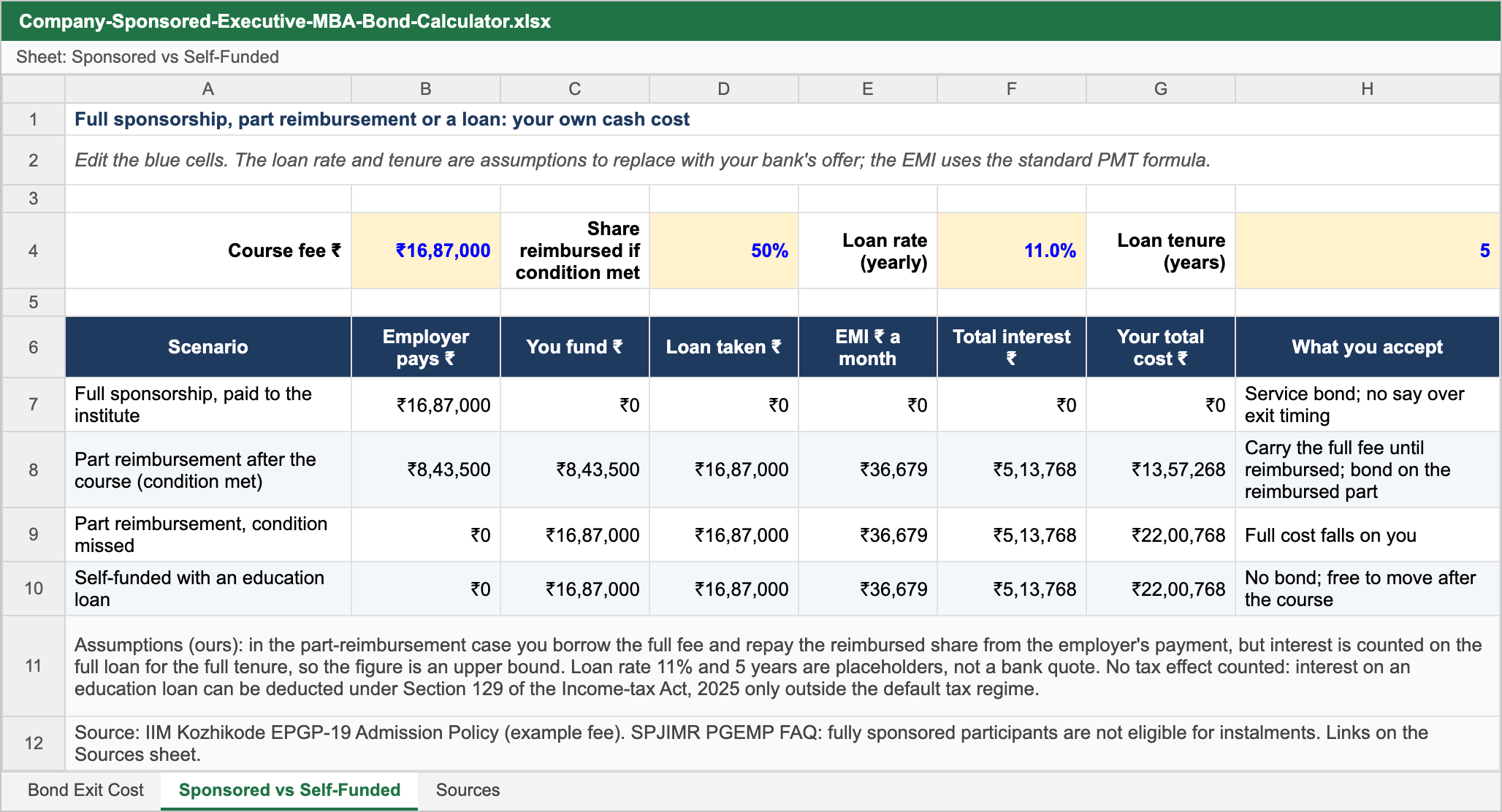
When you self-fund through an education loan, you pay interest during the tenure, but you owe no service bond and can move to a new employer at any time. Interest paid on an education loan from a notified bank can also be claimed as a deduction under the old tax regime (Section 80E / Section 129 of the Income-tax Act, 2025). Employer-paid tuition carries no tax deduction for the employee.
Sponsored and Sabbatical Candidates in One-Year Full-Time MBAs
Several one-year residential courses—including IIM Indore’s EPGP, IIM Lucknow’s IPMX and XLRI’s PGDM (GM)—admit candidates who are on a one-year corporate sabbatical or company sponsorship alongside candidates who have resigned from their jobs.
- Sabbatical candidates return to their employer: in the IIM Indore EPGP Placement Report 2024–25, 8 of the 62 participants rejoined their previous employer after completing the course on sabbatical.
- Placement exclusion: candidates who join on employer sponsorship or a formal sabbatical bond must opt out of the campus placement process, or resign and clear their bond before placement registration begins.
The Desk’s take: Accept full employer sponsorship when two conditions hold: your company has a clear internal promotion path for MBA holders, and you are comfortable staying for 24 months after graduation. In that case, sponsorship turns an ₹18 lakh to ₹40 lakh course into a zero-cost promotion accelerator.
Skip sponsorship and self-fund if your main reason for doing the MBA is to leave your current company or industry within 12 months of graduating. Paying an education loan EMI is almost always cheaper and cleaner than negotiating a ₹15 lakh bond buyout during a job switch.
Courses accepting applications
SponsoredCompany-Sponsored Executive MBA FAQs
Can I sit for campus placements if my company sponsors my MBA?
No. Weekend and blended executive MBAs do not run campus placements at all, and one-year full-time residential MBAs require sponsored or sabbatical candidates to opt out of placements and return to their sponsoring organisation.
Do I need an NOC if I pay for an executive MBA myself?
It depends on the institute. FMS Delhi, IIT Delhi, IIM Bangalore (PGPEM), ISB PGP PRO and ISB PGP MAX require an employer No Objection Certificate or support letter even when you pay the full fee yourself. Blended courses such as IIM Kozhikode’s EPGP do not require a formal sponsorship letter from self-funded applicants, though you still need leave for the campus modules.
Are executive MBA service bonds legally enforceable in India?
Under Section 74 of the Indian Contract Act, 1872, an employer cannot stop you from resigning. Courts do, however, allow the employer to recover reasonable compensation up to the bond amount when the company has spent documented funds on your tuition fee.
Can a new employer buy out my executive MBA bond?
Yes, senior lateral hires sometimes negotiate a joining bonus equal to the pro-rata bond balance. However, the joining bonus is taxed as salary income in your hands, so a ₹10 lakh bond buyout requires roughly ₹14.3 lakh in pre-tax joining bonus at the 30% tax slab.
Last updated: 10 November 2026
Keep reading
- IIM Kozhikode EPGP: fees, schedule and ROI with job
- ISB PGP PRO: ₹39.96 lakh fee, loans and ROI
- FMS Delhi MBA Executive: ₹2.56 lakh fee and NOC rules
- MBA for government and PSU employees: study leave and rules





Questions & answers · 2
Real decisions are rarely one-size-fits-all. Ask a focused question; applicants, participants and alumni answer here.
Can I apply to FMS Delhi or IIT Delhi Executive MBA without telling my employer?
No. Both FMS Delhi and IIT Delhi require a formal No Objection Certificate (NOC) from your current employer as part of the admission process, even when you pay the entire fee from your own pocket.
My company will sponsor my executive MBA if I sign a 3-year bond. Should I accept?
Accept if your company has a defined role or grade jump waiting for you after graduation and you plan to stay at least two to three years. If you want to use the MBA to switch companies within a year of graduating, self-funding with an education loan gives you complete freedom to leave without a bond buyout.