
ISB PGP PRO (Executive MBA): Fees, Eligibility, Format and Admission
ISB's PGP PRO is an 18-month programme for professionals with at least five years of work experience, with classes held on alternate weekends so that participants can continue working. The fee for the Class of 2027–28 is ₹33,69,559 plus GST, and there is no entrance test. Applicants should note that ISB awards a postgraduate certification at the end of the programme, not a master's degree. This guide explains the schedule, the return on investment at different experience levels and how the programme compares with options at IIM Kozhikode, IIM Bangalore and IIM Lucknow.
Key takeaways
- ISB PGP PRO is an 18-month, alternate-weekend programme in Hyderabad or Delhi for professionals with 5+ years' experience; there is no entrance test.
- The Class of 2027–28 fee is ₹33,69,559 + GST, or ₹39,96,080 with GST and a refundable ₹20,000 deposit.
- ISB awards a Postgraduate Certification, not a master's degree, and describes no placement support; IIMK and IIML weekend options award MBAs for under half the fee.

PGP PRO is the Indian School of Business’s course for working professionals. It runs on alternate weekends, so participants can continue in their jobs. ISB says the course “matches the rigour of an Executive MBA”, but it awards a postgraduate certification rather than a master’s degree, because ISB is not permitted to award an MBA.
PGP PRO is also the most expensive option in India for professionals who wish to keep their jobs. This guide explains the fee, the eligibility rules and what the certification means in practice.
ISB PGP PRO (Post Graduate Programme in Management for Working Professionals) is ISB’s 18-month executive course. Participants keep their jobs and attend classes in person on alternate weekends in Hyderabad or Delhi, along with campus residencies. The Class of 2027–28 fee is ₹33,69,559 + GST, which comes to ₹39,96,080 with GST and a refundable deposit. Applicants need a bachelor’s degree and 5+ years of full-time work experience, and there is no entrance test. On completion, ISB awards a Postgraduate Certification, not a master’s degree.
| Award | Postgraduate Certification. ISB: because Indian regulations don’t let independent institutions grant a master’s, it offers “a Postgraduate Certification instead” |
|---|---|
| Format | Executive MBA (keep your job): in-person classes on alternate weekends in Hyderabad or Delhi, campus residencies at Hyderabad or Mohali, plus some online sessions |
| Duration | 18 months, 24 credits |
| Total fee | ₹39,76,080 including GST for the Class of 2027–28 (₹33,69,559 + GST), plus a ₹20,000 refundable deposit; travel extra |
| Placement support | Not offered as a placement process. None of ISB’s PGP PRO pages describes placement or career services |
ISB PGP PRO (Executive MBA) at a Glance
| Item | Class of 2027–28 |
|---|---|
| Official name | Post Graduate Programme in Management for Working Professionals (PGP PRO) |
| Duration | 18 months |
| Format | Modular and hybrid: in-person sessions on alternate weekends, campus residencies, scheduled online sessions |
| Class locations | Hyderabad and Delhi |
| Residencies | Opening and closing campus residencies at Hyderabad or Mohali; residencies run 5–7 days |
| Curriculum | 24 courses: 20 core credits + 4 elective credits |
| Fee | ₹33,69,559 + GST = ₹39,76,080; ₹39,96,080 with the ₹20,000 refundable deposit |
| Work experience | 5+ years full-time after a bachelor’s degree; ISB says participants average about 10 years |
| Entrance test | None required |
| Selection | Application, essays, two recommendations, interview with on-the-spot essays |
| Award | Postgraduate Certification |
Source: ISB PGP PRO course page, fee page and FAQs, October 2026.
Who ISB PGP PRO Is For
ISB’s FAQ says PGP PRO is “specifically designed for mid-level professionals with 5+ years of work experience”. The eligibility page puts the class average at around 10 years. ISB lists technology, finance, consulting and manufacturing as the main professional backgrounds of participants. The school does not publish the batch size, the share of women or age figures in text.
A 10-year average means that the class is made up of managers who already lead teams, rather than people seeking their first managerial title. Three groups of applicants are the best fit for the course:
- Mid-career managers (8–15 years) who want a grounding in general management and the ISB name without leaving their jobs. You can compare options in executive MBAs for mid-career managers.
- Bankers and BFSI professionals, because the finance electives (capital raising, M&A, options and futures, portfolio management) match the work they already do. Related options are listed in executive MBAs for bankers.
- Sales and marketing leaders who are moving towards roles with profit-and-loss (P&L) responsibility. The marketing electives cover strategy, pricing and distribution, and branding.
Who this is not for
- Anyone who needs a master’s degree on paper. If a government job, a PhD route or an overseas credential check requires a master’s degree, ISB’s Postgraduate Certification will not qualify. The IIM courses compared below award MBA degrees instead.
- Career switchers who need placements. ISB does not describe any placement process for PGP PRO. Among ISB courses, the full-time ISB PGP is the one that offers placements.
- Anyone under 5 years of full-time experience. Five years is the strict minimum, and the class average is about 10 years.
- People outside Hyderabad and Delhi without a travel budget. Classes are held in person on alternate weekends, so participants from other cities must travel in twice a month for 18 months.
- Anyone who cannot give up alternate weekends. Weekend class days run from 8 AM to 6 PM, and attendance at these classes is mandatory.
ISB PGP PRO Curriculum
The course has 24 courses spread across preparatory, foundation, core and advanced modules. Participants need 24 credits to graduate, made up of 20 core credits and 4 elective credits. ISB’s curriculum page groups the core courses into five areas.
| Area | Core courses |
|---|---|
| Sociopolitical Economy | Managerial Economics, Global Economics, Corporate Governance and Business Ethics |
| Markets and Customers | Decision Making under Uncertainty, Marketing Research, Marketing Management |
| Money and Profits | Accounting Analysis and Information, Corporate Finance, Financial Statement Analysis |
| Organisation and Fulfillment | Management of Organisations, Operations Management, Supply Chain Management, Managing Teams, Negotiation Analysis |
| Strategy, Growth and Innovation | Competitive Strategy, Strategic Innovation Management, Global Strategic Management, Corporate Entrepreneurship |
| Electives (4 credits) | Marketing: Marketing Strategy, New Product Development, Pricing and Distribution Business Models, Customer Behaviour and Branding. Finance: Capital Raising Strategies, Capital Control and M&A, Options and Futures, Portfolio Management |
The coursework is graded, so attendance alone is not enough to complete the course. Participants need a minimum CGPA of 2.50 and at least 23 credits at grade D or above, with no more than one credit at F. A participant whose CGPA falls between 2.20 and 2.50 can retake up to four credits after finishing coursework. The elective list is short, with eight options across two areas, so applicants who want depth in analytics, operations or HR should look at executive MBA specialisations offered by other schools.
The course also includes a week-long international immersion at a partner business school, which ISB’s course page describes as optional. The fee page does not say whether the fee covers this immersion, so applicants should ask the course office about its cost.
ISB PGP PRO Fees and Eligibility Summary
ISB PGP PRO Fees 2027–28
ISB publishes a single fee for both the Hyderabad and Delhi locations. The “comprehensive programme fee” is ₹33,69,559 + GST, and it covers tuition, course materials, and residential dining and lodging during orientation and term-end residencies. ISB says the fee remains the same whether delivery is offline, online or hybrid.
| Component | Amount | GST | Total |
|---|---|---|---|
| Admission fee | ₹3,38,559 | ₹60,941 | ₹3,99,500 |
| Tuition fee | ₹30,31,000 | ₹5,45,580 | ₹35,76,580 |
| Security deposit (refundable) | ₹20,000 | — | ₹20,000 |
| Total | ₹33,89,559 | ₹6,06,521 | ₹39,96,080 |
Source: ISB PGP PRO fee and scholarships page, academic year 2027–28. ISB may revise fees.
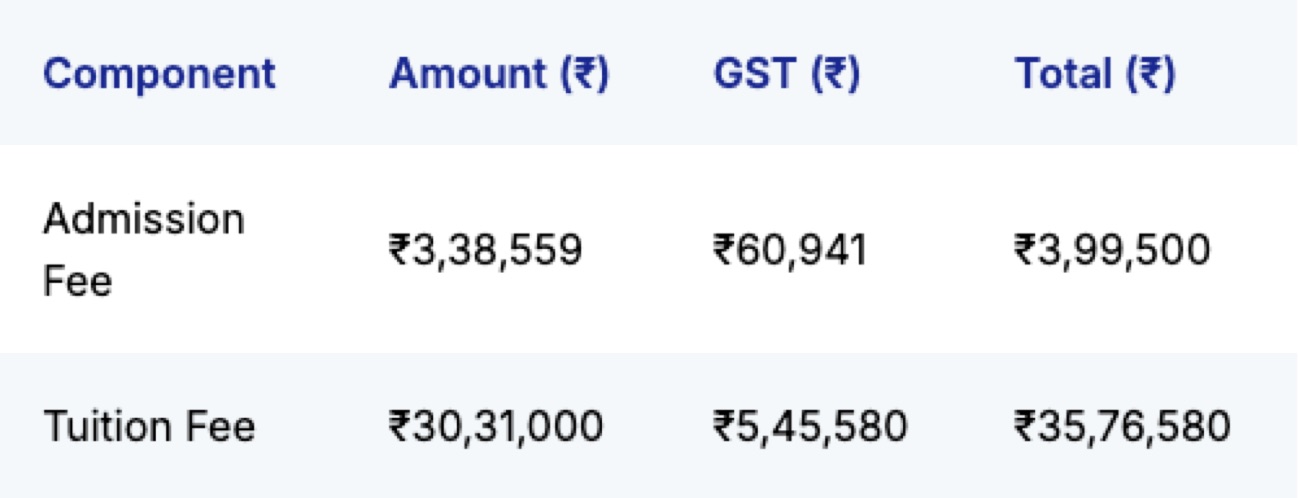
The “₹40 lakh” figure that is often quoted refers to the total of ₹39,96,080. GST alone accounts for ₹6.07 lakh of this amount. The ₹20,000 deposit is returned at the end of the course, less any dues, so the actual cost is ₹39,76,080 before travel. The fee page does not publish an instalment schedule. ISB lists education loans from Axis Bank, Bank of Baroda, Canara Bank, Central Bank of India and Credila. The only scholarship mentioned on the page is a 50% tuition waiver for up to four Indian Armed Forces veterans. Lender terms are compared in EMBA scholarships, loans and EMI, and the full fee details are available on the ISB PGP PRO fees page.
ISB PGP PRO Eligibility
- Degree: a bachelor’s degree or equivalent from a recognised institution, which must be held at the time of submitting the application. Three-year Indian degrees are accepted, and ISB does not publish any minimum percentage.
- Work experience: applicants need at least 5 years of full-time work after their bachelor’s degree, “with strong functional competence and industry expertise”.
- Test: ISB’s FAQ says: “there is no entrance test for our PGP PRO admissions.” The eligibility page still mentions reviewing “relevant test scores”, so a GMAT or GRE score can support an application, although it is not required.
The full eligibility rules are available on the ISB PGP PRO eligibility page. A comparison of this no-test route with the tests used by the IIMs is covered in EMBA entrance tests and scores.
ISB PGP PRO Admission Timeline and Selection
ISB admits each class in three rounds of applications. Round 1 for the Class of 2027–28 has already closed, while Rounds 2 and 3 are still to come.
| Round | Apply by | Interviews (tentative) | Final decision |
|---|---|---|---|
| 1 | 23 August 2026 | Week 2 of September to week 1 of October 2026 | End of October 2026 |
| 2 | 29 November 2026 | Week 3 of December 2026 to week 2 of January 2027 | End of January 2027 |
| 3 | 14 March 2027 | Week 1 of April to week 2 of May 2027 | Mid-May 2027 |
Source: ISB PGP PRO application deadlines, Class of 2027–28.
The selection process for PGP PRO has five steps, which are described below:
- Application: two mandatory 400-word essays (why PGP PRO at this stage, and what shaped you), one optional 300-word essay, transcripts from every institution attended and two professional recommendations. All of these documents are due by the round deadline.
- Verification: ISB completes this within 20 days of submission. Applicants get three days to fix any gaps, and only verified applications move to the next stage.
- Shortlist: the admissions team reviews, together, the applicant’s academics, any test scores, experience, essays, awards and recommendations.
- Interview: the interview lasts about 30 minutes with a panel of ISB faculty and alumni, on Zoom or in person, with 3–7 days’ notice. Applicants write one or two on-the-spot essays before the interview.
- Decision: the admissions committee decides from the interview feedback and emails the result on the round’s date.
ISB PGP PRO interview and on-the-spot essays
The PGP PRO interview day has two parts, a short written test and a panel conversation. The PGP PRO eligibility page says that before meeting the panel, applicants take “On-Spot essays”, a written assessment of one or two essays. The interview then lasts about 30 minutes with a panel of ISB faculty and alumni.
ISB does not publish the essay topics or a time limit, so applicants should practise writing a clear, structured answer of a few paragraphs by hand or on screen. The result does not rest on the interview alone. ISB says interview feedback goes into “a comprehensive evaluation” of the whole application before the admissions committee of faculty and alumni decides on offers.
The application also asks for every role you have held, with designation, employment type, compensation, duration, industry and function. ISB then checks the application against supporting documents such as proof of identity, academic certificates, transcripts and professional documents. Applicants should keep offer letters, relieving letters or salary records ready for each employer listed, because any mismatch must be fixed within three days.
ISB discourages deferrals and grants them only in exceptional cases, for up to one year, and the fee may change for the later year. The application fee is non-refundable, while the admission fee is partly refundable if a candidate cannot join after accepting the offer. The general admission process is laid out in executive MBA admission process and deadlines.
ISB PGP PRO Format, Schedule and Campus Visits
This section is particularly relevant for applicants who search for “ISB online executive MBA”. ISB’s FAQ states clearly that PGP PRO is not a distance or online course. The school describes it as “a modular, hybrid programme where in-person sessions are held on alternate weekends”, and “participants are required to be present at the course location as per the course schedule.”
| Time cost | What ISB states |
|---|---|
| Class rhythm | Alternate weekends, in person, in Hyderabad or Delhi |
| Class day | Saturday and Sunday, 8:00 AM – 6:00 PM, about 7 hours of scheduled class each day (2025–26 calendar); group or individual study runs to 11:00 PM on Saturday |
| Live hours | About 14 class hours per class weekend, roughly 7 a week averaged over a fortnight |
| Online share | Scheduled online sessions; up to 7 credits can be taken remotely in place of weekend classes |
| Campus residencies | One at the start and one at the close, at Hyderabad or Mohali; residencies run 5–7 days |
| International immersion | One week at a partner business school (optional) |
| Attendance | Mandatory; exceptions on request, “subject to policies and prior approval” |
Source: ISB PGP PRO course journey and curriculum page, October 2026. ISB says the 2026–27 calendar will follow and may change.
An alternate-weekend schedule over 18 months works out to roughly three dozen class weekends (an estimate based on the schedule, not an ISB figure), plus residency days, before reading and group work are counted. ISB lists Mohali as a residency venue, but weekend classes are listed only for Hyderabad and Delhi. Applicants searching for “ISB Mohali executive MBA” should therefore note that there is no Mohali weekend cohort. Those who live outside these two cities should add a flight or train journey every fortnight to both the cost and the time commitment. City options are in executive MBA in Hyderabad and executive MBA in Delhi NCR.
ISB PGP PRO Career Outcomes and Alumni Network
There is no placement process to report for this course. ISB’s PGP PRO pages do not describe any placement or career-services support, and ISB does not publish a PGP PRO salary report. The ISB PGP placement report covers the full-time class only, so its numbers should not be read as PGP PRO outcomes.
Consulting firms such as McKinsey, BCG and Bain made offers to the full-time PGP Class of 2026, according to ISB’s graduation press release. That hiring runs through the PGP placement process, which PGP PRO participants are not part of. A PGP PRO graduate who wants a consulting role would have to apply through a firm’s own lateral hiring, where the firm decides how it treats a postgraduate certification.
The course page does, however, highlight the following benefits:
- The PGP-suite network: ISB counts “21,800+ PGP-Suite alumni” and “1,000+ alumni at CXO / top leadership level” on the PGP PRO page. The page does not state the condition for PGP PRO alumni status, so applicants should confirm it with the course office.
- Accreditation: ISB lists AACSB, AMBA and EQUIS accreditation.
- Peers: the class averages about 10 years of experience, and these classmates form the most practical network that participants build.
ISB says the course is for “mid-career professionals seeking career advancement”. In practice, this means advancement in the participant’s current track, either through the employer or through an individual job search. The placement picture across courses is in executive MBA placements and salary, and the ISB-specific detail is on the ISB PGP PRO placements page.
Is ISB PGP PRO Worth ₹40 Lakh? ROI by Experience
Since there is no official salary data, the fairest way to judge the course is to compare its price with your own pay. The table shows the cost as months of gross salary and the raise that would be needed to break even in five years.
| Your experience | Salary (assumed) | Fee ₹39,76,080 as months of salary | All-in ₹40,26,080 as months of salary | Pre-tax raise to break even in 5 years |
|---|---|---|---|---|
| 5–7 years | ₹15 LPA (₹1,25,000/month) | 31.8 months | 32.2 months | ₹11,50,000 a year (+77%) |
| 8–12 years | ₹25 LPA (₹2,08,333/month) | 19.1 months | 19.3 months | ₹11,50,000 a year (+46%) |
| 15+ years | ₹40 LPA (₹3,33,333/month) | 11.9 months | 12.1 months | ₹11,50,000 a year (+29%) |
The assumptions are as follows: the salaries shown are illustrative and are not ISB data. The fee is ₹39,76,080 including GST, without the refundable deposit. The all-in figure adds an assumed ₹50,000 for travel to the two campus residencies. It does not include fortnightly travel if you live outside Hyderabad or Delhi, or the cost of the international immersion. The break-even calculation is ₹40,26,080 ÷ 5 = ₹8,05,216 a year after tax, which is about ₹11,50,000 before tax at a 30% slab. Readers can enter their own numbers in the EMBA ROI calculator sheet, or get it from our free EMBA tools.
Raise vs promotion: a worked example
| Line | Scenario A: raise at 8–12 years | Scenario B: promotion at 15+ years |
|---|---|---|
| All-in cost | ₹40,26,080 | ₹40,26,080 |
| Salary before → after (assumed) | ₹25,00,000 → ₹30,00,000 | ₹40,00,000 → ₹55,00,000 |
| Post-tax gain at 30% slab | ₹3,50,000/yr = ₹29,167/month | ₹10,50,000/yr = ₹87,500/month |
| Payback (cost ÷ monthly gain) | ~138 months | ~46 months |
| 5-year net (5 × annual gain − cost) | ₹17,50,000 − ₹40,26,080 = −₹22,76,080 | ₹52,50,000 − ₹40,26,080 = +₹12,23,920 |
The results are best read by experience band. At 5–7 years, PGP PRO costs nearly three years of salary, which is hard to justify unless the employer pays. At 8–12 years, where the class average sits, it costs about 19 months of pay. A ₹5 lakh raise never recovers this cost, so the course needs to lead to a significant change in role. At 15+ years, the calculation works if the course helps the participant move into a business-head or CXO-track role. Otherwise, an IIM weekend MBA offers a degree for less than half the price. Employer sponsorship changes the calculation considerably, so applicants should speak to HR before applying. More on the trade-off is in is an executive MBA worth it.
Taking a ₹40 Lakh Loan for PGP PRO: When the Numbers Work
A loan for PGP PRO works only when the monthly instalment fits comfortably inside your current take-home pay, because the course has no placement process to raise your salary on a fixed date. ISB’s PGP PRO fee page lists partner lenders with collateral-free loans, repayment of up to 15 years and a moratorium of the course period plus six months to one year, depending on the bank.
| Lender listed by ISB | Rate shown on ISB’s page | Maximum loan | Repayment |
|---|---|---|---|
| Axis Bank | 7.00%* unsecured, 6.99%* secured (floating, linked to repo rate) | 95% of total cost; 100% option | Up to 15 years |
| Canara Bank | 7.35% floating | ₹50 lakh, no security | Up to 15 years after moratorium |
| Central Bank of India | 8.10% for loans above ₹20 lakh | ₹50 lakh | 15 years after moratorium |
| Bank of Baroda | Not shown | ₹40 lakh | Up to 15 years after moratorium |
Source: ISB PGP PRO fee and scholarships page, academic year 2027–28, checked 3 November 2026. Rates are the banks’ terms as shown by ISB and can change; the asterisks are ISB’s.
The table below works out the monthly instalment (EMI) on a loan for the full ₹39,96,080. It assumes repayment starts at once; if you take the moratorium, interest builds up during the course and the EMI is higher. The 10% row is an assumption for a borrower who does not get a partner-bank rate.
| Interest rate | EMI over 7 years | Total interest (7 years) | EMI over 10 years | Total interest (10 years) |
|---|---|---|---|---|
| 7.35% (Canara Bank rate shown by ISB) | ₹60,998 | ₹11,27,716 | ₹47,122 | ₹16,58,550 |
| 8.10% (Central Bank of India rate shown by ISB) | ₹62,483 | ₹12,52,495 | ₹48,695 | ₹18,47,307 |
| 10% (assumption) | ₹66,340 | ₹15,76,451 | ₹52,808 | ₹23,40,939 |
Standard EMI formula on a principal of ₹39,96,080 with monthly compounding. Salary levels in the text below are illustrative assumptions, not ISB data.
At 8.10% over seven years, the EMI of about ₹62,500 is 50% of the gross monthly pay of someone on ₹15 lakh a year, 30% at ₹25 lakh and 19% at ₹40 lakh. The instalment stays the same at every salary, so its share of monthly pay falls sharply as salary rises.
- If you earn ₹15 lakh a year and have about five years of experience, a full loan would take half your gross pay for seven years. An IIM weekend MBA at less than half the fee, or employer sponsorship, is the safer route.
- If you earn ₹25 lakh a year, the loan is easier to justify if a promotion or role change is likely within the 18 months. Ask HR about sponsorship first, as explained in company-sponsored executive MBAs and bonds.
- If you earn ₹40 lakh a year, the EMI is under a fifth of gross pay, and paying part of the fee from savings would cut the total interest.
Applicants who need the course to change their career, not just their title, should compare PGP PRO with the full-time PGP. The PGP costs about the same in fees but adds a year without salary, and in return it gives access to campus placements. Lender comparisons and tax rules are covered in executive MBA scholarships, loans and EMI, and the switch question is covered in executive MBA for career switchers.
ISB PGP PRO vs ISB PGP
ISB’s FAQ explains the difference between the two courses itself. PGP PRO is meant for mid-level professionals with 5+ years of experience, with classes on alternate weekends. The PGP is meant for early-career candidates with 2+ years of experience, and it “requires full-time commitment”. The PGP is a 1-year full-time MBA, so participants leave their jobs, and the school runs a placement process. PGP PRO is an executive MBA (keep your job), so participants continue to earn a salary, but there are no placements.
| PGP PRO | ISB PGP | |
|---|---|---|
| Category | Executive MBA (keep your job) | 1-year full-time MBA |
| Experience | 5+ years (average about 10) | 2+ years |
| Format | Alternate weekends + residencies | Full-time, residential |
| Placements | None described | Yes, through ISB’s placement process |
| Who it suits | Growing inside your current track | Switching role, function or industry |
For applicants who already earn ₹35–40 lakh a year, the full-time route costs far more than its fee. Such an applicant would pay ₹40,46,520 for the PGP and give up about a year’s salary, while the PGP Class of 2026 averaged ₹37.29 lakh a year after placements, according to ISB. The PGP makes financial sense at this salary only when the goal is a change of industry, function or city that the current employer cannot offer.
For applicants who have 15+ years of experience and want a more senior cohort, ISB also runs PGP MAX. All three ISB courses are compared side by side in ISB PGP vs PGP PRO vs PGP MAX.
Why Mid-Career Professionals Pick PGP PRO Over PGP MAX or a One-Year MBA
Published applicant accounts show how mid-career professionals compare PGP PRO with PGP MAX and full-time courses. Vineet Solabannavar, a healthcare IT manager in Hyderabad with 13 years of experience and a newborn child, compared a full-time MBA, INSEAD’s leadership course and ISB PGP MAX before choosing PGP PRO. Because PGP MAX required one full week away from work every six weeks (about 62 days in total), he selected PGP PRO’s alternate-weekend schedule in Hyderabad, which delivered the same 24 credits without week-long absences from his job or family.
Similarly, an automotive sales manager from Navi Mumbai with 12 years of experience at Bajaj Auto and Castrol, who already held a Master of Management Studies from Mumbai University, chose PGP PRO for a second management qualification. Because PGP PRO does not require a GMAT or GRE score, he could apply alongside a high-travel regional sales role and use the finance and strategy curriculum to move toward general management.
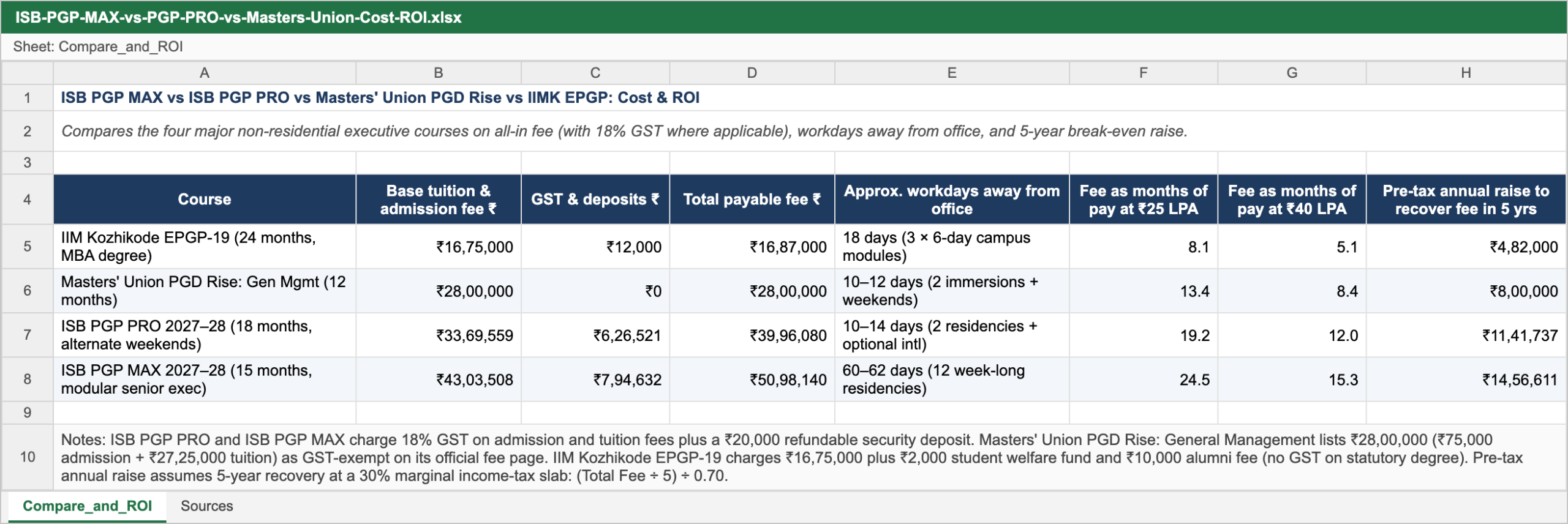
The sheet above also compares PGP PRO and PGP MAX with Masters’ Union PGD Rise (₹28 lakh) and IIM Kozhikode EPGP (₹16.87 lakh) on total fee, workdays away from the office and five-year break-even raise.
ISB PGP PRO vs IIMK EPGP vs IIMB PGPEM vs IIML PGPWE
PGP PRO applicants usually compare it with the IIM courses listed below. IIM Kozhikode (IIMK) and IIM Lucknow (IIML) award MBA degrees for less than half of ISB’s fee. ISB, for its part, offers its brand, a class with a 10-year average and no entrance test.
| ISB PGP PRO | IIMK EPGP | IIMB PGPEM | IIML PGPWE | |
|---|---|---|---|---|
| Award | Postgraduate Certification | Master of Business Administration | Master of Business Administration | MBA degree (“the student gets an MBA degree”) |
| Format | Alternate weekends in person (Hyderabad/Delhi) + residencies | Live classes at TimesPro classroom centres | Friday and Saturday classes at the IIM Bangalore campus | Alternate weekends at Noida campus, Friday afternoon to Sunday afternoon |
| Duration | 18 months | 2 years | 2 years (8 terms) | 2 years |
| Total fee (batch, GST) | ₹33,69,559 + GST = ₹39,76,080 (2027–28) | ₹16,75,000 + ₹12,000 (EPGP-19, 2026–28; no GST line) | ₹21,50,000 (2026–28 batch) | ₹11,00,000 + ₹10,000 refundable caution money + ₹5,000 alumni fee + taxes (2027–29); international immersion about ₹4.5 lakh extra |
| Min work-ex | 5 years (average about 10) | 3 years post-graduation | 4 years post-graduation | 3 years post-graduation |
| Test accepted | No entrance test | EMAT / CAT / GRE / GMAT + PI | CAT / GMAT / GRE or IIMB Test + PI | GMAT / GRE / CAT / GATE or PGPWE entrance exam |
| Placement support | None described | No: “a formal placement assistance scheme is not part of this programme” | No placement process; participants must remain employed | No placement services; Student Advisory Services for career guidance |
| Campus visits | Every alternate weekend + 2 campus residencies (5–7 days) | 3 modules × 6 days at Kozhikode | Weekend classes held on the Bengaluru campus | About 7 weekend visits per term |
| Alumni status | Condition not stated (ISB counts 21,800+ PGP-suite alumni) | On successful completion | IIMB Alumni Association membership on completion | “Similar privileges, including alumni status” |
| Source, as of | Official page, Oct 2026 | Official page, Oct 2026 | Official page, Oct 2026 | Official page, Oct 2026 |
Source: official course pages, October 2026. For IIMB PGPEM, take current figures from the official page linked above.
On fees alone, ISB costs about ₹23 lakh more than IIMK and about ₹28 lakh more than IIML, before IIML’s immersion is added. These IIMs offer an MBA degree, a test-based admission and IIM alumni status with a stated condition. ISB offers a more experienced class, in-person teaching in two metros and a well-known brand, but the award is a certificate. If a degree title matters to your employer, the IIM courses are the better choice. If you are paid at a senior level and the ISB name carries more weight in your sector, PGP PRO can still make sense. The full head-to-head is in IIM executive MBA vs ISB PGP PRO.
The Desk’s take: PGP PRO is a serious, in-person course with a strong class, and its price reflects this. It is not an MBA degree, as ISB itself states. Participants pay ₹40 lakh for ISB’s teaching, peers and brand, rather than for a credential that the IIMs cannot match on paper.
Apply if you have 8+ years of experience and live in or near Hyderabad or Delhi. The course also needs either employer sponsorship for part of the fee or a salary at which ₹40 lakh is about a year’s pay. It suits careers in which no one is likely to check the title of the award.
Skip if you need a master’s degree on paper, want placements to switch careers, or would have to fly in every other weekend. In such cases, IIML’s PGPWE and IIMK’s EPGP award MBAs for less than half the fee.
A cost that is often overlooked: GST is the detail that applicants most often miss. The ₹33.7 lakh headline fee becomes ₹39.8 lakh once the 18% tax is added, while IIM fees are often quoted without a GST line. Applicants should therefore compare all-in figures rather than headline fees.
Explore ISB PGP PRO: Fees, Eligibility, Admission, Placements, Reviews
- ISB PGP PRO fees, GST and loans
- ISB PGP PRO eligibility and work-experience rules
- Executive MBA admission process and deadlines
- ISB PGP PRO placements and career outcomes
- Executive MBA reviews: is it worth it?
ISB PGP PRO FAQs
Is the ISB executive MBA online?
No, the ISB executive MBA is not an online course. ISB’s FAQ says PGP PRO is not a distance or online course. It is a hybrid course with in-person sessions on alternate weekends in Hyderabad or Delhi, plus campus residencies at Hyderabad or Mohali. Some sessions are scheduled online, and up to 7 credits can be taken remotely, but attendance at the course location is mandatory.
How do I do an executive MBA from ISB?
Applicants should apply to PGP PRO in one of ISB’s three admission rounds. For the Class of 2027–28, the remaining deadlines are 29 November 2026 and 14 March 2027. Applicants need a bachelor’s degree and 5+ years of full-time work experience, and there is no entrance test. They submit two essays, transcripts and two recommendations, and then interview with a panel of faculty and alumni. Applicants with 15+ years of experience should also look at ISB’s PGP MAX.
Is ISB PGP PRO a degree?
No, PGP PRO is not a degree. ISB says Indian regulations do not allow independent institutions to grant a master’s degree, so it awards a Postgraduate Certification. ISB says the course matches the rigour of an executive MBA. If a master’s degree is a formal requirement, an IIM executive MBA is a better option because it awards one.
What is the ISB executive MBA fee?
For the Class of 2027–28, the fee is ₹33,69,559 + GST, which is ₹39,76,080 including GST. A ₹20,000 refundable security deposit brings the payable total to ₹39,96,080. The fee is the same for Hyderabad and Delhi. It covers tuition, course materials, and lodging and dining during residencies, but it does not cover travel.
Is ISB PGP PRO worth ₹40 lakh?
The answer depends on your salary and on who pays the fee. At ₹40 LPA, the all-in cost is about 12 months of salary, and a promotion of ₹15 lakh pays it back in about four years. At ₹25 LPA, it is about 19 months of salary, and a routine raise never pays it back. Since there are no placements and the award is a certificate, the course works best for professionals who are already senior or whose employer sponsors the fee.
What are the on-the-spot essays in the ISB PGP PRO interview?
On the interview day, before meeting the panel, applicants complete a written assessment of one or two short essays, which ISB calls “On-Spot essays”. ISB does not publish the topics or a time limit. The panel interview that follows lasts about 30 minutes.
What is the difference between ISB PGP PRO and ISB PGP?
The PGP is a 1-year full-time residential MBA for people with 2+ years of experience, and it has a placement process. PGP PRO is an 18-month alternate-weekend course for people with 5+ years of experience who keep their jobs, and ISB describes no placements for it. Applicants who want to switch careers should choose the PGP, while those who want to grow in their current track should choose PGP PRO.
Last updated: 10 November 2026
Keep reading
- IIM executive MBA vs ISB PGP PRO
- ISB PGP PRO fees and loans
- IIMK EPGP: the IIM MBA at less than half the fee
- Executive MBA in India: every option compared
- Free EMBA ROI calculator and application tracker






Questions & answers · 11
Real decisions are rarely one-size-fits-all. Ask a focused question; applicants, participants and alumni answer here.
I earn about ₹35–40 lakh in a supply-chain role and hold a deferred PGP PRO admit. Should I drop it and take the GMAT for the full-time PGP?
The full-time PGP would cost ₹40,46,520 in fees plus about a year's salary, while ISB's PGP Class of 2026 averaged ₹37.29 lakh a year after placements, close to your current pay. It makes sense only if you need a change of industry or function that placements can provide. ISB grants PGP PRO deferrals for a maximum of one year and the fee may change, so decide before the deferral runs out.
Can I apply to both the ISB PGP and PGP PRO in the same admission year?
The two courses have separate applications, deadlines and rules: the PGP needs a test-centre GMAT or GRE score, while PGP PRO has no entrance test and needs five years of experience. ISB's pages do not set out a rule on applying to both in one cycle, so write to the admissions office before you apply. If you do apply to both, your essays should explain clearly why each format fits your goals.
I already have an MBA from abroad. Is PGP PRO still useful for me?
Much of PGP PRO's 20 core credits, such as corporate finance, marketing management and operations, will repeat what an MBA already covered. The main gains would be ISB's network and a class averaging about 10 years of experience. If you have 10 or more years, PGP MAX or a short ISB Executive Education course on one skill may give more value for the fee.
Do consulting firms treat ISB PGP PRO like an MBA when they hire?
ISB does not publish any data on this. Firms such as McKinsey, BCG and Bain hired from the full-time PGP Class of 2026 through ISB's placement process, which PGP PRO participants are not part of. A PGP PRO graduate would apply through a firm's own lateral hiring, where the firm decides how it views a postgraduate certification.
What are the on-the-spot essays in the ISB PGP PRO interview?
On the interview day, before you meet the panel, ISB asks you to write one or two short essays as a written assessment. ISB does not publish the topics or a time limit. The panel interview that follows lasts about 30 minutes and is conducted by ISB faculty and alumni.
When is the next ISB PGP PRO deadline?
For the Class of 2027–28, Round 1 closed on 23 August 2026. Round 2 closes on 29 November 2026, with interviews from the third week of December to the second week of January and decisions by the end of January 2027. Round 3 closes on 14 March 2027, with decisions by mid-May 2027. ISB verifies applications within 20 days and gives you three days to fix any gaps, so submit well before the deadline.
Will ISB help me switch jobs after PGP PRO?
Don't plan on it. ISB's PGP PRO pages describe no placement process or career services, and ISB publishes no PGP PRO salary report. The ISB placement report covers the full-time PGP class only. What PGP PRO gives you is the curriculum, a class averaging about 10 years of experience and access to ISB's PGP-suite network of 21,800+ alumni. If you need an institute-run placement process to switch careers, the full-time ISB PGP (2+ years' experience) is the ISB programme built for that.
Do I need GMAT for ISB PGP PRO?
No. ISB's FAQ says there is no entrance test for PGP PRO admissions. Selection rests on your academic record, work experience, two essays, two professional recommendations, awards and an interview. The interview lasts about 30 minutes with a faculty and alumni panel, with one or two on-the-spot essays first. The eligibility page mentions reviewing relevant test scores, so a good GMAT or GRE can support your file, but you don't need one to apply.
I live in Pune. Can I do ISB PGP PRO without moving?
Yes, but you'll travel a lot. ISB lists the class locations as Hyderabad and Delhi. In-person sessions run on alternate weekends, Saturday and Sunday from 8 AM to 6 PM under the 2025–26 calendar, and attendance is mandatory. Campus residencies are at Hyderabad or Mohali. Up to 7 credits can be taken remotely, but most of the programme happens in person. Budget for a return trip every fortnight for 18 months, on top of the ₹39.96 lakh fee, and check the cost of the leave and travel before you apply.
Will ISB PGP PRO count as a master's degree for a government job or a PhD?
Treat it as not a master's. ISB's FAQ says Indian regulations don't allow independent institutions to grant a master's degree, so PGP PRO awards a Postgraduate Certification. ISB says it matches the rigour of an executive MBA. If a recruitment rule, a PSU promotion policy or a doctoral programme asks specifically for a master's degree, check with that body before you apply. IIM executive programmes such as IIMK's EPGP and IIML's PGPWE award MBA degrees.
I have 6 years in IT services. Is ISB PGP PRO too early for me?
You clear the bar. ISB asks for 5+ years of full-time work after your bachelor's degree. But ISB says participants average about 10 years, so you'd be among the youngest in the class. The money is the bigger issue. At ₹15 LPA, the ₹39,76,080 fee including GST is about 32 months of salary. Breaking even in five years would take a pre-tax raise of about ₹11.5 lakh a year. Unless your employer sponsors you, an IIM weekend MBA such as IIML's PGPWE (3 years minimum, ₹11,00,000 plus caution money, alumni fee and taxes for 2027–29) is easier to justify at this stage.