
FMS Delhi MBA Executive (Evening): Fees, Eligibility, Admission and Placements
FMS Delhi's MBA Executive is one of the most affordable routes to a top MBA for professionals in Delhi-NCR. It is a two-year evening programme that costs about ₹65,075 a semester, or roughly ₹2.6 lakh in total. Applicants need five years of managerial experience and a Delhi-NCR address, and there is no entrance test; selection is based on a 100-mark evaluation. This guide explains the selection criteria, the 2027 admission dates, the healthcare administration track and the return on investment, and compares the programme with options at IIT Delhi, MDI, IIFT and IIM Lucknow.
Key takeaways
- FMS Delhi's MBA Executive is a two-year evening MBA of the University of Delhi costing about ₹65,075 a semester, roughly ₹2.6 lakh in all for 2027–29.
- There is no CAT or written test: 35 of 100 marks come from Class 12 and graduation scores, 65 from individual discussions, extempore and interview; you need 5 years' managerial experience and a Delhi-NCR address.
- Classes run Monday–Friday 6:15–8:45 pm and Saturday 3:30–8:45 pm with compulsory physical attendance, and the bulletin offers no placement support.
The MBA Executive at the Faculty of Management Studies (FMS), University of Delhi, is among the most affordable well-regarded MBAs in Delhi NCR, at about ₹2.6 lakh for two years. The course asks for other commitments instead: five years of managerial experience, a Delhi-NCR address and up to six evenings a week in a classroom.
FMS does not use CAT, GMAT or any written test for this course. Many people who search “executive MBA FMS” for the first time are surprised by this, so this guide explains how selection actually works.
The FMS Delhi MBA Executive is a two-year evening MBA from the Faculty of Management Studies, University of Delhi. Classes run Monday to Friday from 6:15 to 8:45 pm and on Saturday from 3:30 to 8:45 pm, in person, at the North or South Campus. The fee is about ₹65,075 per semester, or roughly ₹2.6 lakh in all. Applicants need 45% in graduation, five years of managerial experience and a Delhi-NCR address. The course has 200 seats for the 2027–29 batch.
| Award | MBA Executive, a two-year MBA programme of the University of Delhi, run by its Faculty of Management Studies |
|---|---|
| Format | Executive MBA (keep your job): weekday evenings plus Saturday, physical attendance compulsory, at FMS North or South Campus |
| Duration | 2 years, 4 semesters |
| Total fee | About ₹2,60,300 for 2027–29 (₹65,075 per semester × 4, “subject to revision by the University of Delhi”); application fee ₹1,000 |
| Placement support | Not offered in writing. The MBA Executive bulletin does not mention placements, and FMS’s published placement reports cover the full-time MBA only. |
FMS Delhi MBA Executive (Evening) at a Glance
| Item | MBA Executive, 2027–29 batch |
|---|---|
| Institute | Faculty of Management Studies (FMS), University of Delhi, founded 1954 |
| Duration | Two years, four semesters |
| Class timings | Monday–Friday 6:15–8:45 pm; Saturday 3:30–8:45 pm |
| Venue | FMS North Campus or South Campus, allocated “on the basis of merit & choice” |
| Semester fee | About ₹65,075, payable at the start of each academic year; subject to DU revision |
| Eligibility | Three-year bachelor’s degree with 45% aggregate; 5 years as a manager, executive or administrator after graduation, counted to 1 April 2027; employer NOC; Delhi-NCR residence |
| Selection | No entrance test. 100 marks: Class 12 and graduation scores (35) + four individual rounds (65) |
| Seats | 200 (plus supernumerary seats) |
| Application window | 26 October – 25 November 2026 |
| Sister programme | MBA Executive (Health Care Administration), 50 seats, same timings |
Source: FMS MBA Executive information bulletin 2027–29 and the FMS admissions portal, October 2026.
Who the FMS MBA Executive Is For
FMS describes its applicants as “working executives”, and its admission rules are designed to ensure that they are. Applicants need five years in a managerial, executive or administrative role after their degree. The employer has to sign a No Objection Certificate (NOC), and the form asks how often the applicant’s work involves “tours outside Delhi”. This question helps FMS judge whether a candidate will be able to attend classes regularly.
The course typically suits a manager in Delhi NCR who works in banking, a public sector undertaking (PSU), government, IT or sales, with 5–15 years of experience. Such managers usually want a University of Delhi MBA to meet a promotion rule or move up a grade, without paying the fees charged by the IIMs. The list of executive alumni in the FMS bulletin reflects this profile. It ranges from an Additional Chief Secretary in the Delhi government to directors at Microsoft, Oracle and Capgemini. Applicants who work in financial services may also look at executive MBA options for bankers and BFSI professionals.
Who this is not for
- Anyone outside Delhi NCR. The bulletin states that “Applicants must be residents of Delhi-NCR,” and that “attendance in classes in physical mode is compulsory.” FMS does not offer an online track for this course.
- Under 5 years of post-graduation experience. The minimum requirement is five years, not three, and the experience is counted from the date on which you passed your degree.
- Career switchers who need a placement cell. The bulletin does not offer any placement support for this course. A one-year full-time MBA is designed for professionals who want to change careers through campus placements.
- Frequent travellers and late-shift workers. Classes begin at 6:15 pm on weekdays. Applicants who rarely leave the office by 5:30 are likely to miss many of these sessions.
- Anyone whose employer will not sign the NOC. The NOC is a required document, and the admission process cannot be completed without it.
FMS MBA Executive Fees 2027–29
The bulletin states the fee in one sentence: “The semester fee is currently approximately Rs. 65,075/- for MBA programme, per semester, subject to revision by the University of Delhi.” The fee is “payable at the beginning of the academic year”, so applicants should expect to pay roughly ₹1,30,150 per year in two instalments.
| Fee line | Amount | Note |
|---|---|---|
| Semester fee | ₹65,075 (approx.) | DU can revise it |
| Per academic year (2 semesters) | ₹1,30,150 (approx.) | Payable at the start of the year |
| Programme total (4 semesters) | ₹2,60,300 (approx.) | Arithmetic: ₹65,075 × 4 |
| Application fee | ₹1,000 (₹350 for SC, ST, PwD) | Paid online, non-refundable |
| GST | No GST line in the bulletin | — |
Source: FMS MBA Executive bulletin 2027–29, fee structure and application sections.
For comparison, the IIT Delhi Executive MBA charges ₹4,50,000 in tuition each semester, which is about seven times the FMS semester fee. Because the FMS fee is so low, it rarely decides whether an applicant should join. The real constraints for most applicants are time, location and the competition for a seat. Full comparisons are on the FMS MBA Executive fees page and in executive MBA fees across India. Applicants for whom price is the main concern can begin with the guide to executive MBAs for budget-conscious learners.
FMS MBA Executive Eligibility and Selection
- Degree: applicants need at least a three-year bachelor’s degree after 12 years of schooling, with 45% aggregate or equivalent grades in any discipline. Degrees in arts, commerce, law, medicine and engineering are all accepted.
- Experience: at least five years “as a manager / executive / administrator in a commercial/government establishment/registered organization” after passing the degree. This experience is counted as on 1 April of the year of admission, which is 1 April 2027 for this batch.
- Paperwork: applicants must submit an employer NOC in the FMS format, and must bring original certificates, work-experience letters and salary slips to the interview.
- Residence: applicants must be residents of Delhi-NCR.
- Relaxations: relaxations follow University of Delhi rules. OBC (non-creamy layer) candidates get a 10% relaxation on minimum marks, and CW candidates get a relaxation of 5%.
How FMS selects: the 100-mark table
The course does not use CAT, GMAT or a written test. Instead, FMS scores every eligible candidate out of 100 marks, as shown below:
| Component | Marks | How it’s scored |
|---|---|---|
| Class 12 | 10 | 50–59.99%: 5; 60% and above: 10 |
| Graduation | 25 | 50–59.99%: 15; 60% and above: 25 |
| Discussion on executive experience and statement of purpose | 25 | Individual, all eligible candidates |
| Extempore | 15 | Individual |
| Discussion on national and international business affairs | 10 | Individual |
| Personal interview | 15 | Individual |
Source: FMS MBA Executive bulletin 2027–29, selection procedure.
Applicants should read the first two rows of the table carefully, because about a third of the score comes from marks earned years ago. A candidate with 60%+ in both Class 12 and graduation starts at 35/35, while a candidate with 52% in both starts at 20. The scoring table has no band below 50%, so a 47% graduate is eligible but starts with zero academic marks. The remaining 65 marks come from discussions and interviews, which is where applicants should focus their preparation.
The online form also asks for a 150-word write-up, “My Executive Experience and Statement of Purpose”. This write-up forms the basis of the 25-mark discussion, so applicants should write it as the opening of that conversation rather than as a promotional summary. A comparison with test-based courses is available in the guide to executive MBA entrance tests, and the full rules are on the FMS MBA Executive eligibility page.
What the FMS executive interview rounds test
FMS runs four separate individual rounds, and each one has a different purpose. The bulletin gives your work experience and statement of purpose their own 25-mark discussion, so the 15-mark personal interview is a separate round in which panels are free to ask about other parts of your profile.
FMS does not publish the questions for any round. Because graduation marks carry 25 of the 100 marks, applicants should be ready to answer basic questions on the main subjects of their degree, as well as on their present job. The extempore tests how clearly you speak on an unseen topic, and the 10-mark business-affairs round rewards regular reading of national and international business news.
Employer NOC for the FMS executive MBA: when to submit it
FMS needs the employer’s No Objection Certificate (NOC) before the interview stage, not after admission. The 2027–29 bulletin says candidates who do not submit all supporting documents “before the stipulated date may not be called for interview”, and the NOC is part of the eligibility conditions.
The NOC must be signed by the employer or the head of the organisation, in the FMS format. The signatory certifies that they have gone through your application, and states your designation, your level in the organisation, the number of staff under you and how often your work involves tours outside Delhi. The form also records that the employer has no objection to you attending classes and appearing in examinations.
This means FMS applicants cannot keep the application private from their employer, unlike some other courses. IIFT, for example, asks for the NOC “at the time of Admission” for its weekend MBA, according to its information bulletin. FMS does not ask for a recommendation letter, so the NOC is the only document your employer has to sign.
Government and public-sector employees should request the NOC as soon as the application window opens on 26 October 2026, because approvals often pass through several levels. The options for such applicants are covered in MBA for government and PSU employees, and employer support more generally in company-sponsored executive MBA, bonds and NOC.
FMS MBA Executive seats 2027–29
| Category | Seats |
|---|---|
| General (unreserved) | 80 |
| OBC (non-creamy layer) | 55 |
| SC | 30 |
| EWS | 20 |
| ST | 15 |
| Total | 200 |
| Supernumerary | PwD 10, CW 10, Ward (Teaching) 4, Ward (Non-Teaching) 4, Orphan Quota 2 |
FMS MBA Executive Admission Dates 2027
FMS runs one admission cycle each year for all of its MBA courses. Applications for the 2027–29 batch of the MBA Executive are currently open.
| Stage | Date |
|---|---|
| Applications open | 26 October 2026 |
| Last date to apply | 25 November 2026 |
| Experience counted up to | 1 April 2027 |
| Interviews | 2nd/3rd week of April 2027 |
| Results | 3rd/4th week of April 2027 |
| Last date of admission and of withdrawal | 31 July 2027 (no refunds after this) |
Source: FMS online admissions portal 2027 and the 2027–29 bulletin.
Applications are accepted only through the FMS online portal, and the bulletin says “there will be no other mode of registration”. All updates are sent by email to the registered address, so applicants should use an email account they check regularly. The category chosen at registration cannot be changed later. Applicants can follow the schedule on the FMS MBA Executive admission dates page, or record all their deadlines in the application tracker sheet.
FMS Executive MBA Class Timings, Schedule and Campus
The FMS executive MBA class timings are Monday to Friday from 6:15 pm to 8:45 pm, and Saturday from 3:30 pm to 8:45 pm. Both the general MBA Executive (Evening) and the MBA Executive (Health Care Administration) follow this six-day evening schedule, which adds up to 17.75 classroom hours a week. The FMS 2027–29 bulletin states that physical attendance on campus is compulsory, and there is no online or weekend-only option.
| Time cost | What FMS states | What it adds up to |
|---|---|---|
| Weekday classes | Monday–Friday, 6:15–8:45 pm | 2.5 hours × 5 = 12.5 hours |
| Saturday classes | 3:30–8:45 pm | 5.25 hours |
| Sunday classes | None scheduled in the bulletin | Rest and self-study day |
| Scheduled class time | Six days a week in person | Up to 17.75 hours a week |
| Attendance | “Attendance in classes in physical mode is compulsory” | No online or recorded option |
| Venue | North or South Campus, allocated by merit and choice | A higher rank improves your chance of the nearer campus |
| Campus visits | None separate | Every class is on campus |
Source: FMS MBA Executive bulletin 2027–29 and MBA Executive (HCA) bulletin 2027–29.
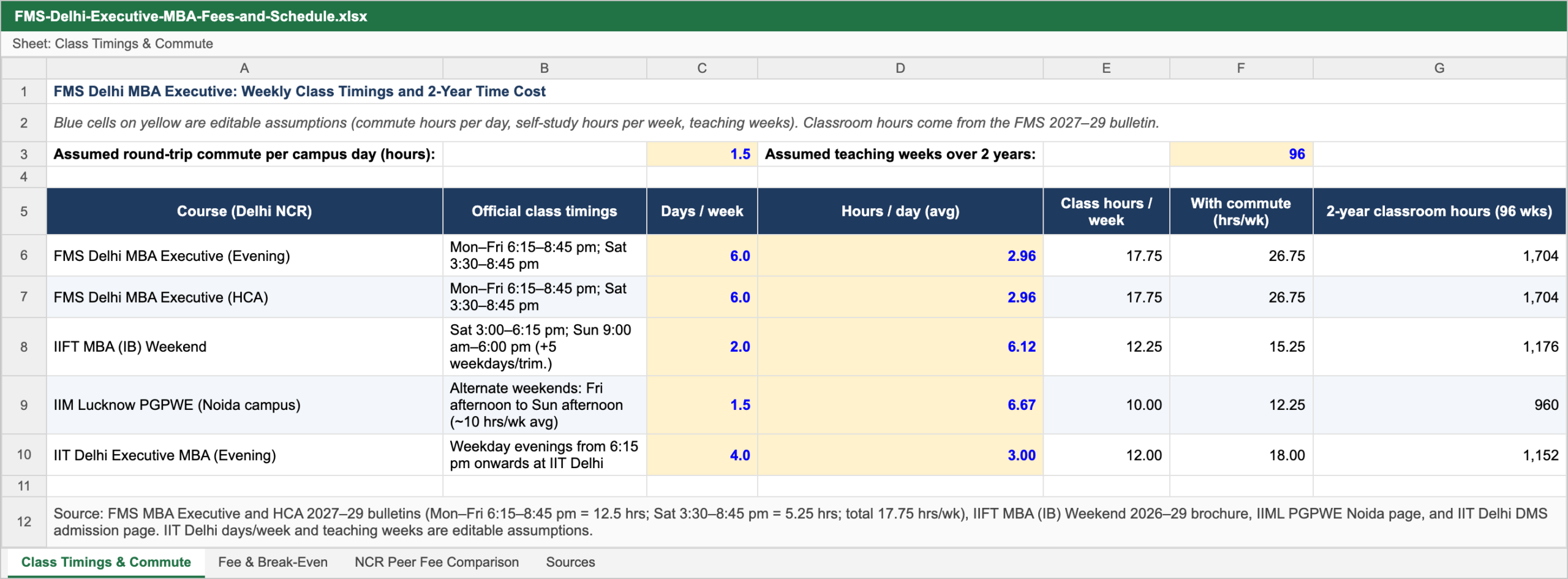
Not every slot will be used every week, but applicants should plan as if it will be. More than seventeen hours of class, along with reading and a weekday commute across Delhi at rush hour, is a heavy load to carry for two years. The IIM Lucknow PGPWE follows a different pattern, with classes on alternate weekends from Friday afternoon to Sunday afternoon at its Noida campus. These schedules are compared in the guide to executive MBA class schedules and campus visits.
FMS MBA Executive Curriculum Snapshot
The course is “divided into four semesters” and is built on two parts: a conceptual foundation in the first year and “a high degree of academic flexibility” in the second year.
| Year | What you study |
|---|---|
| Year 1 (core) | Human Resource Management, Organisational Behaviour, Marketing Management, Managerial Finance, Quantitative Methods, Managing Information Technology, Operations Management |
| Year 2 (electives) | Finance, Marketing, Strategy, Information Technology, Operations, HRM, Organisational Behaviour, Entrepreneurship; plus business strategy courses |
| Throughout | Industry-expert sessions, guest lectures, field studies, live projects and workshops |
Applicants should note that, according to FMS, the MBA Executive curriculum “is currently undergoing a revision and the new curriculum will be updated on the FMS Website.” The course list for the 2027–29 batch may therefore change. A comparison with other courses is available in the guide to executive MBA curriculum and subjects.
FMS MBA Executive (Health Care Administration)
FMS runs a second evening MBA for professionals who already work in healthcare. The course started in 1974, “long before healthcare management became a mainstream management discipline”, in the words of FMS. Its timings, fee, selection table, Delhi-NCR rule and attendance rule are the same as those of the general MBA Executive, but its eligibility and seats are different.
| Item | MBA Executive | MBA Executive (HCA) |
|---|---|---|
| Qualifying degree | Bachelor’s in any discipline, 45% | Bachelor’s with 45% in MBBS, BDS, BAMS, BUMS or BHMS; or a Master’s with 55% in biotechnology, genomics, genetics, nursing, bioengineering, alternative systems of medicine, paramedical disciplines, pharmacology, anthropology or zoology |
| Experience | 5 years as manager/executive/administrator in any organisation | 5 years as manager/executive/administrator in a healthcare organisation or the health sector |
| Curriculum | General management core + functional electives | 28 courses: core taught “through a healthcare lens”, plus hospital planning, hospital operations, supply chain, quality and accreditation, healthcare ethics, regulation, public health, health financing and insurance |
| Seats (2027–29) | 200 | 50 (General 20, OBC 14, SC 7, EWS 5, ST 4; plus 8 supernumerary) |
| Fee | About ₹65,075 per semester for both | |
Source: FMS MBA Executive (HCA) bulletin 2027–29.
For doctors and hospital administrators in NCR, the HCA track is the natural first application. It offers 50 seats and a class made up only of healthcare professionals, at the same fee. More details are on the dedicated page for FMS MBA Executive (HCA). Options outside FMS are in executive MBAs for doctors and healthcare professionals, and both FMS courses are compared on FMS executive courses compared.
Is FMS MBA Executive Worth It? ROI by Experience
FMS does not publish salary outcomes for the MBA Executive, so there is no official salary increase to quote. Applicants can, however, compare the cost of the course with their own pay, and at FMS this cost is small.
| Your experience | Salary (assumed) | Fee ₹2,60,300 as months of salary | All-in ₹3,09,300 as months of salary | Pre-tax raise to break even in 5 years |
|---|---|---|---|---|
| 5–7 years | ₹15 LPA (₹1,25,000/month) | 2.1 months | 2.5 months | ₹88,400 a year (+5.9%) |
| 8–12 years | ₹25 LPA (₹2,08,333/month) | 1.2 months | 1.5 months | ₹88,400 a year (+3.5%) |
| 15+ years | ₹40 LPA (₹3,33,333/month) | 0.8 months | 0.9 months | ₹88,400 a year (+2.2%) |
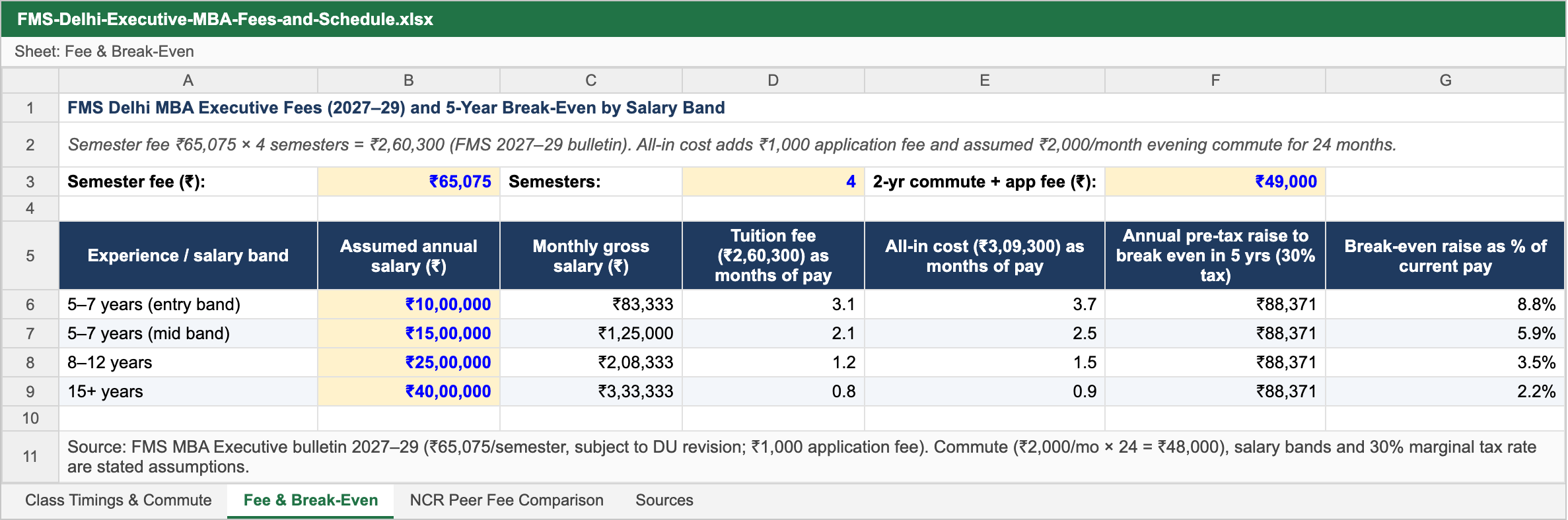
The salaries in this table are illustrative assumptions and are not FMS data. The all-in cost adds the ₹1,000 application fee and ₹48,000 for two years of evening commuting (an assumed ₹2,000 a month). To break even over five years, a graduate needs ₹3,09,300 ÷ 5 = ₹61,860 a year after tax, which is about ₹88,400 before tax at a 30% slab. The table starts at 5 years of experience because FMS does not admit applicants with less. Readers can enter their own figures in the EMBA ROI calculator sheet, which is also available from our free EMBA tools.
At every experience band, a single ordinary pay rise is enough to recover the fee. The return on investment at FMS therefore depends on time rather than money. The real cost is roughly 1,700 hours of evening class over two years (about 17.75 hours a week across some 96 teaching weeks, assumed), which comes out of evenings and family time. With 5–7 years of experience, this effort earns a DU MBA at the stage when promotions first list an “MBA preferred” condition. With 15+ years, applicants should consider whether the degree adds anything that their CV does not already show. More options are covered in executive MBA picks for mid-career managers.
FMS MBA Executive Placements and Career Outcomes
FMS does not offer placements for the MBA Executive in writing, and the 2027–29 bulletin has no placement section. FMS’s published placement reports are for the full-time MBA: the 2024–26 final report covers a batch of 307, of whom 304 sat placements and 287 were placed. These figures do not apply to the evening course, and MBA Executive applicants should not treat them as their own outcomes.
The bulletin does, however, offer the following to MBA Executive students:
- An MBA from the University of Delhi awarded through its management faculty, which is a degree rather than a diploma or certificate.
- Alumni standing: the bulletin lists graduates of the evening course under “Prominent Alumni – Executives”, and the 2025–26 calendar included an FMS Alumni Annual Networking Event. FMS states no separate condition for alumni status.
- Industry contact: students have access to industry-connect sessions (four were listed for December 2025 to August 2026), guest lectures and live projects.
- Library and data: students can use the Bloomberg terminal, CMIE Prowess and the Delhi University library system.
Any career move is left to the graduate, either within the current employer or through an independent job search. This arrangement suits the people FMS admits, who are mostly managers with five or more years of experience seeking the next grade rather than a new industry. The wider picture is covered in executive MBA placements and salary and executive MBA degree type and alumni status.
FMS MBA Executive vs IIT Delhi EMBA vs MDI PGDM-BA vs IIFT vs IIML PGPWE
These are the five in-person executive courses in Delhi NCR that most applicants compare with one another. FMS is by far the least expensive of them, but it also has the strictest experience rule and the most class hours.
| FMS MBA Executive | IIT Delhi EMBA | MDI PGDM-BA | IIFT MBA (IB) Weekend | IIML PGPWE | |
|---|---|---|---|---|---|
| Award | MBA, University of Delhi | MBA: “Yes, this is a degree programme” | PGDM (Business Administration) | MBA (IB); “no degree will be awarded if Port Visit is not successfully completed” | “The student gets an MBA degree” |
| Format | Mon–Fri 6:15–8:45 pm + Sat 3:30–8:45 pm, in person, North/South Campus | Evening classes “from 6.15 PM onwards at IIT Delhi” | Non-residential, “for experienced professionals in & around Delhi/NCR” | Offline at IIFT: Sat 3:00–6:15 pm, Sun 9:00 am–6:00 pm, plus 5 weekday classes per trimester | Alternate weekends, Friday afternoon to Sunday afternoon, Noida campus |
| Duration | 2 years, 4 semesters | 2 years, 4 semesters | 24 months (21 classroom + 3 dissertation) | 2 years 6 months, 9 trimesters | 2 years, 7 terms |
| Total fee (batch, GST) | About ₹2,60,300 (2027–29); no GST line | ₹18,80,600: ₹4,50,000 tuition + ₹20,150 other charges × 4 semesters (2026–28); GST not stated | ₹11,50,000 incl. ₹27,500 refundable deposit and ₹15,000 alumni fee (2027–29); immersion extra | ₹10,00,000 (2026–29); GST not stated | ₹11,00,000 tuition + ₹15,000 deposits/fees + taxes (2027–29); mandatory immersion about ₹4.5 lakh extra |
| Min work-ex / marks | 5 years; 45% in graduation | 3 years; 60% (55% SC/ST/PH) | 3 years; 50% in graduation, Class 10 and 12 | 3 years managerial; 50% (45% SC/ST/PwD) | 3 years full-time post-qualification |
| Test accepted | None: marks + individual discussions, extempore, interview | IIT Delhi written test + interview | CAT/GMAT/XAT/MAT/ATMA/CMAT + online interview | CAT/XAT/CMAT/ATMA/MAT/GMAT or IIFT’s WAT + interview | GMAT/GRE (test centre), CAT, GATE or PGPWE entrance exam |
| Placement support | Not stated; placement reports cover full-time MBA only | No: “placement support is not provided” | Not stated on the PGDM-BA admissions page | Not stated for the weekend programme | No: FAQ answers “NO.” |
| Campus visits | All classes on campus | All classes on campus | Classroom programme; international immersion optional, at actual cost | All classes on campus + mandatory port visit | All classes on campus + mandatory international immersion |
| Alumni status | Executive graduates listed as FMS alumni; no condition stated | “IIT Delhi Alumni status” listed as a programme feature | ₹15,000 alumni fee in programme fee | ₹15,000 alumni membership in programme fee | “Similar privileges, including alumni status” |
| Source, as of | Official page, Oct 2026 | Official page, Oct 2026 | Official page, Oct 2026 | Official page, Oct 2026 | Official page, Oct 2026 |
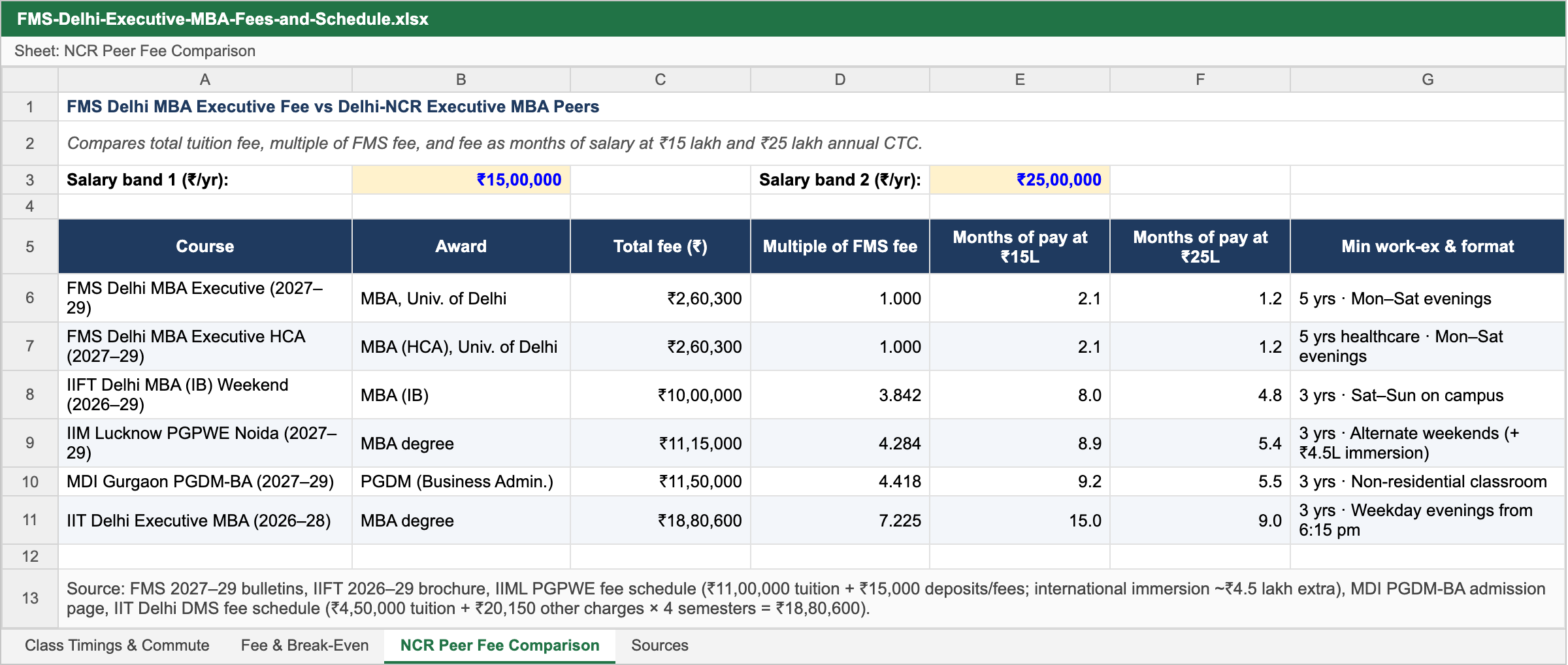
The difference in fees is very large. IIT Delhi costs about seven times as much as FMS, and MDI, IIFT and IIM Lucknow cost roughly four times as much. On eligibility, however, the position is reversed. The other four courses accept three years of experience, while FMS requires five. Applicants with 3–4 years of experience therefore cannot apply to FMS yet, and their practical choice is between IIT Delhi’s evening classes and the weekend formats of IIML or IIFT. MDI awards a PGDM (Post Graduate Diploma in Management), not an MBA, which matters for some government and PSU promotion rules, as explained in executive MBA vs PGDM. IIT Delhi’s figures are covered in detail in IIT Delhi Executive MBA fees.
The Desk’s take: The FMS MBA Executive offers the best value of any executive MBA in India by a wide margin. For about ₹2.6 lakh, students earn a University of Delhi MBA from one of the country’s oldest business schools, taught in person on campus by FMS faculty.
Apply if you live and work in Delhi NCR, have five clear years in a managerial role, can leave the office by 5:30 on most days, and want the MBA for a promotion or higher grade with your current employer.
Skip if you need placements, live outside NCR, travel in most weeks, or have less than five years of experience. Applicants in the last group should consider the IIML PGPWE or IIT Delhi now rather than wait to become eligible for FMS.
The condition applicants most often overlook: 35 of the 100 selection marks come from Class 12 and graduation percentages, which cannot be changed. Applicants who scored under 60% therefore start behind, and they need to make up the difference in the four discussion and interview rounds.
Explore: FMS MBA Executive Fees, Eligibility and Admission
- FMS MBA Executive fees: semester fee, payment timing and total cost
- FMS MBA Executive eligibility: the 5-year rule, marks and relaxations
- FMS MBA Executive admission process and dates
- FMS MBA Executive (Health Care Administration)
- FMS executive course fees compared
FMS MBA Executive FAQs
What are the FMS executive MBA class timings?
Classes for the FMS Delhi MBA Executive and the MBA Executive (Health Care Administration) run from 6:15 pm to 8:45 pm from Monday to Friday, and from 3:30 pm to 8:45 pm on Saturdays. That comes to 2.5 hours on each weekday evening and 5.25 hours on Saturday, or up to 17.75 hours of classroom teaching a week. All classes are held in person at the FMS North or South Campus, and the full-time FMS MBA runs separately during daytime hours.
How to prepare for the FMS executive MBA?
Since there is no entrance test, applicants should spend their preparation time on the 65 marks awarded in discussions and interviews. The 150-word statement of purpose should state a specific goal, and applicants should be ready to explain every line of it in the 25-mark experience discussion. It helps to practise two-minute extempore answers on business topics and to read a business newspaper daily for the 10-mark round on national and international business affairs. The Class 12 and graduation marks (35 points) are already fixed and cannot be improved.
Is there an executive MBA at FMS Delhi?
Yes, FMS Delhi runs two executive MBAs: the MBA Executive (Evening), with 200 seats, and the MBA Executive (Health Care Administration), with 50 seats. Both are two-year evening MBAs of the University of Delhi, with classes on weekday evenings and Saturdays at the North or South Campus. FMS also runs the full-time MBA, a doctoral course and short management development courses.
How to do an executive MBA from FMS Delhi?
Applicants should first check that they have 45% in graduation, five years of managerial experience counted to 1 April 2027, and a Delhi-NCR address. They must then apply on the FMS online portal between 26 October and 25 November 2026 and pay the ₹1,000 application fee. The employer’s NOC must also be signed. Eligible candidates are called for the individual rounds and the interview in April 2027.
How to do an executive MBA from FMS without CAT?
Applicants do not need CAT, because the MBA Executive does not use any entrance exam. FMS ranks candidates on Class 12 marks (10), graduation marks (25), an individual discussion of your experience and statement of purpose (25), an extempore (15), a business-affairs discussion (10) and a personal interview (15). CAT scores are required only for the full-time FMS MBA.
Is the FMS MBA Executive as valuable as the FMS full-time MBA?
Both courses lead to a University of Delhi MBA from FMS, but they serve different purposes. The full-time MBA admits students through CAT and has a placement process. The executive course admits managers with five years of experience without a test and offers no placements in writing. For a promotion with a current employer, the executive degree counts in the same way, but it does not give access to campus hiring.
Can I manage the FMS evening MBA with a full-time job?
Yes, the course is designed for people in full-time jobs, but the workload is heavy. Class slots add up to 17.75 hours a week: 6:15–8:45 pm on weekdays and 3:30–8:45 pm on Saturdays, and attendance in person is compulsory. The schedule is manageable if your office is close to your allotted campus and you usually leave work on time. It is much harder for professionals who travel often or work late shifts.
Keep reading
- IIT Delhi Executive MBA: the other evening MBA in Delhi
- FMS MBA Executive fees in detail
- IIM Lucknow PGPWE: weekend MBA in Noida
- Executive MBA in India: every option compared
- Free EMBA ROI calculator and application tracker
Last updated: 29 October 2026





Questions & answers · 10
Real decisions are rarely one-size-fits-all. Ask a focused question; applicants, participants and alumni answer here.
Who should sign my FMS NOC, and do I also need a recommendation letter?
The NOC must be signed by your employer or the head of your organisation, and it certifies your designation, level, team size and travel outside Delhi. FMS does not ask for a recommendation letter for the MBA Executive. The NOC is therefore the only document your employer needs to sign during the application.
What are the FMS executive MBA class timings, and are there Sunday classes?
Classes for both the FMS MBA Executive and the MBA Executive (Health Care Administration) run Monday to Friday from 6:15 pm to 8:45 pm and on Saturday from 3:30 pm to 8:45 pm. The 2027–29 bulletin does not schedule regular classes on Sundays. In total, the timetable blocks up to 17.75 hours of in-person classroom teaching across six days a week at the North or South Campus.
When do I have to submit my employer NOC for the FMS executive MBA?
FMS treats the NOC as an eligibility document, and the bulletin says candidates who do not submit supporting documents before the stipulated date may not be called for interview. Your employer or head of organisation must sign it in the FMS format before the April interviews. This is earlier than at IIFT, which asks for the NOC at the time of admission.
My FMS executive interview asked about my graduation subjects, not my work. Is that normal?
FMS scores your work experience and statement of purpose in a separate 25-mark discussion, so the 15-mark personal interview can cover other parts of your profile, including your degree. Graduation marks also carry 25 of the 100 selection marks. Applicants should revise the main subjects of their degree along with their job details before the rounds.
Will FMS help me get a new job after the MBA Executive?
Don't count on it. The 2027–29 MBA Executive bulletin says nothing about placement support. FMS's published placement reports cover the full-time MBA; the 2024–26 report counts 307 students, and those are not evening-programme numbers. What you do get is a University of Delhi MBA, a class of five-year-plus managers, industry-connect sessions, alumni events and live projects. That makes it a strong programme for a promotion or role change with your current employer. For an external switch, you'll be job-hunting on your own, with a better CV.
I'm a hospital administrator with a BHMS. Should I apply to the regular MBA Executive or the HCA track?
You can apply to the HCA track, and it's probably the better fit. The MBA Executive (Health Care Administration) accepts a bachelor's degree with 45% in MBBS, BDS, BAMS, BUMS or BHMS, plus five years as a manager, executive or administrator in a healthcare organisation or the health sector. It has 50 seats, the same evening timings and the same semester fee of about ₹65,075. The curriculum covers hospital planning, operations, quality and accreditation, and health financing. If you also want to apply to the general MBA Executive, check on the FMS portal whether you can apply to both.
Do I need CAT or GMAT for the FMS executive MBA?
No. The MBA Executive and the MBA Executive (Health Care Administration) don't use any entrance test. FMS scores eligible applicants out of 100: Class 12 marks (10), graduation marks (25), an individual discussion of your executive experience and statement of purpose (25), an extempore (15), a discussion on national and international business affairs (10) and a personal interview (15). CAT is only for FMS's full-time MBA. Prepare by writing a sharp 150-word statement of purpose and practising short spoken answers on current business news.
I live in Gurugram and work in Noida. Which FMS campus will I get?
You don't choose outright. FMS says classes are held at either the North or South Campus and "the allocation of the campus is done on the basis of merit & choice". You state a preference, and a higher rank gives you a better chance of getting it. Either way, you'll be crossing Delhi in the evening rush to make a 6:15 pm start, up to six days a week, because physical attendance is compulsory. Work out that commute honestly before you accept. For many Gurugram and Noida residents it's the hardest part of the programme.
My graduation score is 48%. Is it worth applying to FMS?
You are eligible, because the minimum is 45% aggregate. But look at the scoring table before you pay. Graduation carries 25 of the 100 selection marks, and the bands start at 50%: 50–59.99% earns 15 and 60% or more earns 25. At 48% you start with zero there, and Class 12 adds at most 10 more. That leaves you making up 15–25 marks across the experience discussion, extempore, business-affairs round and interview against people who started ahead. It's possible with a strong profile, but apply to a test-based programme alongside it.
I have 4 years and 8 months of experience on 1 April 2027. Can I still apply to the FMS MBA Executive?
No. FMS asks for at least five years as a manager, executive or administrator after passing your bachelor's degree, counted as on 1 April of the year of admission. For the 2027–29 batch that date is 1 April 2027, so you would fall short, and the bulletin warns that candidates who don't meet every condition may not be called for interview. Apply in the next cycle. If you don't want to wait a year, IIT Delhi's evening Executive MBA and IIM Lucknow's weekend PGPWE in Noida accept three years of experience, though both cost several times more.