
Is an Executive MBA Worth It in India? Costs, Outcomes and Who It Suits
An executive MBA is worth it in India when the format matches your goal and the fee is reasonable against your salary. This guide shows the fees of 15 courses as months of pay at ₹15, ₹25 and ₹40 lakh a year, the official placement medians of one-year courses (₹27 lakh to ₹36.5 lakh) and the written placement statements of keep-your-job courses. It works out payback by experience band and adds the first-hand view of the author, an IIM Kozhikode EPGP alumnus.
Key takeaways
- Executive MBA fees in India run from about ₹2.6 lakh (FMS Delhi) to ₹40.5 lakh (ISB PGP), which is 1 to 19 months of pay at ₹25 lakh a year.
- Only one-year full-time courses publish placement outcomes, with medians of ₹27 lakh to ₹36.5 lakh; most keep-your-job courses state in writing that they offer no placement support.
- At ₹25 lakh a year, a keep-your-job IIMK EPGP pays back in about 40 months with an assumed 20% raise, while quitting for IIMB's EPGP takes about 61 months.
An executive MBA is a management degree or diploma for people who already have several years of work experience, taught either full-time over about a year or alongside a job over two years. Whether it is worth the money depends on three things: the fee measured against your salary, whether the course has a placement process, and what you want to change in your career.
Is an executive MBA worth it in India? Yes, if you have at least four to five years of experience, a clear goal and a fee that is small next to your salary or paid by your employer. No, if you expect the course alone to find you a new job, because most keep-your-job courses in India say in writing that they offer no placement support.
| Question | Short answer from the official data |
|---|---|
| Worth it if | You keep your job and want to grow in your field, or you have 4–8 years of experience and can leave work for a one-year MBA with a placement report. |
| Not worth it if | You want a career switch from a weekend or online course, or you earn more than the published medians of one-year courses (₹27–36.5 lakh). |
| Cost | ₹2.6 lakh (FMS Delhi) to ₹40.5 lakh (ISB PGP); about 6 to 17 months of pay at ₹25 lakh a year for the IIM courses in this guide. |
| Placements | Only one-year full-time courses publish outcomes; keep-your-job courses do not. |
| Salary increase | Only IIM Lucknow’s IPMX publishes one: an average 54% rise from pre-course to post-course pay (Class of 2026). |
The sections below count each course’s fee in months of salary, sets out what the institutes’ own placement reports show, and works out how long the fee takes to pay back in each experience band. The data comes from official fee pages and placement reports, and every table is also available as a downloadable Excel file. The author, Nishit Kumar, completed the IIM Kozhikode EPGP in 2024, and his own experience is added in marked boxes, kept separate from the data.
Is an Executive MBA Worth It in India? The Short Answer
An executive MBA is worth it in India when the course matches the reason you are taking it. Courses fall into two groups, and the answer is different for each one. The first group is the one-year full-time MBA for experienced professionals, such as IIMA’s PGPX, IIMB’s EPGP and IIML’s IPMX, where you leave your job and go through campus placements.
The second group is the keep-your-job executive MBA, taught on weekends, on weekday evenings or online with short campus visits. IIM Kozhikode’s EPGP, IIM Bangalore’s PGPEM and IIT Delhi’s EMBA belong to this group. Courses in the second group do not run placements, so their value comes from the degree, the learning and the peer group rather than from a new job offer arranged by the institute.
For a one-year course, the case depends on your current pay. The published median salaries after these courses range from ₹27 lakh (IIML IPMX, Class of 2026) to ₹36.5 lakh (IIMB EPGP, 2025–26), so a professional already earning ₹40 lakh a year gains little from the placement process itself. For a keep-your-job course, the case depends on what your employer does after you finish, because the institutes publish no salary outcomes. A full overview of both formats is in Executive MBA in India: Programmes, Fees, Eligibility and How to Choose.
What Does an Executive MBA Cost in Months of Your Salary?
An executive MBA in India costs between about 2 and 32 months of pre-tax salary for a professional earning ₹15 lakh a year, depending on the course. At ₹25 lakh a year, most IIM keep-your-job courses cost 6 to 10 months of salary, while the one-year full-time courses cost 12 to 19 months before counting the salary you give up. The table below sets each official fee against three salary levels.
| Course (batch) | Format | Total fee ₹ | Months of pay at ₹6 lakh | At ₹10 lakh | At ₹15 lakh | At ₹25 lakh | At ₹40 lakh | Campus time | Award |
|---|---|---|---|---|---|---|---|---|---|
| ISB PGP (2027–28) | 1-year full-time | ₹40,46,520 | 80.9 | 48.6 | 32.4 | 19.4 | 12.1 | Lives on campus | Certificate, not a degree (ISB) |
| IIMA MBA-PGPX (2027–28) | 1-year full-time | ₹36,20,000 | 72.4 | 43.4 | 29.0 | 17.4 | 10.9 | Lives on campus | MBA |
| IIMB EPGP (2026–27) | 1-year full-time | ₹33,68,000 | 67.4 | 40.4 | 26.9 | 16.2 | 10.1 | Lives on campus | MBA |
| IIM Indore EPGP (2027–28) | 1-year full-time | ₹26,76,800 | 53.5 | 32.1 | 21.4 | 12.8 | 8.0 | Lives on campus | Pending with Ministry |
| IIML IPMX (2027–28) | 1-year full-time | ₹26,25,000 | 52.5 | 31.5 | 21.0 | 12.6 | 7.9 | Lives on campus | Pending with Ministry |
| XLRI PGDM (GM) (2027) | 18-month full-time | ₹25,80,000 | 51.6 | 31.0 | 20.6 | 12.4 | 7.7 | Lives on campus | PGDM |
| ISB PGPpro (2027–28) | Alternate weekends | ₹39,96,080 | 79.9 | 48.0 | 32.0 | 19.2 | 12.0 | Weekend classes + 5–7 day residencies | Postgraduate Certification |
| IIMA Blended MBA (2027–29) | Live online + campus | ₹21,00,000 | 42.0 | 25.2 | 16.8 | 10.1 | 6.3 | 3 campus modules | MBA |
| IIMB PGPEM (2026–28) | Weekend on campus | ₹20,21,000 | 40.4 | 24.3 | 16.2 | 9.7 | 6.1 | Fridays and Saturdays | MBA |
| IIT Delhi EMBA (2026–28) | Evening on campus | ₹18,80,600 | 37.6 | 22.6 | 15.0 | 9.0 | 5.6 | Weekday evenings | Executive MBA degree |
| IIMK EPGP-19 (2026–28) | Online at a classroom centre | ₹16,87,000 | 33.7 | 20.2 | 13.5 | 8.1 | 5.1 | 3 modules of 6 days | MBA |
| IIM Indore MMS (2027–29) | Online weekends + campus | ₹14,00,000 | 28.0 | 16.8 | 11.2 | 6.7 | 4.2 | 16 days in 3 modules | Master of Management Studies |
| IIM Amritsar EMBA | Online weekends + campus | ₹12,00,000 | 24.0 | 14.4 | 9.6 | 5.8 | 3.6 | 2 visits of 5 days a year | MBA |
| SPJIMR PGEMP | Residential modules | ₹10,45,000 | 20.9 | 12.5 | 8.4 | 5.0 | 3.1 | 8 immersions, 60 days | PGEMP qualification |
| FMS Delhi MBA Executive (2027–29) | Evening on campus | ₹2,60,300 | 5.2 | 3.1 | 2.1 | 1.2 | 0.8 | Weekday evenings | MBA (University of Delhi) |
Source: official fee pages of each institute, October 2026 (IIMB fee pages re-checked 3 November 2026). Fees include refundable deposits where listed. GST is included for ISB PGP, ISB PGPpro and IIM Indore EPGP, is extra (“+ taxes”) for IIMB PGPEM and SPJIMR PGEMP, and is not stated by the others. Months of pay = fee ÷ (annual salary ÷ 12), before tax.
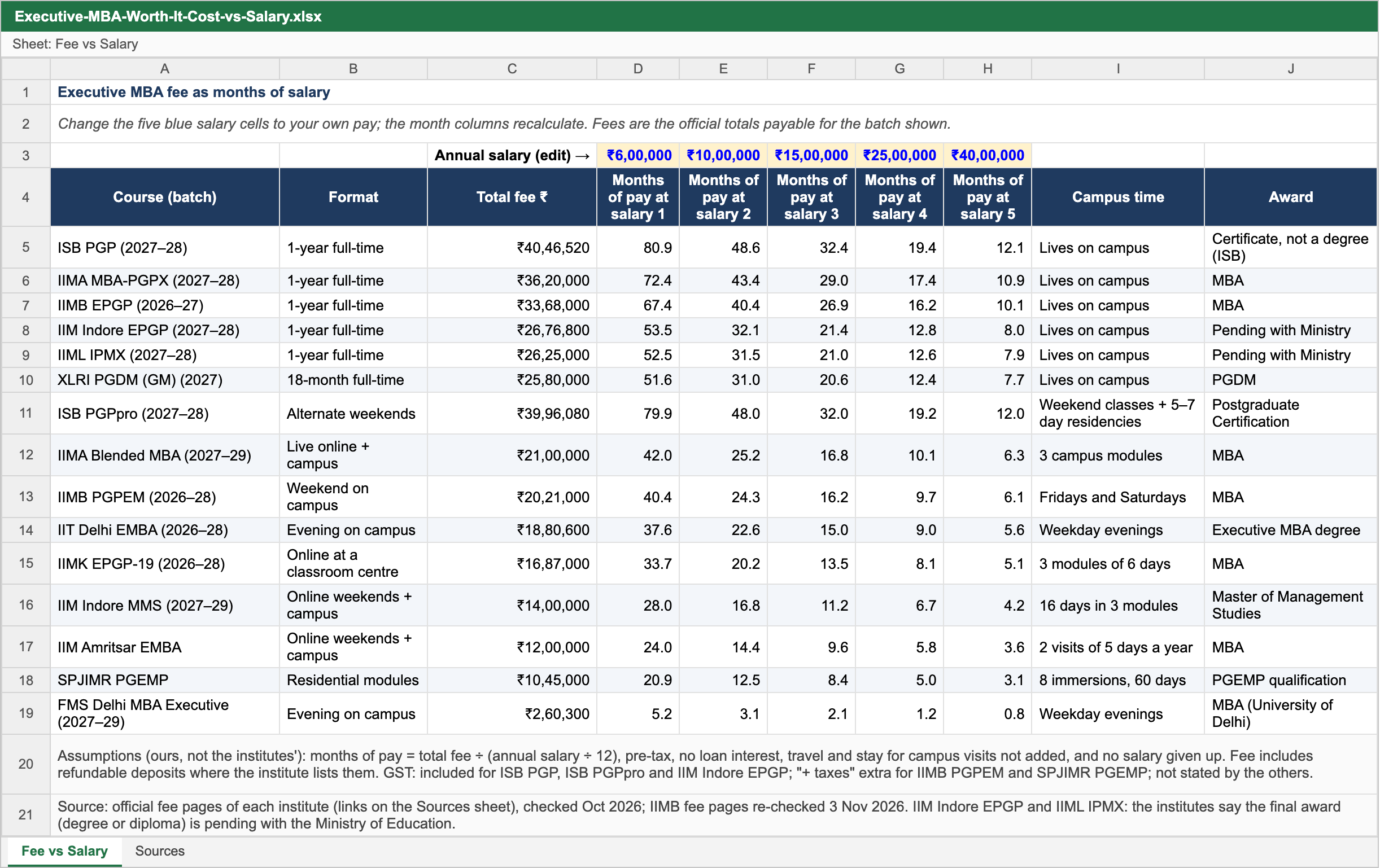
The month columns leave out two costs that change the picture. Travel and stay for campus modules are extra at most blended courses, and a one-year full-time course also costs twelve months of salary that you do not earn. At ₹25 lakh a year, the IIMA PGPX fee of 17.4 months becomes 29.4 months once the lost year is added. You can type your own salary into the blue cells of the workbook above, and the full fee breakdown with instalments is in Executive MBA Fees.
The award column matters as much as the fee. IIM Ahmedabad, IIM Bangalore and IIM Kozhikode award an MBA, while ISB describes its PGP as a certificate course and its PGPpro as a Postgraduate Certification. IIM Lucknow and IIM Indore say the final award of their one-year courses, degree or diploma, is pending with the Ministry of Education.
Earning Under ₹10 Lakh a Year: What to Do First
At a salary under ₹10 lakh a year, most IIM executive MBAs cost more than a full year of pay, so the fee alone can strain a household budget. In the table above, IIMK’s EPGP costs 20.2 months of pay at ₹10 lakh and 33.7 months at ₹6 lakh, while IIM Indore’s MMS costs 16.8 and 28.0 months.
A loan makes the monthly strain visible. On a stated assumption of a 10% interest rate over seven years, a loan for the full ₹16,87,000 IIMK EPGP fee has an EMI of about ₹28,000. That EMI is about 34% of the gross monthly pay at ₹10 lakh a year and 56% at ₹6 lakh. The same assumption gives an EMI of about ₹4,300 for the ₹2,60,300 FMS Delhi MBA Executive, which needs you in Delhi on weekday evenings.
| Your situation at under ₹10 lakh | Option that fits | Why |
|---|---|---|
| Your pay is low because of the role, not the market | Change role or employer first, then apply | A keep-your-job course runs no placement process, so it does not move you to a better-paid job by itself. |
| Four or more years of experience and you want a new function | One-year full-time MBA with a placement report | At ₹6–10 lakh, the jump to a published median of ₹27–36.5 lakh is large enough to cover the fee and the lost year within a few years. |
| You need the degree for your employer’s promotion rules | A lower-fee recognised degree, such as FMS Delhi’s evening MBA or a UGC-approved online MBA | The award is what the rule checks, so a lower fee does the same job without a large loan. |
| Your employer will pay part of the fee | A keep-your-job IIM MBA with sponsorship | Sponsorship removes most of the cost, although it usually comes with a service bond. |
Source: fees from the official pages in the table above. EMI uses the standard reducing-balance formula at an assumed 10% a year over 84 months, before tax; it is an illustration, not a bank quote.
A low fee does not mean a weak award. The University of Delhi awards the FMS MBA Executive degree, and an online degree from a university recognised by the University Grants Commission (UGC) is treated as equal to a campus degree. The online route and its rules are explained in MBA for Working Professionals, and the fee for each course with instalments is in Executive MBA Fees.
What Do Placement Reports Show for One-Year Executive MBAs?
The placement reports of one-year executive MBAs show median salaries of ₹27 lakh to ₹36.5 lakh a year after the course. These figures are post-course salaries, not salary increases, because only IIM Lucknow publishes how much its students earned before the course. Most institutes also report a median for the whole batch, so a single student’s result can sit well above or below it.
| Course | Batch (report) | Seeking placement | Offers accepted / placed | % placed | Median ₹ lakh | Average ₹ lakh | What else it says |
|---|---|---|---|---|---|---|---|
| IIMA MBA-PGPX | Finals 2026 | 139 | 134 | 96.4% | 32.16 | 33.64 | Fixed yearly cash; audited (B2K Analytics, IPRS); 17 did not seek placement; pre-course pay not published |
| IIMB EPGP | 2025–26 | Not published | 61 | Not published | 36.50 | 37.10 | 73 students; 3 opted out; 4 on sabbatical; pre-course pay not published |
| IIMC MBAEx | 19th batch (year not on page) | 82 | Not published | Not published | 35.00 | 34.09 | 82 students used placements and received 90 offers; consulting 67% of offers |
| IIML IPMX | Class of 2026 | 108 | 100 | 92.6% | 27.00 | 27.65 | Average pre-to-post CTC increase of 54%; 79% changed function; 8 without a job on 15 Apr 2026 |
| IIM Indore EPGP | 2024–25 | 62 | Not published | Not published | Not published | 23.50 | 3 opted out; 8 rejoined previous firm after sabbatical; 11 placed off campus |
| XLRI PGDM (GM) | Year not stated on site | Not published | Not published | Not published | 27.00 | 29.00 | Placement support needs a relieving or sabbatical letter (Prospectus 2027) |
| ISB PGP | Class of 2026 (press report) | Not published | 1,117 offers | Not published | Not published | 37.29 | Figure from a Business Today report, not an ISB page; ISB median not published |
Source: IIMA PGPX Finals 2026 IPRS report, IIMB Placement Report 2026, IIMC MBAEx 19th-batch statistics, IIML IPMX Class of 2026 report, IIM Indore EPGP report 2024–25, XLRI PGDM (GM) site, Business Today, 6 April 2026; checked 3 November 2026.
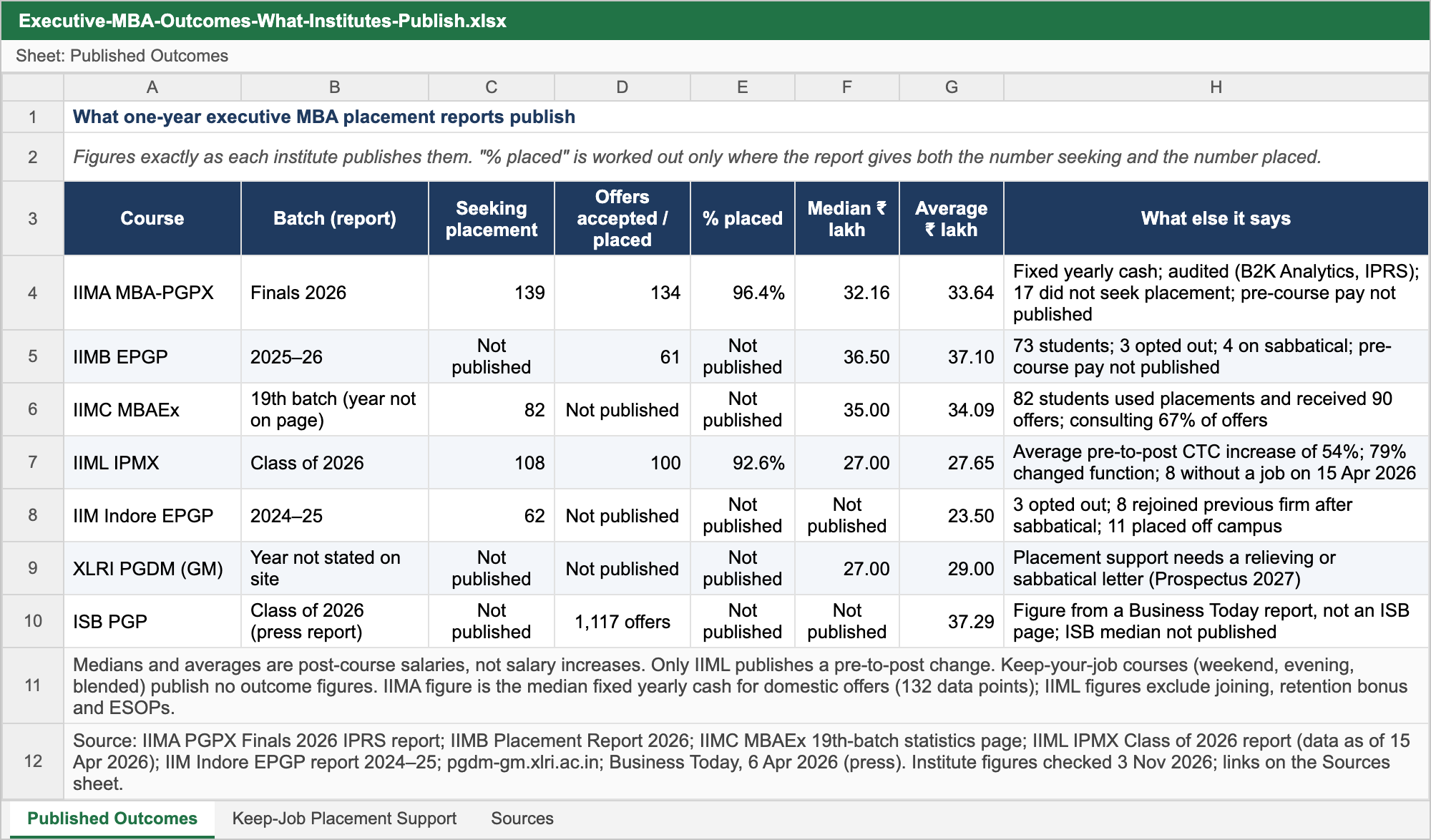
IIM Ahmedabad’s report is the only one in the table that carries an auditor’s letter under the Indian Placement Reporting Standards (IPRS). Its ₹32.16 lakh median is fixed yearly cash for 132 domestic offers, which excludes one-time payments such as joining bonuses. IIM Lucknow’s report says its figures exclude joining bonuses, retention bonuses and stock options, and gives its data as of 15 April 2026.
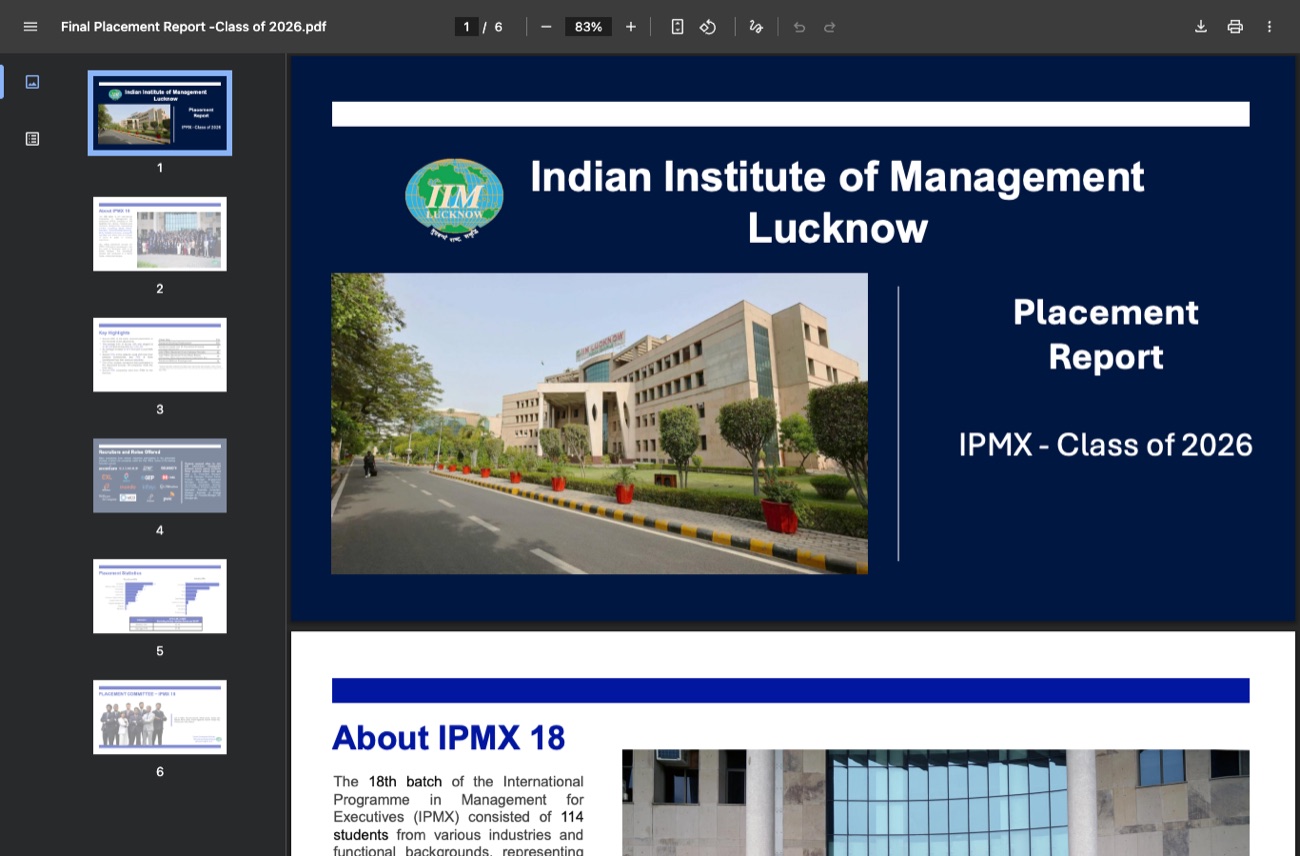
IIM Lucknow is also the only institute that publishes the change in pay. Its IPMX Class of 2026 report gives “an average increase of 54% from pre to post MBA CTC” and says about 79% of students shifted from their previous function or role. Many ranking and coaching websites quote salary rises of 30% to 150% for executive MBAs without naming a placement report, so applicants should treat such figures with caution. The full salary picture is in Executive MBA Placements and Salary.
How to Compare a Placement Report With Your Current Salary
Compare the fixed-pay median in a placement report with your own fixed pay, not with your total CTC including bonuses. IIM Ahmedabad’s audited PGPX report splits each offer into salary heads, and the heads give different answers for the same batch of 132 domestic offers.
| Salary head in the IIMA PGPX Finals 2026 report | Median ₹ | Mean ₹ | Offers with data |
|---|---|---|---|
| Fixed yearly cash component | ₹32,16,250 | ₹33,63,914 | 132 |
| One-time cash payment (such as a joining bonus) | ₹2,00,000 | ₹3,33,750 | 88 |
| Total guaranteed cash component | ₹34,87,600 | ₹35,86,414 | 132 |
| Maximum earning potential | ₹37,77,778 | ₹41,47,612 | 132 |
Source: IIMA MBA-PGPX Placement Report, Finals 2026 (Table 5.1, domestic offers), audited by B2K Analytics under IPRS Revision 2.2.
The fixed median of ₹32.16 lakh is the number to set against your current fixed salary, because one-time payments are paid once and the maximum earning potential includes variable pay that may not be paid in full. IIM Lucknow’s IPMX figures already exclude joining bonuses, retention bonuses and stock options. Monthly take-home pay after tax and deductions will be lower than any of these figures.
Do Executive MBAs for Working Professionals Offer Placements?
No, most executive MBAs for working professionals in India do not offer placements, and the institutes say so in their own FAQs. The reason they give is that participants are expected to stay in their current jobs. A few offer limited help, and none of them publishes salary outcomes.
| Course | Placement support (institute’s words) | Alumni status (condition) | Source |
|---|---|---|---|
| IIMK EPGP | “a formal placement assistance scheme is not part of this programme” | “Upon successful completion of the programme, participant will be an alumnus of IIM Kozhikode” | EPGP FAQ (updated 2 May 2024) |
| IIM Lucknow PGPWE | “Does the Institute offer placement services? NO.” | Not stated on the FAQ | iiml.ac.in/wmp |
| IIM Lucknow bMBA | “does not include a dedicated placement cell” | “Upon successful completion, participants become alumni of IIM Lucknow” | iiml.ac.in bMBA page |
| SPJIMR PGEMP | “PGEMP is not a placement-oriented programme” | “full SPJIMR alumni status” for those who successfully complete | PGEMP FAQ |
| IIM Amritsar EMBA | “limited placement assistance on a case to case basis through our corporate partners” | “After successful completion of the program, all participants will get an IIM Amritsar Alumni status” | EMBA FAQ |
| IIT Delhi EMBA | “placement support is not provided”; an employer No Objection Certificate is required | Not stated on the page | dms.iitd.ac.in EMBA page |
| IIMC EPBM and other long courses | “No placement assistance is provided to the participants of LDPs.” | “IIMC – Executive Education Alumni status” after successful completion | IIMC LDP FAQ |
| IIMB PGPEM | IIMB FAQ: the EPGP provides placement services “unlike the PGPEM” | Not stated on the page | IIMB PGPEM pages |
| IIMA Blended MBA | No placement process listed in the 2027–29 brochure | IIMA alumni status on graduating | BPGP 2027–29 brochure |
| ISB PGPpro | No placement process described on the course pages | Condition not stated; ISB counts a “PGP Suite” alumni network | ISB PGP PRO pages |
Source: official FAQ or course page of each institute, checked 3 November 2026 (IIMB PGPEM, IIMA Blended and ISB PGPpro wording as checked in October 2026). “Not stated” means the official page is silent.
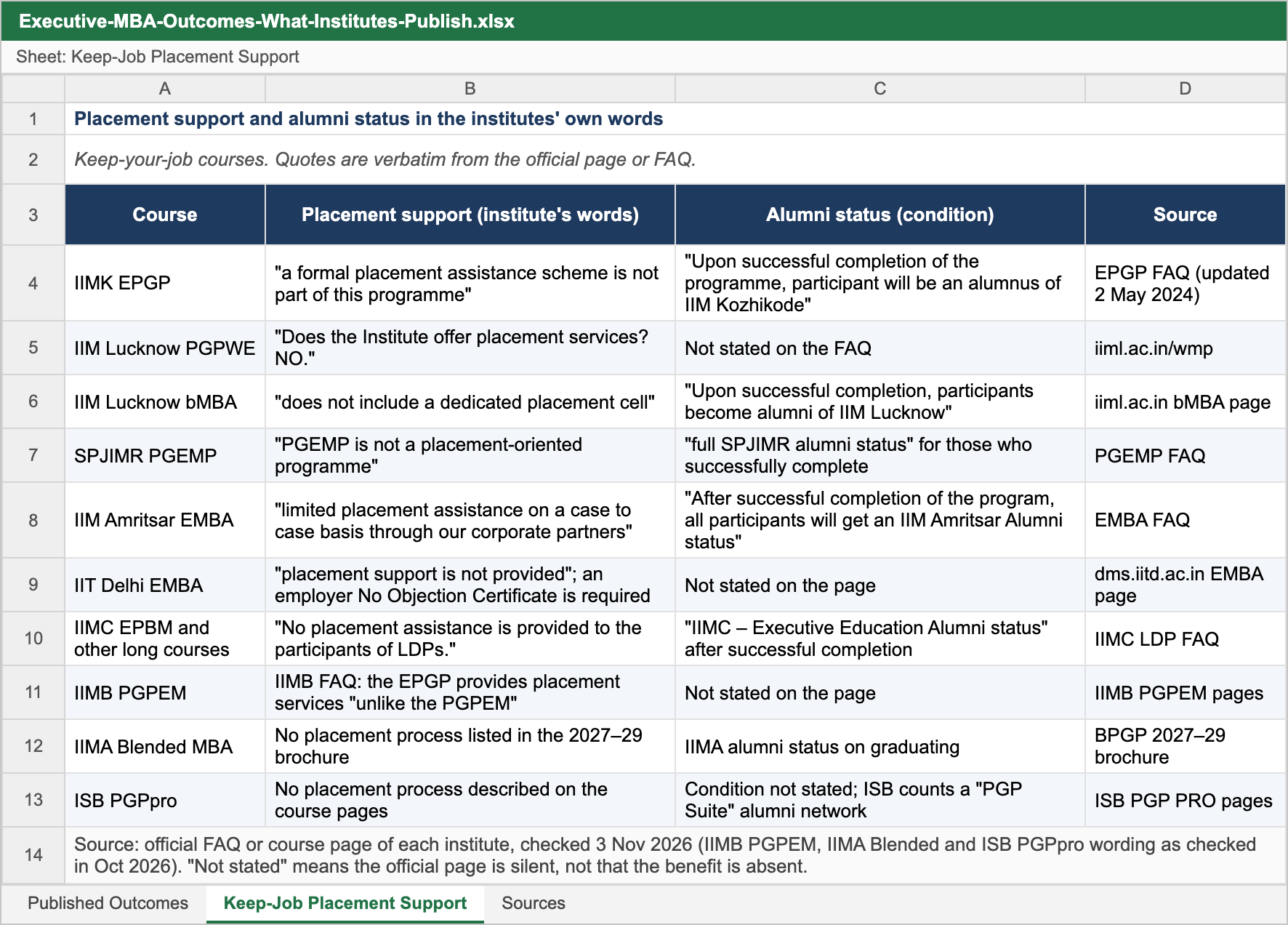
The practical meaning is simple for applicants. A keep-your-job executive MBA can make your CV stronger when you apply for jobs yourself, but the institute will not bring recruiters to you. Applicants who need a structured job search should compare the one-year courses in One-Year MBA in India, while those planning to stay with their employer can read MBA for Working Professionals.
How Long Does an Executive MBA Take to Pay Back?
A keep-your-job executive MBA such as IIMK’s EPGP takes about 40 months to pay back for a professional earning ₹25 lakh a year, if the course leads to a 20% raise. A one-year full-time course pays back fastest for lower earners: about 27 to 41 months at ₹15 lakh a year, but more than five years at ₹25 lakh, and never at ₹40 lakh on the published medians.
The worked example uses IIMK’s EPGP for the keep-your-job route and the three one-year courses with an official median for the quit-for-a-year route. The 20% and 10% raises are assumptions made for this guide, because no keep-your-job course publishes salary data. The quit calculation adds one year of lost salary to the fee and divides by the monthly gain from moving to the course’s published median.
| Experience band | Current salary ₹ (assumed) | Keep job, IIMK EPGP: 20% raise | Keep job, IIMK EPGP: 10% raise | Quit: IIML IPMX | Quit: IIMA PGPX | Quit: IIMB EPGP |
|---|---|---|---|---|---|---|
| 4–6 years | ₹15,00,000 | 67 | 135 | 41 | 36 | 27 |
| 8–12 years | ₹25,00,000 | 40 | 81 | 308 | 103 | 61 |
| 15+ years | ₹40,00,000 | 25 | 51 | Median below current pay | Median below current pay | Median below current pay |
Payback in months, rounded. Inputs: IIMK EPGP-19 fee ₹16,87,000; IIML IPMX fee ₹26,25,000 and median ₹27,00,000 (Class of 2026); IIMA PGPX fee ₹36,20,000 and median fixed pay ₹32,16,250 (Finals 2026); IIMB EPGP fee ₹33,68,000 and median ₹36,50,000 (2025–26). Pre-tax, no loan interest, no raise you would have got anyway, campus travel not added. Salaries and raises are assumptions.
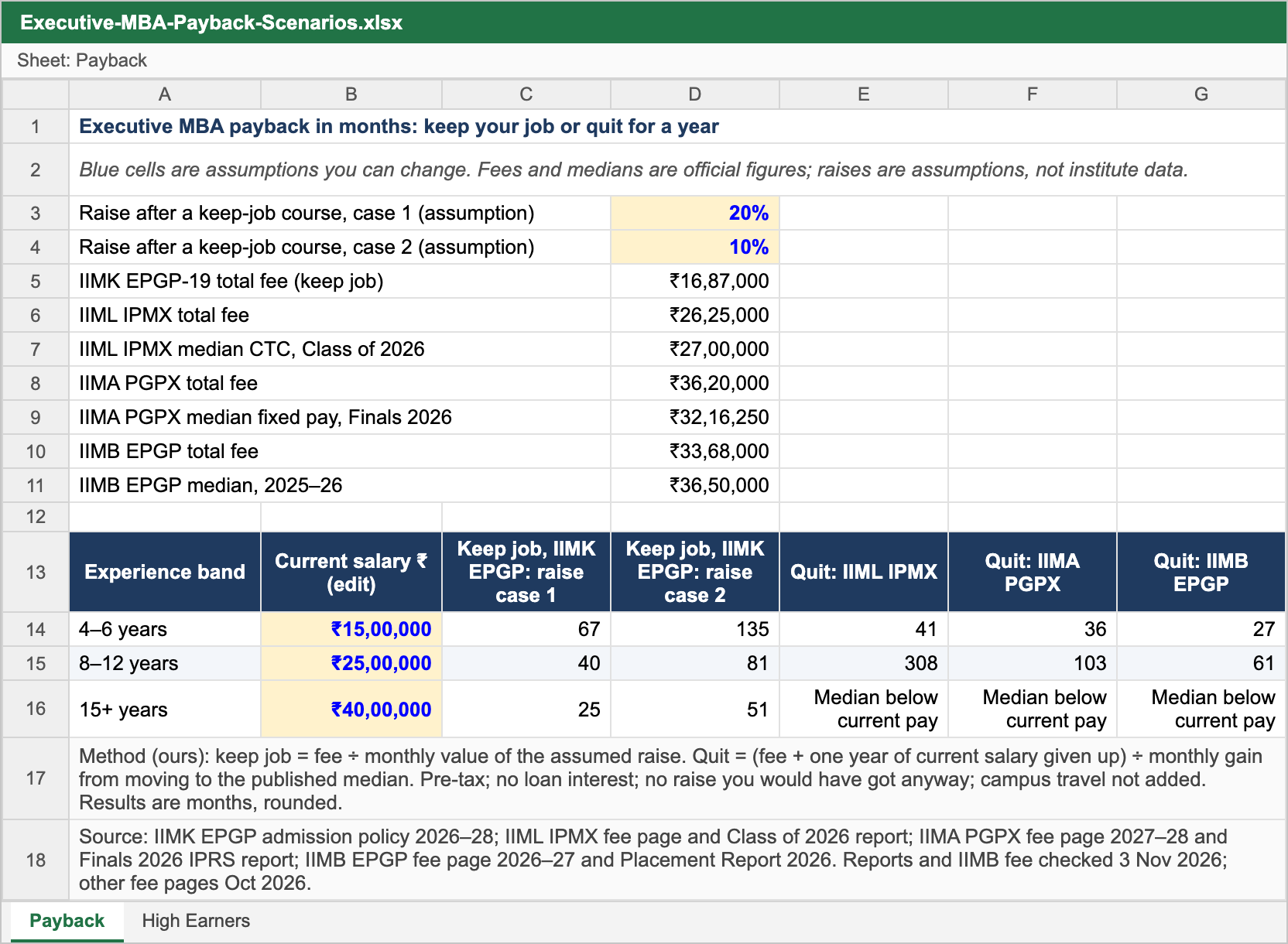
Two conclusions follow from the arithmetic. At ₹40 lakh a year, every published one-year median is below your current pay, so leaving work for a one-year course makes sense only for a planned change of function or industry. At ₹15 lakh a year, the one-year route pays back faster than a keep-your-job course, because the jump to a ₹27–36.5 lakh median is large.
Both calculations are only as good as their assumptions. A raise you would have received anyway should be subtracted, and an education loan adds interest to the fee. You can change the salary and raise cells in the workbook, or use the executive MBA ROI calculator on the Free Executive MBA Tools: ROI Calculator and Application Tracker page.
I Already Earn ₹30 Lakh or More. Does a One-Year MBA Still Pay?
At ₹30 lakh or more, a one-year MBA rarely pays for itself through salary alone, because the published medians sit close to or below that level. At ₹35 lakh, only IIM Bangalore’s EPGP median of ₹36.5 lakh is higher than current pay, and at ₹45 lakh all three published medians are lower.
The table adds one year of salary to the fee, because a full-time course means a year without pay. It then divides that total by the change in yearly pay if you land exactly on the course’s published median.
| Current salary (assumed) | Course | Fee + one year of pay ₹ | Published median ₹ | Change in yearly pay ₹ | Years to recover the cost |
|---|---|---|---|---|---|
| ₹15,00,000 | IIMA PGPX | ₹51,20,000 | ₹32,16,250 | +₹17,16,250 | 3.0 |
| ₹15,00,000 | IIMB EPGP | ₹48,68,000 | ₹36,50,000 | +₹21,50,000 | 2.3 |
| ₹25,00,000 | IIMA PGPX | ₹61,20,000 | ₹32,16,250 | +₹7,16,250 | 8.5 |
| ₹25,00,000 | IIML IPMX | ₹51,25,000 | ₹27,00,000 | +₹2,00,000 | 25.6 |
| ₹35,00,000 | IIMB EPGP | ₹68,68,000 | ₹36,50,000 | +₹1,50,000 | 45.8 |
| ₹35,00,000 | IIMA PGPX | ₹71,20,000 | ₹32,16,250 | −₹2,83,750 | Not on the median |
| ₹45,00,000 | IIMA PGPX, IIMB EPGP, IIML IPMX | ₹71,25,000 to ₹81,20,000 | ₹27,00,000 to ₹36,50,000 | −₹8,50,000 to −₹18,00,000 | Not on the median |
Inputs: fees and medians as in the payback table above (IIMA PGPX Finals 2026 fixed median; IIMB EPGP 2025–26; IIML IPMX Class of 2026). Salaries are assumptions; pre-tax, no loan interest and no raise you would have received anyway. IIMC MBAEx publishes a ₹35 lakh median for its 19th batch but no fee for the next batch, so it is not in the calculation.
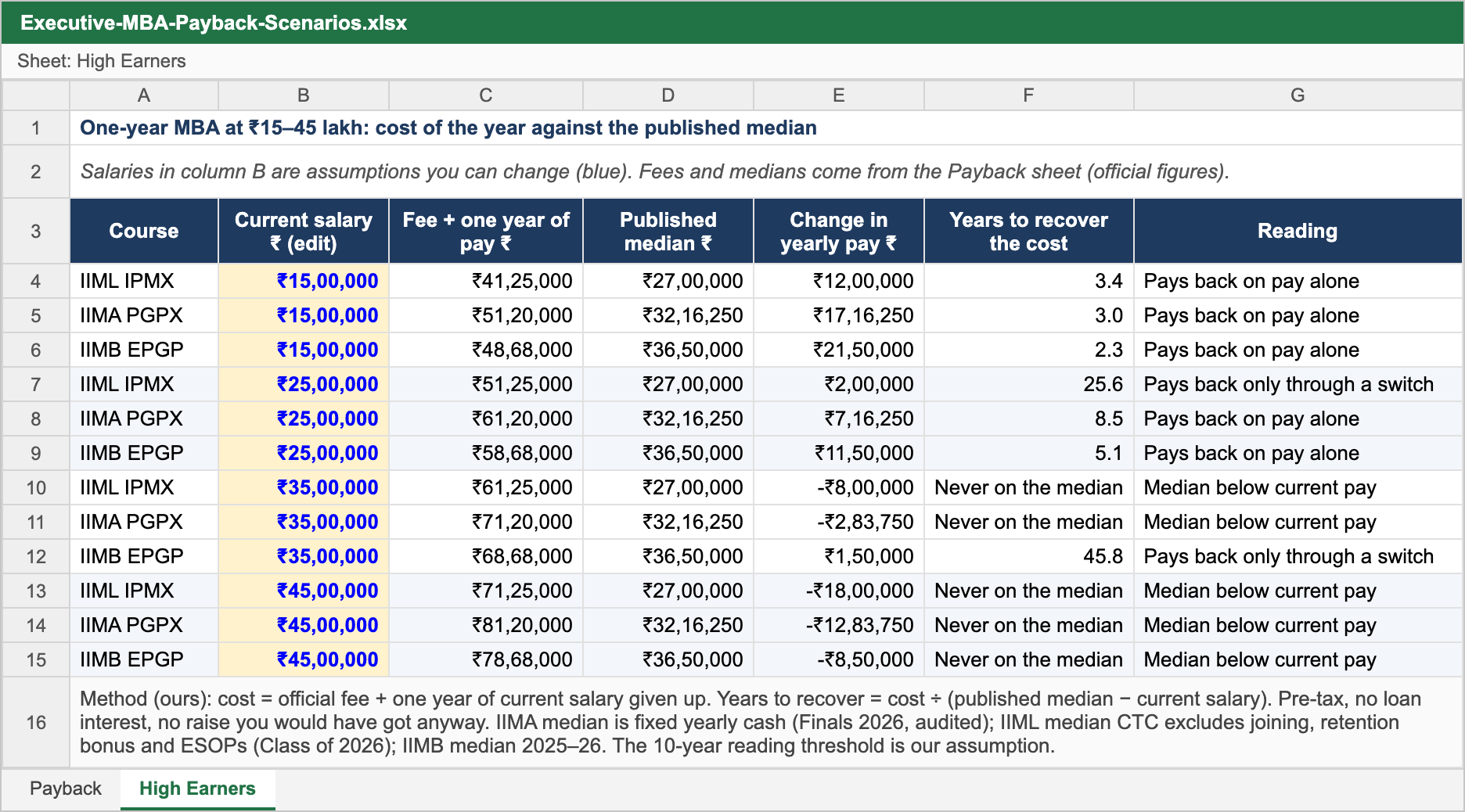
For a professional earning ₹30–45 lakh, the case for a one-year MBA rests on a planned change of function, industry or city, not on the first salary after the course. IIM Lucknow reports that about 79% of its IPMX Class of 2026 moved to a new function or role, which is the outcome such applicants are paying for. Product managers and engineers at this salary level can see role-specific options in Executive MBA for Product Managers: Courses, Fees and What Changes After.
When there is no target role, a keep-your-job course is the cheaper choice at this salary. IIMK’s EPGP costs about 5 months of pay at ₹40 lakh, and you keep your salary throughout. The cost of the one-year route in each salary band is also set out in Executive MBA Fees, and the main one-year courses are compared in ISB PGP vs IIMA PGPX vs IIMB EPGP: Fees, Class Profile and Placements Compared.
Who an Executive MBA Is Worth It For, and Who Should Skip It
An executive MBA is most often worth it for professionals with five to twelve years of experience who want to move into general management in their own field. It is least useful for people with under three years of experience, because most courses require more, and for senior professionals paying a high fee themselves without a clear target role.
| Experience | Goal | Format that fits | Example courses | Skip it if |
|---|---|---|---|---|
| 2–4 years | Management degree while keeping your job | Online or blended degree with a low minimum | IIM Indore MMS, IIMA Blended MBA (both state lower minimums than one-year courses) | You want a new job soon: neither runs placements, so a two-year MBA through CAT may suit you better |
| 4–8 years | Change function or industry | One-year full-time with a placement report | IIML IPMX, IIMA PGPX, IIMB EPGP, IIMC MBAEx | You already earn close to the ₹27–36.5 lakh medians |
| 4–8 years | Grow in your current company | Weekend, evening or blended | IIMK EPGP, IIMB PGPEM, IIT Delhi EMBA | Your employer will not release you for campus modules or class days |
| 8–12 years | General management role | Blended, weekend or modular | IIMA Blended MBA, IIMK EPGP, SPJIMR PGEMP | You expect the course alone to bring a promotion |
| 8–12 years | Planned switch | One-year full-time, only if the switch is worth more than a year’s pay | IIMB EPGP, IIMC MBAEx | You earn ₹30 lakh or more and have no target role |
| 15+ years | Senior leadership | Modular or senior executive courses | SPJIMR PGEMP, ISB PGP MAX | You would pay ₹40 lakh yourself with no sponsor |
| Any | Running a family business or own firm | Weekend, evening or blended | FMS Delhi MBA Executive, IIMK EPGP | You need a placement process |
Source: experience minimums and formats from the official course pages cited in the tables above, October–November 2026.
Career stage matters more than age. Applicants in their late twenties often meet the minimum experience for one-year courses, since IIMA’s PGPX requires four years of full-time work, while senior professionals usually get more from courses with a peer group of similar experience. Detailed advice by stage is in Executive MBA for Mid-Career Managers (8–15 Years): Best Programmes, Eligibility and Fees and Executive MBA for Early-Career Professionals (2–5 Years): Best Programmes, Eligibility and Fees.
Who an executive MBA is not for: professionals who need the institute to find them a new job through a keep-your-job course, applicants whose employer will not agree to class days or campus visits, and people who earn more than the published medians and plan to leave work for a one-year course without a target role.
Can I Do an MBA Without Resigning From a Government Job?
Yes, central government employees do not always have to resign, because the Central Civil Services (Leave) Rules, 1972 allow study leave for some courses. Under Rule 50 of the CCS (Leave) Rules, study leave may be granted after probation and at least five years of regular continuous service.
The same rules set three conditions that matter for an MBA. The authority granting leave must certify that the course is of definite advantage to the public interest and connected with your duties. Rule 51 caps study leave at 12 months at a time and 24 months over the whole career, which covers a one-year full-time MBA. Rule 50(5) also requires a bond to serve the government for three years after the leave ends.
Employees of public sector undertakings and public sector banks follow their own employer’s study-leave or sponsorship policy, not the CCS rules, so the HR policy document decides what is possible. Keep-your-job formats, such as weekend, evening or blended MBAs, avoid leave altogether, although many ask for a No Objection Certificate from the employer. The options for each type of public employer are compared in MBA for Government and PSU Employees: Study Leave, One-Year and Weekend Options.
Public-sector experience is not a bar to a one-year MBA with placements. IIM Lucknow’s IPMX Class of 2026 drew students from sectors including energy, oil and gas, BFSI, education and manufacturing. Whether a move from a PSU into consulting works depends on the target role, so applicants should check the recruiter and function lists in each course’s placement report.
Is an Executive MBA from an IIM Worth It?
An executive MBA from an IIM is worth it for most working professionals who need a recognised degree, because the IIMs award an MBA for most of their executive courses under the IIM Act. The fee ranges widely, from ₹9.5 lakh at IIM Nagpur to ₹36.2 lakh for IIMA’s PGPX, so the IIM name alone does not decide the value.
Three checks separate one IIM course from another. The first is the award: IIM Kozhikode, IIM Ahmedabad and IIM Bangalore state that they award an MBA, while IIM Indore’s EPGDPM&AI ends in a completion certificate and the one-year courses at IIM Lucknow and IIM Indore await a final decision on the award. The second is alumni status, which IIM Kozhikode and IIM Lucknow grant “upon successful completion” and IIM Calcutta grants as a separate Executive Education Alumni status for its long courses. The third is placement support, which only the one-year residential IIM courses provide.
IIM Kozhikode adds one further benefit for degree holders. Its EPGP FAQ says that candidates who complete the course and receive the MBA degree are eligible to apply for its FPM (PhD) and PhD (Practice track). The full comparison of IIM formats is in IIM Online and Blended MBA, and the award wording for each course is set out in Executive MBA Degree Type, Recognition and Alumni Status.
Executive MBA Courses Compared on Eight Criteria
The table compares 13 executive MBA courses on eight criteria taken from each institute’s own documents: award, format and campus time, total fee, placement support, alumni status, whether you can keep your job and the outcome the institute publishes. A course is included if it has an official fee for the current or next batch and either an official placement report or a written placement statement.
| Course | Award | Format and campus time | Total fee ₹ | Placement support (institute) | Alumni status | Keep your job? | Published outcome |
|---|---|---|---|---|---|---|---|
| IIMA MBA-PGPX | MBA | Full-time, on campus, 1 year | ₹36,20,000 | Yes, audited IPRS report | On graduation | No | Median ₹32.16 lakh (2026) |
| IIMB EPGP | MBA | Full-time, on campus, 1 year | ₹33,68,000 | Yes, placement report | Graduates (no condition quoted) | No | Median ₹36.50 lakh (2025–26) |
| IIML IPMX | Pending with Ministry | Full-time, Noida, 1 year | ₹26,25,000 | Yes, placement report | Graduates (no condition quoted) | No | Median ₹27.00 lakh; +54% average (2026) |
| IIM Indore EPGP | Pending with Ministry | Full-time, on campus, 1 year | ₹26,76,800 | Yes, placement report | Graduates (no condition quoted) | No | Average ₹23.5 lakh (2024–25) |
| XLRI PGDM (GM) | PGDM | Full-time, Jamshedpur, 18 months | ₹25,80,000 | Yes, with relieving or sabbatical letter | Graduates (no condition quoted) | No | Median ₹27.00 lakh (year not stated) |
| ISB PGP | Certificate | Full-time, on campus, 1 year | ₹40,46,520 | Yes, placement process | Graduates (no condition quoted) | No | Average ₹37.29 lakh (press, 2026) |
| ISB PGPpro | Postgraduate Certification | Alternate weekends + residencies | ₹39,96,080 | No process described | Condition not stated | Yes | None published |
| IIMA Blended MBA | MBA | Live online + 3 campus modules | ₹21,00,000 | No process listed | On graduation | Yes | None published |
| IIMB PGPEM | MBA | Fridays and Saturdays on campus | ₹20,21,000 | No (“unlike the PGPEM”) | Not stated | Yes | None published |
| IIT Delhi EMBA | Executive MBA degree | Weekday evenings on campus | ₹18,80,600 | No; employer NOC needed | Not stated | Yes | None published |
| IIMK EPGP | MBA | Classroom centre + 3 × 6 campus days | ₹16,87,000 | No formal scheme | On successful completion | Yes | None published |
| SPJIMR PGEMP | PGEMP qualification | 8 residential immersions, 60 days | ₹10,45,000 | Not placement-oriented | Full, on completion | Yes | None published |
| FMS Delhi MBA Executive | MBA (University of Delhi) | Weekday evenings on campus | ₹2,60,300 | Not mentioned in bulletin | No separate condition | Yes | None published |
Source: official fee pages (October 2026), FAQs and placement reports of each institute (checked 3 November 2026). ISB PGP average is a press figure (Business Today, April 2026). Disclosure: findmycollege.com has commercial partnerships with some courses in this grid, including the IIMA Blended MBA and IIM Kozhikode’s EPGP; every course is assessed on the same criteria.
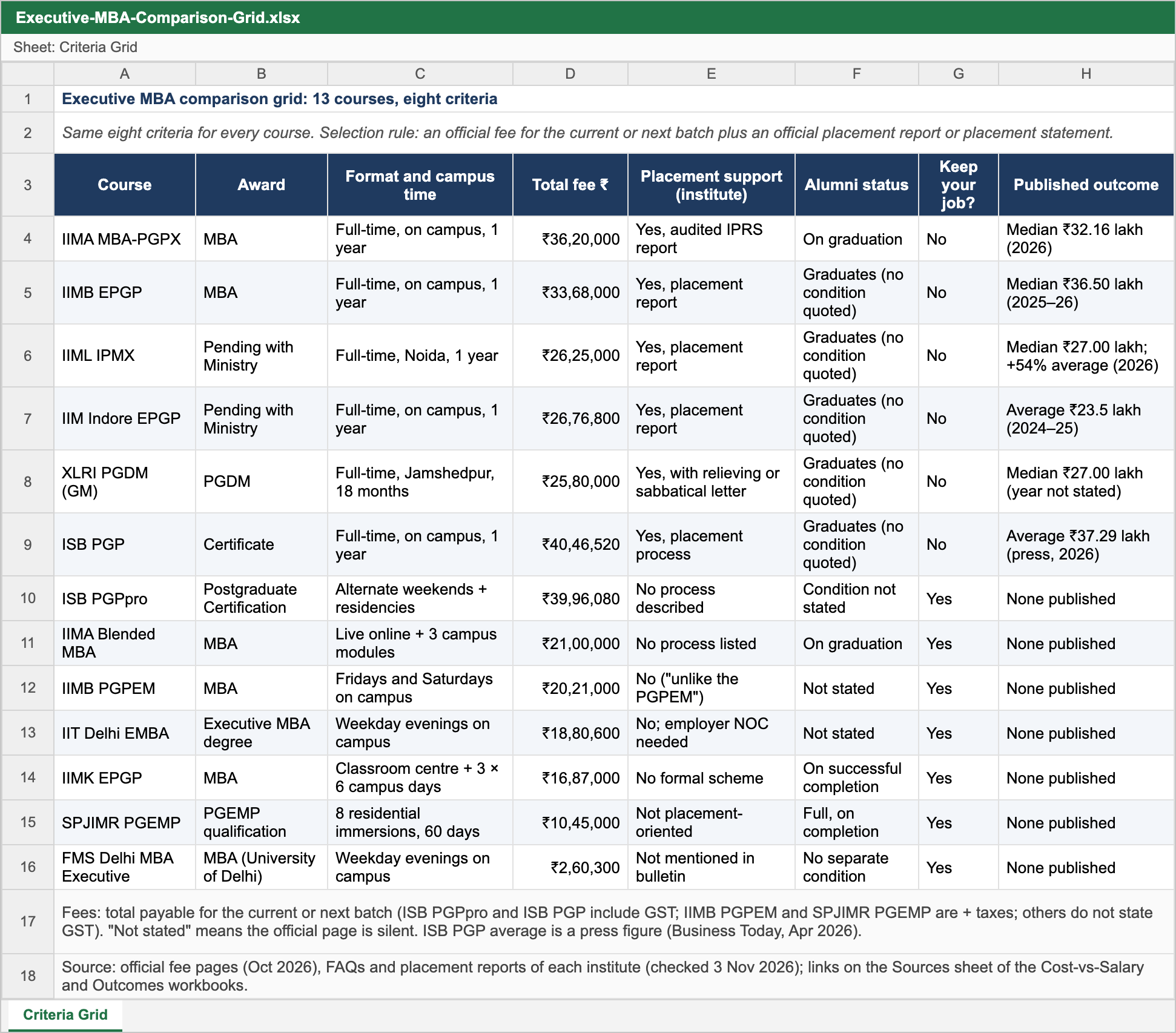
What each course offers and where it falls short
- IIMA MBA-PGPX: the main strength is the only audited placement report in the group, with 134 of 139 job seekers accepting offers in 2026. The main limitation is the cost of ₹36.2 lakh plus a year without salary, so the course suits professionals earning well below the ₹32.16 lakh median who want a switch.
- IIMB EPGP: the course has the highest published median in the group, at ₹36.50 lakh for 2025–26. The limitation is that IIMB does not publish how many students sought placement, so the share placed cannot be worked out; the course suits mid-career professionals targeting consulting, which made up half of its offers.
- IIML IPMX: IIM Lucknow is the only institute that publishes pre-to-post pay (an average rise of 54%) and the share who changed function (79%). The limitation is the lower median of ₹27 lakh, so the course suits professionals earning ₹15–20 lakh who want a new function.
- IIM Indore EPGP: the fee of ₹26.77 lakh includes GST, which makes the true cost easy to compare. The limitation is that the report gives an average (₹23.5 lakh) but no median, and 8 participants returned to their previous employer after a sabbatical.
- XLRI PGDM (GM): the course suits managers who want a full-time general management course in Jamshedpur over 18 months. The limitation is that XLRI’s site does not say which batch its ₹27 lakh median belongs to, and placement support requires a relieving or sabbatical letter.
- ISB PGP and ISB PGPpro: ISB’s strength is its brand and a large class; the PGP runs placements, while the PGPpro lets you keep your job. The limitation is that both end in a certificate rather than a degree, and the PGPpro costs ₹40 lakh with no placement process, so it suits senior professionals or those with employer sponsorship.
- IIMA Blended MBA and IIMB PGPEM: both award an MBA from an older IIM while you keep your job. The limitation is the time cost, since the IIMA course has live sessions on four days a week and the PGPEM needs Fridays and Saturdays on campus in Bengaluru.
- IIT Delhi EMBA: the course suits Delhi professionals who can reach the campus on weekday evenings. IIT Delhi states that placement support is not provided and asks for an employer No Objection Certificate.
- IIMK EPGP: the course awards an MBA at ₹16.87 lakh, with classes attended from a classroom centre in your city. The limitation is that there is no formal placement scheme, and the author of this guide is an alumnus, so his account below is one person’s experience.
- SPJIMR PGEMP and FMS Delhi MBA Executive: SPJIMR offers 60 residential days at ₹10.45 lakh plus taxes, and FMS offers a University of Delhi MBA for about ₹2.6 lakh. Neither offers placements, and the FMS course needs you in Delhi on weekday evenings.
The author’s batch went to campus once a year, while IIM Kozhikode’s admission policy for EPGP-19 (2026–28) lists three campus modules of six days each. Applicants should plan around the schedule in the current admission policy. The full course profile is in IIM Kozhikode Executive MBA (EPGP).
Is an Executive MBA Equivalent to a Regular MBA?
Yes, an executive MBA is equivalent to a regular MBA when the institute awards the same degree, as IIM Ahmedabad, IIM Bangalore and IIM Kozhikode do. The difference lies in who the course is for and whether it has placements, not in the name on the certificate. A certificate course such as ISB’s PGP or PGPpro is not a degree, so it may not meet a job rule that asks for a master’s degree.
Validity depends on the approval behind the award, not on the fee. An IIM awards its MBA under the IIM Act, 2017, and the University of Delhi awards the ₹2.6 lakh FMS MBA Executive. A degree from a UGC-recognised online course is treated as equal to a campus degree under the UGC’s open, distance and online learning regulations. A government recruitment or promotion rule can still ask for a full-time or regular degree, so the wording of that rule decides whether an online MBA counts for that post.
Employers and recruiters usually ask which format you completed, so the CV should name the course accurately. The side-by-side comparison of eligibility, fees and outcomes is in Executive MBA vs Regular MBA.
Can Your Employer or the Tax Rules Reduce the Cost?
Yes, employer sponsorship and the tax deduction on education-loan interest can both reduce the cost of an executive MBA. Sponsorship has the larger effect, because it removes the fee, but it is usually tied to staying with the employer. The tax deduction lowers only the interest cost of a loan.
Sponsored students are common on the one-year courses. IIM Lucknow’s IPMX report lists 6 company-sponsored students who opted out of placements in 2026, and IIM Ahmedabad’s PGPX report lists 8 students who were company-sponsored or already employed. Keep-your-job courses often need the employer’s agreement before you join: IIT Delhi asks for a No Objection Certificate, and XLRI’s PGDM (GM) needs a relieving or sabbatical letter before it offers placement support.
Interest on an education loan can be deducted under Section 129 of the Income-tax Act, 2025, which carries over the deduction known earlier as Section 80E. The section allows an individual to deduct interest paid on a loan from a bank, a notified financial institution or an approved charitable institution for higher education of the individual, a spouse or children. The deduction is available for the year in which interest payments start and the seven years after it, and the law sets no rupee limit.
The deduction does not apply under the default tax regime. Section 202 of the Act computes income under the default regime without Chapter VIII deductions, except a few listed sections, and Section 129 is not one of them. You can claim the interest only if you opt out of the default regime for that year. Loan options and scholarships are covered in Executive MBA Scholarships, Loans and EMI, and a tax adviser should confirm the choice of regime for your own case.
What Graduates and Surveys Say About Executive MBA Outcomes
Surveys of executive MBA graduates report pay rises and promotions, but the main survey is global and mostly from the United States. According to a GMAC article of 12 January 2026, the Executive MBA Council’s 2025 exit survey found that salaries rose by 17.5% on average between the start and end of the course. The same survey found that 40% of students were promoted after finishing and 55% received more responsibility during their studies.
The GMAC article does not state the sample size, and the average graduate salary it quotes ($226,400) shows that the survey reflects a very different market from India. In India, the only institute-published measure of change is IIM Lucknow’s IPMX figure of an average 54% rise, which applies to a one-year full-time course where students left their jobs.
What Are the Disadvantages of an Executive MBA?
The main disadvantages of an executive MBA are the time it takes from work and family, the lack of placements on keep-your-job courses and a fee that is rarely recovered quickly. Most keep-your-job courses run for two years, with classes on weekends or weekday evenings plus campus modules that need leave from work.
Applicants can reduce these problems by agreeing class days and campus leave with their manager before applying, and by checking the attendance rules in the admission policy. The class schedule of each course is compared in Executive MBA Duration, Class Schedule and Campus Visits.
The Desk’s take: An executive MBA is worth it in India when the format matches the goal and the fee is reasonable against your salary. Professionals with four to eight years of experience who want a new function have the strongest case for a one-year full-time course, because the official medians show a clear jump in pay. Professionals who want to grow in their current company have a good case for a keep-your-job IIM degree, provided the employer supports the time away.
No single course suits everyone. The condition applicants most often overlook is the placement statement: most weekend, evening and blended courses say in writing that they do not help with jobs, so a career switch from these courses depends on your own search.
FAQs
Is an executive MBA worth it after 10 years of experience?
An executive MBA after 10 years of experience is usually worth it as a keep-your-job course if you want a general management role in your field. At that stage, salaries are often close to or above the ₹27–36.5 lakh medians of one-year courses, so leaving work for a year makes sense only for a planned switch.
Is 27 too old for an executive MBA?
No, 27 is not too old for an executive MBA, but at that age many applicants do not yet meet the experience rules. IIMA’s PGPX requires four years of full-time work, and most keep-your-job IIM courses ask for three years or more, so check the minimum on the course’s admission page.
Which IIM executive MBA is the cheapest?
On the official IIM fee pages for the next intake (October 2026), IIM Nagpur’s hybrid Executive MBA (Nagpur and Pune) had the lowest stated fee, at ₹9,50,000 for 2027–29, with a ₹20,000 refundable deposit listed in its fee table. IIM Visakhapatnam’s EMBA (₹11,90,000 for 2026–28) and IIM Amritsar’s EMBA (₹12,00,000) follow.
Is an executive MBA good for a career change?
An executive MBA helps a career change mainly through a one-year full-time course with placements. IIM Lucknow reports that about 79% of its IPMX Class of 2026 shifted function or role, while keep-your-job courses such as IIMK’s EPGP state that they offer no formal placement scheme.
Does an executive MBA get you a promotion?
An executive MBA can support a promotion, but Indian institutes publish no data on promotions after keep-your-job courses. The Executive MBA Council’s 2025 global survey, quoted by GMAC, found that 40% of students were promoted after completing the course, but its sample is mostly outside India.
Is ISB PGP a degree?
No, ISB describes its PGP as a certificate course and not a degree, and its PGPpro ends in a Postgraduate Certification. Applicants who need a degree for a government job, a PhD or a job abroad should check whether a certificate meets that requirement.
Can I do an executive MBA without CAT or GMAT?
Yes, several executive MBAs admit students through their own test or interview. IIT Delhi selects through its own written test and interview, and IIMK’s EPGP accepts EMAT, CAT, GMAT and GRE scores; details for each course are in Executive MBA Entrance Test and Score.
Keep reading
Last updated: 29 October 2026





Questions & answers · 9
Real decisions are rarely one-size-fits-all. Ask a focused question; applicants, participants and alumni answer here.
How should I compare the CTC in an MBA placement report with my current salary?
Compare your fixed pay with the fixed-pay median, not with total CTC. IIM Ahmedabad's audited PGPX report for 2026 gives a median fixed yearly cash of ₹32,16,250, a median total guaranteed cash of ₹34,87,600 and a separate median one-time payment of ₹2,00,000. Take-home pay after tax will be lower than any of these figures.
I work in a PMO role at a Big 4 firm on ₹18 lakh. Will an executive MBA move me into strategy?
A weekend or blended MBA helps most with an internal move, because these courses do not run placements. A move into a new function outside your firm is more realistic through a one-year full-time MBA: IIM Lucknow reports that about 79% of its IPMX Class of 2026 changed function or role. At ₹18 lakh, the published one-year medians of ₹27–36.5 lakh are well above your current pay.
I am a bank officer with a stable job. Is a weekend executive MBA safer than quitting for a one-year MBA?
A weekend or blended MBA keeps your salary and job security, but it has no placement process, so its value depends on your bank's promotion policy. A one-year full-time MBA is the only route with campus placements, and at ₹15 lakh a year the fee plus a lost year is recovered in about two to three years on the published medians. Public sector bank staff should check their employer's study-leave and sponsorship rules before deciding.
I am 30 and cannot afford a full-time MBA. Will an executive MBA still help my career over time?
A keep-your-job executive MBA lets you keep your salary, and IIM courses such as IIMK's EPGP (₹16,87,000) award an MBA degree. The institutes run no placement process for these courses, so the benefit comes through promotions with your employer or your own job search. Ask your employer about sponsorship first, because it removes most of the fee.
Is ISB PGPpro worth it compared with an IIM executive MBA?
ISB PGPpro costs ₹39,96,080 for 2027–28, ends in a Postgraduate Certification and describes no placement process. IIM keep-your-job courses such as IIMK's EPGP (₹16,87,000) and IIMB's PGPEM (₹20,21,000) award an MBA. PGPpro suits professionals who value the ISB brand and have employer sponsorship.
Can I claim tax benefits on an executive MBA loan?
Interest on an education loan from a bank or notified institution can be deducted under Section 129 of the Income-tax Act, 2025, the successor to Section 80E, for up to eight tax years. The deduction is not available under the default tax regime, so you must opt out of it for that year to claim the interest.
Is the salary hike after an executive MBA really 50% or more?
Only one Indian course publishes a pre-to-post figure: IIM Lucknow reports an average 54% rise for its IPMX Class of 2026, a one-year course where students left their jobs. Keep-your-job courses publish no salary data. Higher figures quoted on coaching and ranking websites usually cite no placement report.
Will an IIM executive MBA help me get a new job?
Most keep-your-job IIM courses say they do not offer placements; IIMK's FAQ says a formal placement assistance scheme is not part of its EPGP. The degree can make your CV stronger when you apply on your own. Only the one-year full-time IIM courses run a placement process.
I earn ₹25 lakh with 9 years of experience. Should I quit for a one-year IIM MBA or do a weekend course?
At ₹25 lakh, the published medians of one-year courses (₹27 lakh at IIML IPMX, ₹32.16 lakh at IIMA PGPX, ₹36.50 lakh at IIMB EPGP) are only a little above your pay, so the fee plus a lost year takes 61 to 308 months to recover. A keep-your-job course such as IIMK's EPGP costs about 8 months of pay. Quit only if you have a specific new function or industry in mind.