ISB PGP vs IIMA PGPX vs IIMB EPGP: Fees, Class Profile and Placements Compared
ISB PGP, IIM Ahmedabad PGPX and IIM Bangalore EPGP are India's top three one-year full-time residential management courses. This head-to-head comparison covers their 2027–28 fees, work-experience sweet spots, GMAT and interview differences, statutory degree vs certificate status, and 2026 placement reports.
ISB PGP admits candidates from 2 years of experience (batch average ~4 years, 839 students), whereas IIMA PGPX (min 4 years) and IIMB EPGP (min 5 years) average 6.5 to 8 years in smaller cohorts of 75 to 160.
IIMA PGPX and IIMB EPGP award statutory Master of Business Administration degrees under the IIM Act, 2017, while ISB PGP awards a postgraduate certificate.
Once IIMA PGPX's Maximum Earning Potential median (₹37.78 lakh) is compared with IIMB EPGP's median CTC (₹36.50 lakh) and ISB PGP's average CTC (₹37.29 lakh), post-MBA pay across the three courses is nearly identical.
The Indian School of Business Post Graduate Programme (ISB PGP), the IIM Ahmedabad PGPX and the IIM Bangalore EPGP are the three most widely compared one-year full-time residential management courses in India. All three require you to resign from your job (or take a full-year sabbatical), live on campus for twelve months, and apply with a test-centre GMAT or GRE score.
ISB PGP vs IIMA PGPX vs IIMB EPGP: which one should you choose? Choose ISB PGP if you have two to five years of work experience and want the largest placement pool (1,117 job offers for 808 graduates in 2026). Choose IIMA PGPX or IIMB EPGP if you have five to ten years of experience and want a smaller class of 75 to 160 students. Both IIM courses also grant a statutory Master of Business Administration degree under the IIM Act, 2017 rather than ISB’s postgraduate certificate.
₹36,20,000 single accommodation (2027–28) + ~₹1.5L living
₹33,68,000 incl. international module (2026–27)
2026 placement headline
Average CTC ₹37.29 lakh; 69% changed function
Median fixed yearly cash ₹32.16 lakh (highest ₹70.52 lakh)
Median CTC ₹36.50 lakh; average ₹38.66 lakh (2025–26)
This guide compares ISB PGP, IIMA PGPX and IIMB EPGP across work-experience fit, GMAT Focus and GRE scores, and interview formats (including IIMA’s mandatory extempore and ISB’s test-blind interview panel). It also sets out 2026 placement outcomes and break-even maths for candidates already earning ₹25 lakh to ₹60 lakh a year.
IIM Ahmedabad Blended MBA in Business Analytics and AI Batch dates, the full fee schedule and the eligibility check for this course are on its course page. Apply now →
Work Experience and Class Profile: Where You Fit Best
Although all three courses last twelve months, ISB PGP serves an earlier career stage than the two IIM courses. In ISB’s Class of 2027 (839 students across Hyderabad and Mohali), the average age is 26 and most students have between two and five years of work experience. At IIMA PGPX and IIMB EPGP, the minimum experience is four and five years respectively, and the typical classmate is 29 to 32 years old with seven to eight years of work.
At 2 to 4 years of experience: ISB PGP is the only one of the three courses open to you. You sit near the class average and compete for roles designed for early-career consultants, product managers and general management trainees.
At 5 to 8 years of experience: You qualify for all three courses. In ISB PGP you will be older than roughly two-thirds of the batch, whereas in IIMA PGPX and IIMB EPGP you sit squarely at the median of the cohort.
At 9 to 12+ years of experience: IIMA PGPX is generally the strongest fit among the three, because IIMB EPGP states a preference for candidates with under 12 years of experience and ISB’s cohort averages about four years. Candidates at 10 to 15 years who cannot justify losing a year of senior pay often compare IIM Kozhikode EPGP or ISB PGP MAX instead.
GMAT, GRE and Interview Differences: Extempore vs WAT
All three schools require a valid GMAT or GRE score taken at an official test centre; none of them accepts online or at-home GMAT or GRE scores. However, the way each school uses the test score and runs the interview day differs sharply.
Selection item
ISB PGP
IIMA PGPX
IIMB EPGP
Accepted tests
GMAT or GRE (test-centre only)
GMAT or GRE (test-centre only)
GMAT or GRE (test-centre only)
Published class GMAT range / average
530 to 780 (Classic scale in Class of 2027 FAQ); GRE 319–330
Classic ~680–750; GMAT Focus ~615–715+
Classic ~704 average; GMAT Focus ~645+
Written test or extempore on interview day
Two short on-the-spot essays before the interview
Mandatory extempore: pick a topic chit, 1–2 minutes to prepare, speak for 2 minutes
20–30 minute Written Ability Test (WAT) before the panel interview
What the interview panel tests
Panel is blind to your GMAT score; focuses on career trajectory, leadership and why ISB now
Panel grills your extempore stance (avoid fence-sitting) and deep domain / P&L mechanics
Panel tests first-principles understanding of your employer’s business model and industry
Source: official admission pages of ISB PGP, IIMA PGPX and IIMB EPGP, checked 10 November 2026. Score conversions and ranges are detailed in our GMAT score guide for ISB and IIM one-year MBAs.
Fees, Total Outlay and Break-Even for High Earners
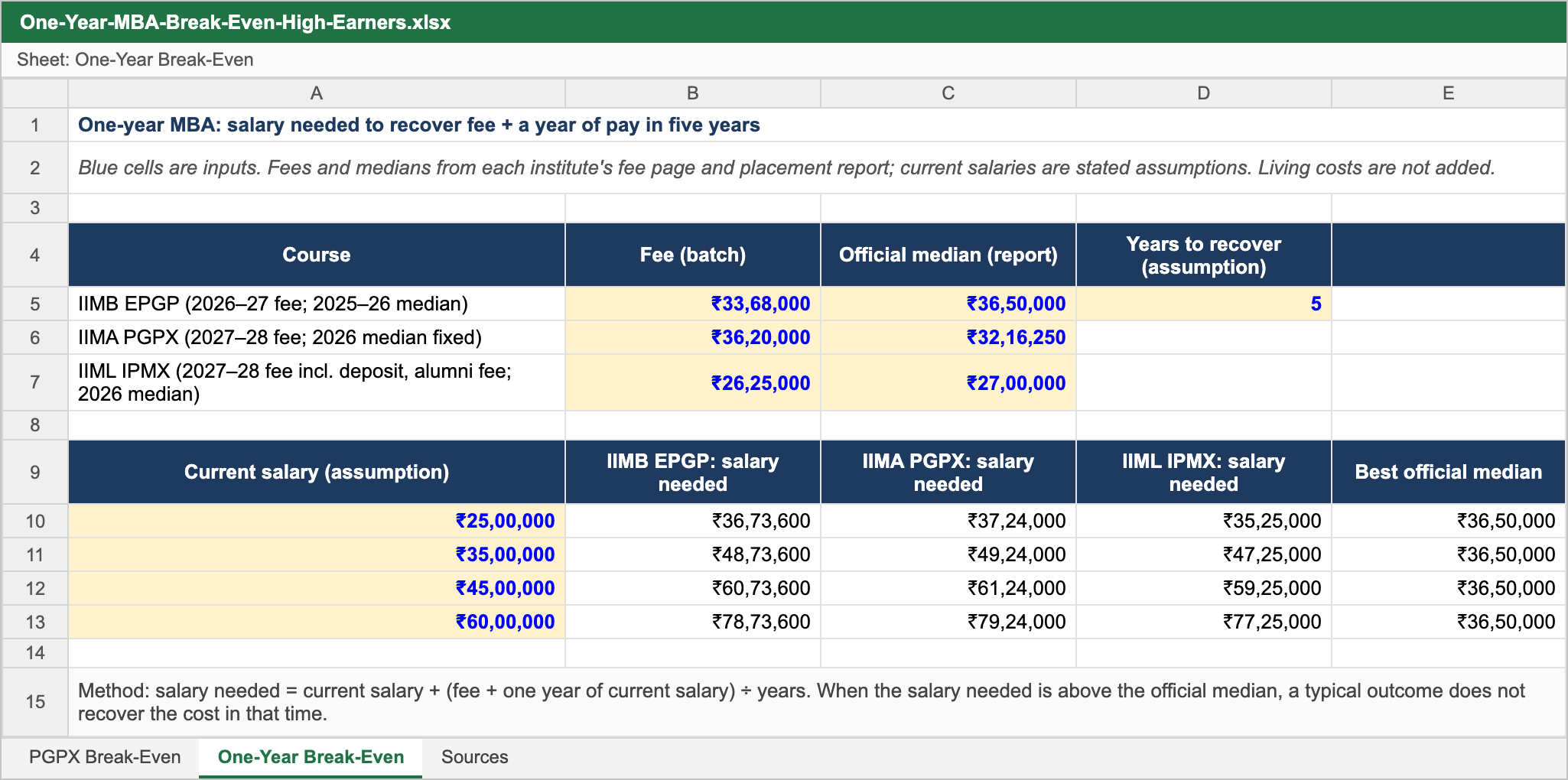
For a one-year full-time MBA, the tuition fee is only half the cost. Because you must leave your job for twelve months, your true outlay is the course fee plus living expenses plus one full year of forgone salary.
As the calculator sheet shows, an applicant earning ₹25 lakh a year who pays ₹36.2 lakh for IIMA PGPX or ₹33.68 lakh for IIMB EPGP invests roughly ₹58 lakh to ₹61 lakh in total (fee plus forgone pay). To recover that sum over five years, the candidate needs a post-MBA salary of about ₹36.7 lakh to ₹37.2 lakh—which sits right around the published median of both schools. By contrast, an applicant already earning ₹45 lakh a year would need a post-MBA salary above ₹61 lakh to break even in five years, which is well above the median package at all three institutes.
Placements Compared: CTC vs Fixed Cash in the 2026 Reports
When comparing placement numbers across the three schools, pay close attention to the reporting standard each institute uses. IIM Ahmedabad publishes its PGPX report under the Indian Placement Reporting Standards (IPRS), which separates guaranteed fixed yearly cash from variable bonuses and stock options. ISB and IIM Bangalore report total Cost to Company (CTC), which bundles fixed pay, joining bonus, variable bonus and first-year stock grants.
Metric (2026 / 2025–26 reports)
ISB PGP (Class of 2026)
IIMA PGPX (Finals 2026 IPRS)
IIMB EPGP (2025–26 report)
Reporting metric
Total CTC (press release)
IPRS Domestic Fixed Yearly Cash (and Maximum Earning Potential)
Total CTC
Graduates / placement seekers
808 graduates (1,117 total offers)
158 in batch; 134 accepted offers through campus
76 students; 69 sought placements, 69 placed
Median package
Not published
₹32.16 lakh fixed yearly cash (₹37.78 lakh maximum earning potential)
₹36.50 lakh CTC
Average package
₹37.29 lakh CTC
₹33.76 lakh fixed yearly cash
₹38.66 lakh CTC
Highest domestic package
₹1.56 crore CTC
₹70.52 lakh fixed yearly cash
₹78.20 lakh CTC
Top recruiting functions / sectors
Consulting, technology, BFSI; 69% changed function, 67% changed industry
Once IIMA PGPX’s maximum earning potential (median ₹37.78 lakh) is compared on a like-for-like basis with IIMB EPGP’s median CTC (₹36.50 lakh) and ISB PGP’s average CTC (₹37.29 lakh), the salary outcomes of the three schools are remarkably close. Your decision should therefore turn on your years of experience, whether you need a statutory MBA degree on paper, and which recruiter mix fits your target function.
The Desk’s take: Pick ISB PGP if you have 2 to 5 years of experience and want to pivot into management consulting or product management through India’s largest one-year placement process. Pick IIMB EPGP if you have 5 to 8 years of experience, want a 75-student cohort in Bengaluru and aim for consulting or IT product leadership. Pick IIMA PGPX if you have 6 to 12 years of experience, want the case-method classroom and need a statutory IIM MBA degree for senior general management or strategy roles.
ISB PGP vs IIMA PGPX vs IIMB EPGP FAQs
Why is IIMA PGPX’s reported median lower than IIMB EPGP’s median?
They measure different things. IIMA’s ₹32.16 lakh figure is domestic fixed yearly cash under the audited IPRS standard, excluding variable bonuses and ESOPs. When variable pay is included (Maximum Earning Potential), IIMA PGPX’s median is ₹37.78 lakh, slightly above IIMB EPGP’s ₹36.50 lakh median CTC.
Does ISB PGP award an MBA degree like IIMA PGPX and IIMB EPGP?
No. IIMA PGPX and IIMB EPGP award a statutory Master of Business Administration degree under the Indian Institutes of Management Act, 2017. ISB is not a university or an IIM, so the ISB PGP awards a Post Graduate Certificate in Management, backed by AACSB, EQUIS and AMBA accreditation.
Can I apply to all three with a GMAT Focus score?
Yes, all three schools accept GMAT Focus Edition and GRE scores taken at a test centre within the last five years. None of the three accepts online or at-home test scores.
Last updated: 10 November 2026
Keep reading
ISB PGP: full guide to fees, class profile and placements
Nishit Kumar completed the Executive Post Graduate Programme in Management (EPGP) at IIM Kozhikode in 2024, which he did while working full time. He writes about executive MBA, one-year MBA and IIM programmes for working professionals: fees, eligibility, admissions and outcomes, checked against official institute sources.
Among the three, IIMA PGPX fits 9 years of experience best, as its cohort averages 7 to 8 years and IIMB EPGP prefers candidates under 12 years. However, at ₹32 lakh current pay, your total outlay including forgone salary will approach ₹70 lakh, so weigh PGPX against keep-your-job options such as IIM Kozhikode EPGP or ISB PGP PRO.
Applicants often ask
I have 4.5 years of experience and a 675 GMAT Focus score. Should I pick ISB PGP or IIMA PGPX?
At 4.5 years you sit right at the average of ISB's PGP class and just above the 4-year minimum of IIMA PGPX (where the class average is 7–8 years). Apply to both: if you want product management or consulting with 1,100+ offers on campus, ISB PGP is slightly better aligned with your experience band; if you want a statutory IIM MBA degree and a smaller case-method classroom, choose IIMA PGPX.
Ask a question or share your experience Cancel reply








Questions & answers · 2
Real decisions are rarely one-size-fits-all. Ask a focused question; applicants, participants and alumni answer here.
I have 9 years of experience and earn ₹32 lakh. Which of the three courses fits me best?
Among the three, IIMA PGPX fits 9 years of experience best, as its cohort averages 7 to 8 years and IIMB EPGP prefers candidates under 12 years. However, at ₹32 lakh current pay, your total outlay including forgone salary will approach ₹70 lakh, so weigh PGPX against keep-your-job options such as IIM Kozhikode EPGP or ISB PGP PRO.
I have 4.5 years of experience and a 675 GMAT Focus score. Should I pick ISB PGP or IIMA PGPX?
At 4.5 years you sit right at the average of ISB's PGP class and just above the 4-year minimum of IIMA PGPX (where the class average is 7–8 years). Apply to both: if you want product management or consulting with 1,100+ offers on campus, ISB PGP is slightly better aligned with your experience band; if you want a statutory IIM MBA degree and a smaller case-method classroom, choose IIMA PGPX.