
ISB PGP (One-Year MBA): Fees, Eligibility, Class Profile and Placements
ISB's PGP is a one-year, full-time residential management course in Hyderabad or Mohali for people with at least two years of work experience. The fee for the Class of 2028 is ₹40,46,520 with shared housing, and the Class of 2026 received 1,117 offers at an average of ₹37.29 lakh. This guide covers the fee and scholarships, how ISB counts experience, the Class of 2027 profile, the admission rounds and how long the year takes to pay back at different salaries.
Key takeaways
- ISB's PGP costs ₹40,46,520 for the Class of 2028 with shared housing, and about ₹42.7 lakh once ISB's estimate of books, laptop and meals is added.
- The Class of 2027 has 839 students with an average of 4.10 years of experience; only 81 of them (9.7%) have six years or more.
- The Class of 2026 averaged ₹37.29 lakh across 1,117 offers, so the year pays back in about 31–44 months at a ₹15–20 lakh salary but not at ₹40 lakh.
The Post Graduate Programme in Management (PGP) of the Indian School of Business (ISB) is a one-year, full-time residential management course for people with at least two years of work experience. Students leave their jobs, live on the Hyderabad or Mohali campus for twelve months, and join a campus placement process at the end of the year.
The PGP is the course most people mean when they search for “ISB one year MBA”. This guide sets out the 2027–28 fee and what it pays for, the scholarships and loans on offer, how ISB counts work experience, what the Class of 2027 looks like, and what the Class of 2026 earned after placements. It also works out how long the year takes to pay back at different salaries.
ISB’s PGP is a 12-month residential course in Hyderabad or Mohali for applicants with 24 months of full-time work experience and a test-centre GMAT or GRE score. The fee for the Class of 2028 is ₹40,46,520 with shared housing. The Class of 2026 received 1,117 offers at an average salary of ₹37.29 lakh. ISB awards a certificate, not an MBA degree.
| ISB PGP verdict strip, Class of 2028 (fee year 2027–28) | |
|---|---|
| Award | “ISB PGP is neither a degree nor a diploma”; ISB calls it a certificate programme accredited by AACSB, AMBA and EQUIS |
| Format | 1-year full-time, residential at Hyderabad or Mohali. You leave your job. |
| Duration | 12 months, with no summer internship |
| Total fee | ₹40,46,520 with shared housing or ₹44,45,000 with a studio, including GST and a ₹20,000 deposit |
| Placement support | Yes, through ISB’s careers office, but ISB “does not guarantee placements” |
Source: ISB PGP FAQs and PGP fee structure for 2027-28, checked 3 November 2026
In the glossary used across this site, the PGP is a 1-year full-time MBA-type course, in the same group as IIM Ahmedabad’s PGPX and IIM Bangalore’s EPGP. It is not an executive MBA that you take while keeping your job. ISB’s keep-your-job options, PGP PRO and PGP MAX, are compared in the guide to ISB’s PGP, PGP PRO and PGP MAX, and the wider list of residential courses is in one-year MBAs in India.
ISB PGP at a Glance
| Item | Detail | Source |
|---|---|---|
| Full name | Post Graduate Programme in Management (PGP) | Official page |
| Next intake | Class of 2028 (fee year 2027–28) | Official page |
| Campuses | Hyderabad and Mohali; all students live on campus | Official page |
| Minimum experience | 24 months of full-time work, counted as of 31 March | Official page |
| Test | GMAT (10th Edition or Focus) or GRE, test-centre scores only, no minimum score | Official page |
| Selection | Two essays, one recommendation, a 30-minute interview with two on-the-spot essays | Official page |
| Class size | 839 students in the Class of 2027 (424 Hyderabad, 415 Mohali) | ISB press release |
| Average experience and age | 4.10 years (range 2–18); average age 26 | Class profile |
| Ranking cited by ISB | 12th in the Financial Times Global MBA Ranking 2026 | ISB press release |
Batch dates, the full fee schedule and the eligibility check for this course are on its course page. Apply now →
ISB PGP Fees 2027–28: What You Pay and When
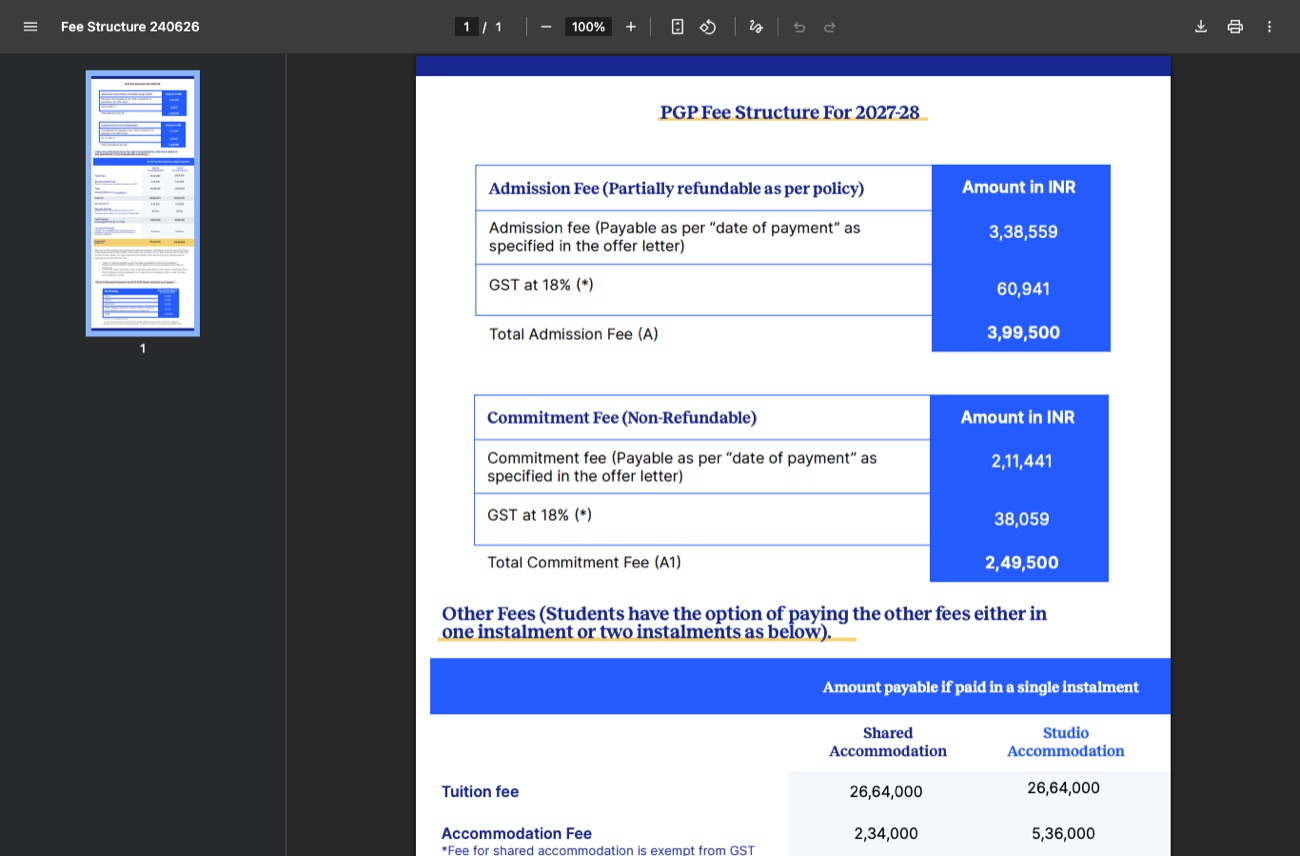
The ISB PGP costs ₹40,46,520 for the Class of 2028 if you choose shared accommodation, and ₹44,45,000 if you choose a studio apartment. Both totals include 18% GST and a refundable security deposit of ₹20,000, according to ISB’s fee structure for 2027-28.
| Payment | Shared accommodation | Studio apartment | When it is due |
|---|---|---|---|
| Admission fee with GST (partially refundable) | ₹3,99,500 | ₹3,99,500 | When you accept the offer |
| Commitment fee with GST (non-refundable) | ₹2,49,500 | ₹2,49,500 | Date in the offer letter |
| Tuition ₹26,64,000 + accommodation + GST + ₹20,000 deposit | ₹33,97,520 | ₹37,96,000 | One instalment, or two with 6% interest on the second |
| Total payable to ISB | ₹40,46,520 | ₹44,45,000 | Health insurance extra, at actuals |
| ISB estimate for books, laptop, meals and other costs | ₹2,25,000 | ₹2,25,000 | Indicative, over the year |
| Cash cost of the year | ₹42,71,520 | ₹46,70,000 | Before the salary you give up |
Source: ISB PGP fee structure for 2027-28, including “Other Estimated Expenses”, checked 3 November 2026
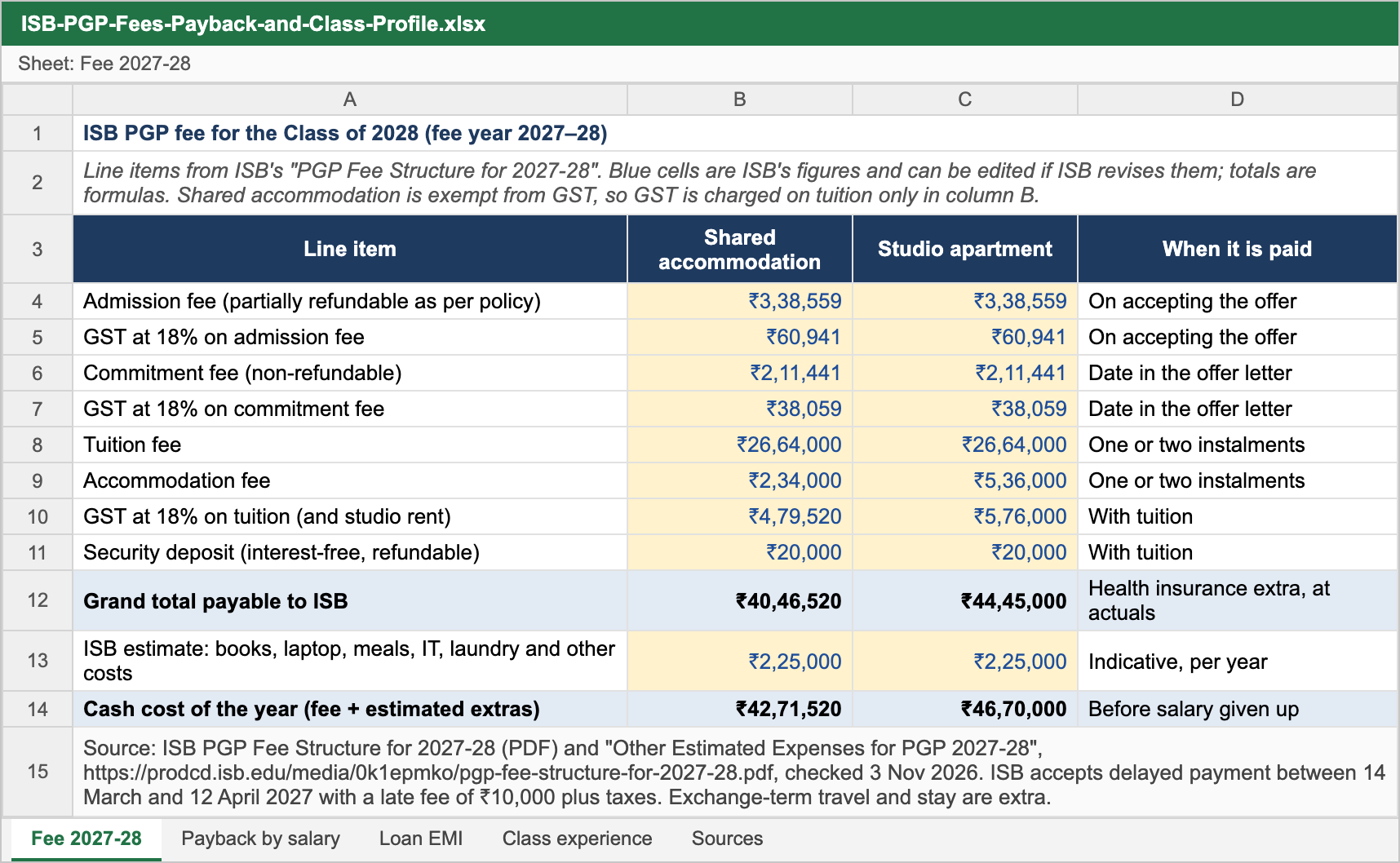
The first two payments matter most if you are waiting on another school. The admission fee of ₹3,99,500 is “partially refundable as per policy”, and the commitment fee of ₹2,49,500 is not refundable at all. ISB’s FAQ says it must receive your acceptance within 10 days of the offer, and the acceptance date cannot be extended.
Shared accommodation is exempt from GST, which is why the gap between the two housing options is larger than the difference in rent. Students on an exchange term pay their own visa, travel and stay, although no extra tuition goes to the partner school. ISB accepts late payment between 14 March and 12 April 2027 with a fee of ₹10,000 plus taxes. Fees at other schools are listed in executive MBA fees across India.
ISB PGP Scholarships and Education Loans
ISB says that about 25% of PGP students receive financial support each year. For the Class of 2027, ISB awarded scholarships worth over ₹12 crore to about 13% of the cohort, according to its press release welcoming the class. Most awards are tuition waivers announced in the admission offer.
| Waiver or scholarship | Who it is for | Share of tuition | How to apply |
|---|---|---|---|
| ISB Merit Waiver | All admitted applicants are considered | 25%–100% | No separate application |
| ISB Merit by Diversity Waiver | Applicants from diverse education or work backgrounds who are high on merit | 25%–100% | No separate application |
| ISB Need-based Waiver | Family income up to ₹8 lakh, including the applicant’s pre-ISB pay | 100% | Essay and proof of income |
| ISB Need-based Waiver | Family income above ₹8 lakh and up to ₹20 lakh | 75% | Essay and proof of income |
| Bridge to India Waiver | Indians working abroad who plan to return | 25% | Essay |
| Armed Forces Scholarship | Up to 6 veterans who left service in the previous two years | 50% | Separate application |
| Serving IAS Officers Scholarship | Up to 3 IAS officers with 2+ years of service who return to government | 100% | Separate application |
Source: ISB PGP fees and scholarships page, checked 3 November 2026. Donor-funded scholarships are listed separately on the same page.
Each applicant can receive only one tuition waiver, and ISB’s FAQ says waivers are given in every round, from 25% up to full tuition. Merit waivers weigh the test score, academics, quality of work experience and the interview together. A waiver is withdrawn if the student leaves the course before graduating.
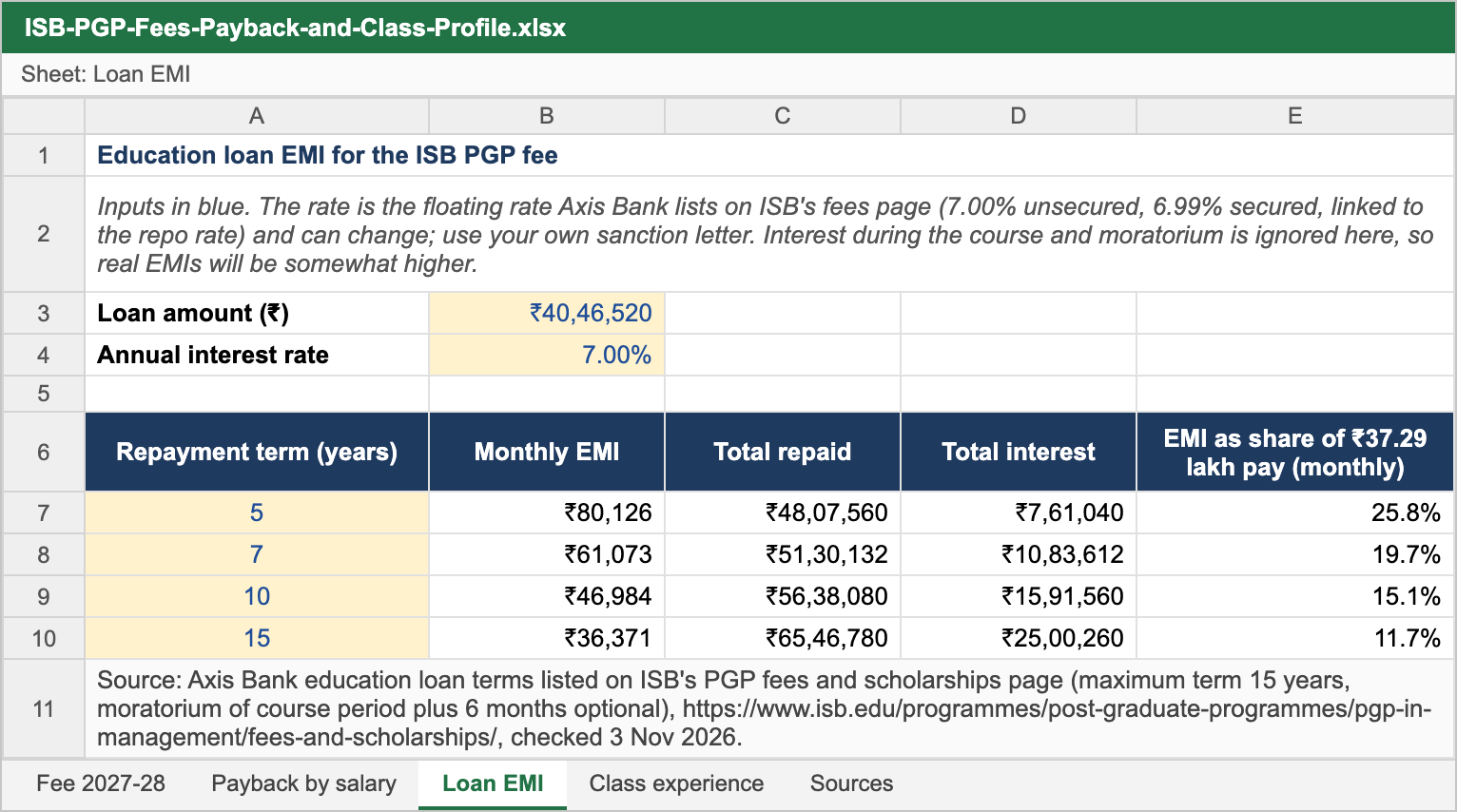
For loans, ISB’s fees page lists Axis Bank terms: a floating rate of 7.00% for unsecured loans and 6.99% for secured loans, linked to the repo rate. The bank lends up to 95% of the total cost, with a 100% option, no processing fee, a moratorium of the course period plus six optional months, and up to 15 years to repay. Your sanctioned rate may differ, so treat the figures below as a guide.
| Loan of ₹40,46,520 at 7.00% | Monthly EMI | Total interest | EMI as share of monthly pay at ₹37.29 lakh a year |
|---|---|---|---|
| 5 years | ₹80,126 | ₹7,61,040 | 25.8% |
| 7 years | ₹61,073 | ₹10,83,612 | 19.7% |
| 10 years | ₹46,984 | ₹15,91,560 | 15.1% |
| 15 years | ₹36,371 | ₹25,00,260 | 11.7% |
Calculated from the Axis Bank rate listed on ISB’s fees page; interest during the course and moratorium is not included, so actual EMIs will be higher
ISB’s FAQ says employer sponsorship is welcome and that sponsored applicants go through the same selection and pay the same fee. The rules on bonds and leave are covered in company-sponsored MBAs, and loan options at other schools are in executive MBA scholarships, loans and EMI.
ISB PGP Eligibility: How ISB Counts Your Work Experience
You need a bachelor’s degree in any discipline, at least 24 months of full-time work experience as of 31 March of the joining year, and a GMAT or GRE score taken at a test centre. ISB sets no minimum percentage or CGPA, and three-year degrees are accepted. TOEFL or IELTS is needed only by applicants whose undergraduate teaching was not in English.
| Your situation | What ISB says |
|---|---|
| Part-time jobs or internships | “Part-time work experience will not be considered.” |
| CA articleship | Adds to your exposure but “will not be considered as work experience for admission”. |
| Armed forces service | Counted, and judged by the responsibilities you held. |
| Family business | Counted if it was full-time and backed by documents; recommendations from relatives are not accepted. |
| Under 24 months of experience | Apply to PGP YL instead; the old deferred routes (YLP and EEO) have been discontinued. |
| Already hold an MBA | No bar, but you must explain clearly why you want the PGP. |
| Online or home GMAT/GRE score | Not accepted since the April 2025 intake; the score must be under five years old on the round deadline. |
Source: ISB PGP FAQs and application deadlines page, checked 3 November 2026
The 31 March date is the one applicants most often get wrong. Experience gained between 31 March and the start of classes does not count towards the 24 months. Applicants close to the line should write to the admissions office before paying the application fee. Age and experience rules at other schools are compared in age limits and work experience for IIMs and ISB.
ISB PGP Class Profile: Who Sits in the Class of 2027
The Class of 2027 has 839 students, with an average age of 26 and an average of 4.10 years of work experience. Women make up 46% of the class (389 students). The age range is 21 to 42, and the experience range is 2 to 18 years, according to ISB’s class profile.
| Years of work experience | Students | Share of class | Cumulative share |
|---|---|---|---|
| 2 to 4 | 485 | 57.8% | 57.8% |
| 4 to 6 | 273 | 32.5% | 90.3% |
| 6 to 8 | 57 | 6.8% | 97.1% |
| 8 and above | 24 | 2.9% | 100% |
| Total | 839 | 100% |
Source: ISB PGP class profile, Class of 2027; shares calculated from ISB’s student counts
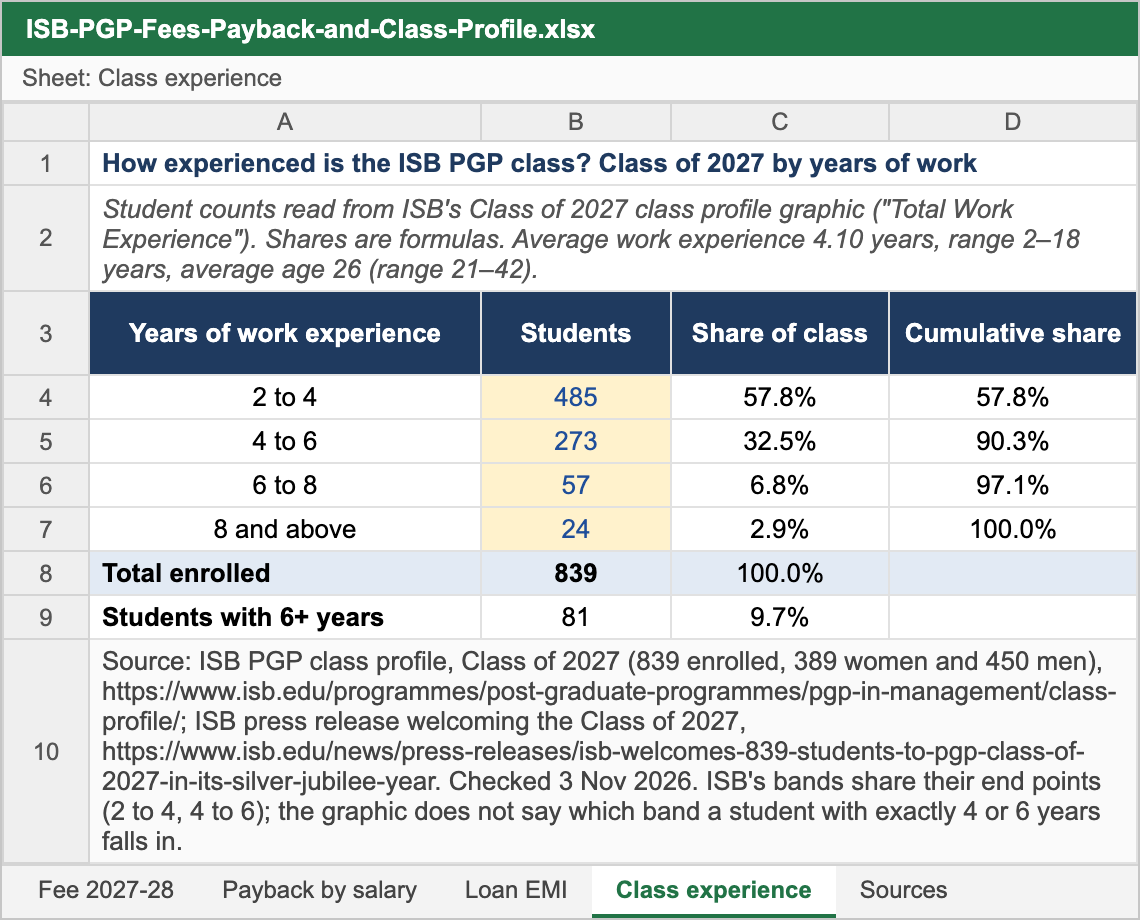
Only 81 of the 839 students, or 9.7%, have six or more years of experience. An applicant with seven or eight years will therefore sit in a class where most people are three or four years behind in their careers. The same applicant would be close to the average at IIM Ahmedabad’s PGPX, whose 2026–27 cohort averages 7–8 years, as set out in ISB PGP vs IIMA PGPX vs IIMB EPGP.
| Class of 2027 figure | GMAT (classic) | GMAT Focus | GRE |
|---|---|---|---|
| Average | 720 | 672 | 325 |
| Median | 723 | 675 | 325 |
| Range | 640–780 | 575–795 | 309–337 |
Source: ISB PGP class profile, Class of 2027
ISB states that “there is no specific minimum score required” for the GMAT or GRE, and it does not prefer one test over the other. The class is spread across industries: IT-enabled services, professional services and R&D make up 38%, banking, financial services and insurance 21%, and government, defence and public-sector employers 3%. How the averages compare with the IIMs is in the guide to the GMAT score for ISB and IIM one-year MBAs.
Is ISB Right for You With 7 or More Years of Experience?
ISB accepts applicants with long careers, since the Class of 2027 includes people with up to 18 years of work. However, fewer than one student in ten has six or more years. Applicants in this band should check whether the roles offered on campus suit their seniority before they apply.
Three alternatives are worth comparing. IIM Ahmedabad’s PGPX asks for four years and has an average age of 31. IIM Bangalore’s EPGP asks for five years and prefers fewer than twelve. If you would rather keep your job, ISB’s own PGP PRO asks for five years and runs on alternate weekends.
The choice between these courses for mid-career applicants is set out in executive MBAs for mid-career managers. The difference between leaving your job and studying alongside it is explained in executive MBA vs one-year MBA.
ISB PGP Admission Process, Deadlines and Interview
ISB admits the Class of 2028 in three rounds, and its FAQ says the round you choose has no material effect on your chances. Applying early gives you more time to arrange a loan, serve notice and move. Each applicant can apply only once in an admission year, and late applications roll into the next round.
| Round | Application deadline | Interviews (tentative) | Final decision |
|---|---|---|---|
| Round 1 | 20 September 2026 (closed) | Week 2 of October to week 2 of December 2026 | End of December 2026 |
| Round 2 | 6 December 2026 | Week 4 of December 2026 to week 1 of February 2027 | Mid-February 2027 |
| Round 3 (final) | 17 January 2027 | Week 1 to week 4 of February 2027 | Mid-March 2027 |
Source: ISB PGP application deadlines, Class of 2028, checked 3 November 2026
The selection runs in seven stages, set out on ISB’s eligibility and requirements page:
- Application: you submit two 400-word essays on leadership and on your approach to learning, an optional 250-word essay, one online recommendation and your documents.
- Verification: ISB checks your documents within 20 days, and you get three days to fix any gap or mismatch.
- Shortlist: academics, test score, work experience, essays, awards and the recommendation are scored together into one profile score.
- Interview: a panel of faculty, alumni and senior staff interviews you for about 30 minutes, on Zoom or in person in a large city, and you write two on-the-spot essays.
- Admissions committee: faculty and alumni decide the final offers after reading the interview feedback.
- Decision: results arrive by email on the dates for your round.
- Scholarship: some admitted applicants are invited to a separate scholarship interview.
There is no group discussion, and ISB says it calls no fixed share of applicants to interview. Reapplicants make up 20–25% of the applicant pool each year, pay a reduced application fee and write a reapplicant essay. Deadlines across schools can be tracked in the free application tracker, and test planning is covered in preparing for the GMAT Focus while working.
ISB PGP Placements: Average Salary, Offers and Recruiters
The PGP Class of 2026 received 1,117 job offers, and the average salary was ₹37.29 lakh a year, according to ISB’s press release on the graduation of the class. ISB says the average was about 11% higher than the previous cohort’s and 156% higher than the class’s average pay before ISB.
| PGP Class of 2026 | Figure |
|---|---|
| Graduates | 808 |
| Job offers | 1,117 |
| Average salary | ₹37.29 lakh a year |
| Highest offer | ₹1.56 crore a year |
| International offers | 30 (26 in 2025) |
| First-time recruiters | 25 |
| Moved to a new industry / new function | 67% / 69% |
| Median salary, students placed, salary by experience | Not published |
Source: ISB press release, PGP Class of 2026, April 2026
Three limits apply to these figures. ISB counts offers, not students placed, so the 1,117 offers cannot be read as 1,117 jobs for 808 people. ISB gives an average rather than a median, and a few very high offers raise an average more than a median. ISB also does not split the salary by years of experience, which matters for applicants far from the class average of 4.10 years.
A separate figure follows from ISB’s own numbers. If the average after ISB was 156% above the average before, the class’s average pre-ISB pay was close to ₹14.6 lakh a year. Applicants who already earn well above that should read the payback table below carefully.
Consulting, technology and banking led hiring. Accenture made over 100 offers, and Mastercard and EY GDS each made more than 40. McKinsey, BCG, Bain and Deloitte recruited for consulting, and Amazon, Google, Razorpay and Uber for technology. ISB’s FAQ adds that “ISB does not guarantee placements”, and that placements run from November or December to the end of March. More detail is in ISB PGP placements and salary, and outcomes across schools are in one-year MBA placements.
ISB’s career impact page shows a second set of figures, 1,208 offers from 405 companies for 816 enrolled students, but it does not name the class year. Because the year is not stated, the 2026 press release figures are used on this page.
Is ISB PGP Worth It at Your Current Salary?
The ISB year pays back in about three to four years for applicants earning ₹15–20 lakh, but takes ten years at ₹30 lakh and does not pay back at ₹40 lakh if you land the class average. The table adds the cash cost of ₹42,71,520 to a year of salary given up. It then divides the total by the monthly gain at ISB’s ₹37.29 lakh average.
| Current salary (assumption) | Fee as months of pay | Total cost of the year | Yearly gain at ₹37.29 lakh | Payback | 5-year gain |
|---|---|---|---|---|---|
| ₹15 lakh | 32.4 | ₹57,71,520 | ₹22,29,000 | 31 months | ₹53,73,480 |
| ₹20 lakh | 24.3 | ₹62,71,520 | ₹17,29,000 | 44 months | ₹23,73,480 |
| ₹25 lakh | 19.4 | ₹67,71,520 | ₹12,29,000 | 66 months | −₹6,26,520 |
| ₹30 lakh | 16.2 | ₹72,71,520 | ₹7,29,000 | 120 months | −₹36,26,520 |
| ₹40 lakh | 12.1 | ₹82,71,520 | −₹2,71,000 | No payback | −₹96,26,520 |
Current salaries are stated assumptions; the post-ISB figure is ISB’s Class of 2026 average. Loan interest, tax and the raises you would have earned by staying are not included.
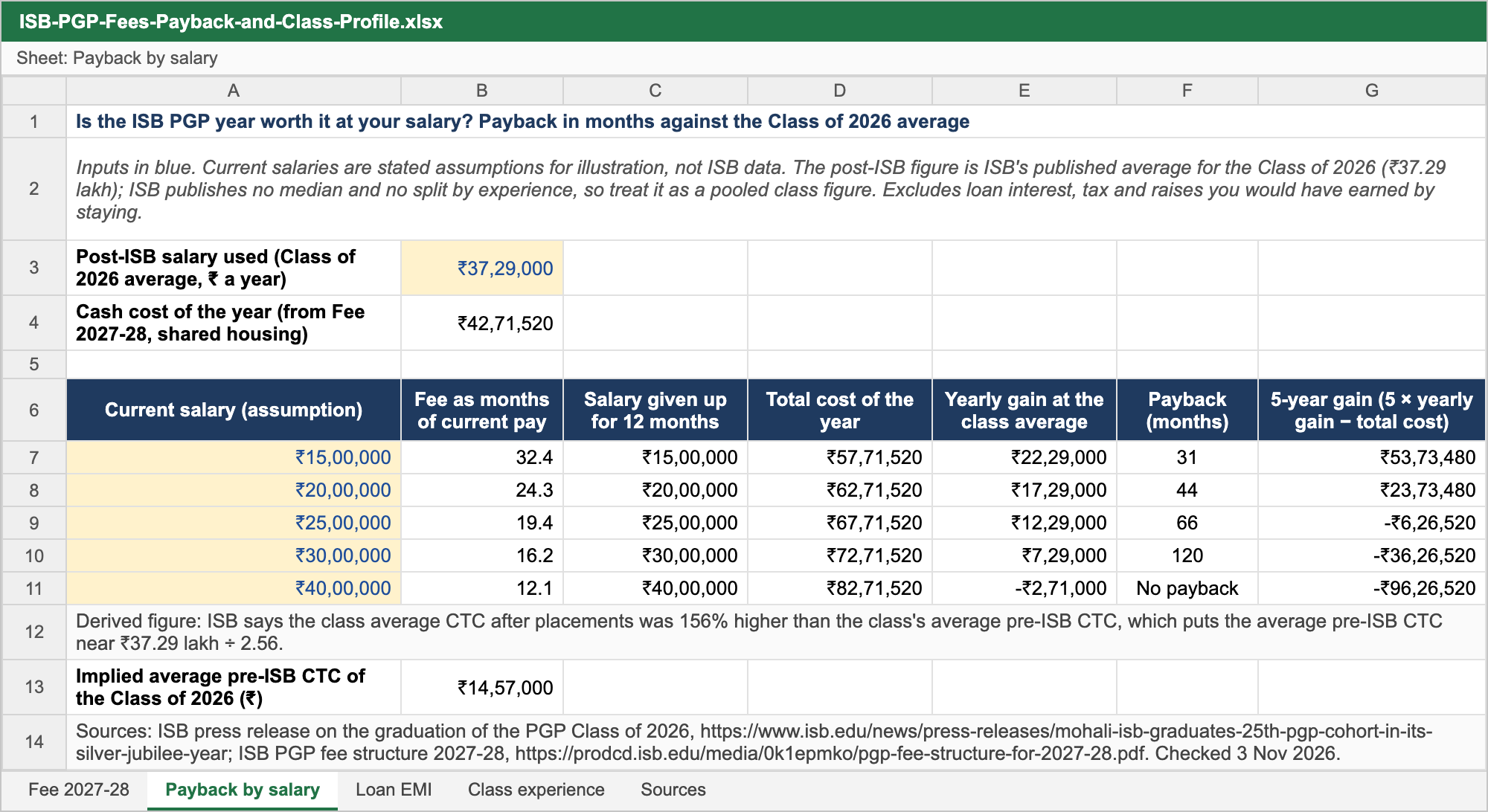
The numbers favour applicants who earn close to the class’s pre-ISB average and who want to change industry or function. At higher salaries, the case rests on a switch that would be hard to make without the course, such as a move into consulting or a general management track. A salary rise alone does not justify the year at ₹30 lakh or above.
You can enter your own salary, fee waiver and expected pay in the workbook above or in the executive MBA ROI calculator. The broader question of whether any MBA suits a working professional is covered in is an executive MBA worth it.
Does ISB Give an MBA Degree?
No. ISB’s FAQ says “only universities can award a degree in India” and that the “ISB PGP is neither a degree nor a diploma”. It describes the PGP as “a certificate programme for students with experience”, for which ISB has not sought AICTE or UGC recognition. ISB points instead to its international accreditation by AACSB, AMBA and EQUIS.
The award type rarely matters for private-sector hiring, but it can matter for a government job, a PhD admission or an overseas credential check that asks for a master’s degree by name. The one-year courses at IIM Ahmedabad and IIM Bangalore award an MBA degree under the IIM Act, 2017. How each award is treated is explained in executive MBA vs PGDM.
Who ISB PGP Suits and Who Should Look Elsewhere
The PGP suits applicants with two to six years of experience who want to change industry or function and can live without a salary for a year. Nine in ten members of the Class of 2027 fall in that band, and the placement process is built around them.
Who the ISB PGP is not for
- People who cannot leave their job. The course is fully residential, so ISB’s PGP PRO, the IIM blended MBAs and the IIM online and blended MBAs are the options to compare.
- Applicants who need an MBA degree on paper. ISB awards a certificate, so a government rule or a foreign evaluation that asks for a degree may not accept it.
- Senior applicants with eight or more years. Only 24 students in the Class of 2027 had eight years or more, and the IIM one-year courses have older classes.
- High earners who want only a pay rise. At ₹30 lakh or more, the year takes a decade or longer to recover at the class average.
- Applicants without a test-centre GMAT or GRE score. ISB does not waive the test or accept home-based scores.
The Desk’s take: Apply to ISB’s PGP if you have two to six years of experience, earn around ₹15–20 lakh, and want a change of industry or function that needs a campus placement process. The class is large, the recruiter list is long, and ISB’s own figures show most graduates moving to a new industry. Look harder at the IIM one-year courses if you have seven or more years, and at keep-your-job courses if you earn ₹30 lakh or more. The point applicants overlook most often is the money paid at the offer: ₹6,49,000 of it is due early and is largely non-refundable, so settle your other applications first.
Batch dates, the full fee schedule and the eligibility check for this course are on its course page. Apply now →
FAQs
What is the ISB one-year MBA fee for 2027–28?
The total is ₹40,46,520 with shared accommodation and ₹44,45,000 with a studio apartment, including GST and a ₹20,000 refundable deposit. ISB estimates another ₹2,25,000 for books, a laptop, meals and other costs. Health insurance is charged at actuals.
What GMAT score do I need for ISB?
ISB sets no minimum GMAT or GRE score. The Class of 2027 averaged 720 on the classic GMAT, 672 on GMAT Focus and 325 on the GRE. Only test-centre scores taken within five years of the round deadline are accepted.
Can I get into ISB with less than two years of experience?
No, the PGP needs 24 months of full-time experience as of 31 March of the joining year. Applicants with less experience, or final-year students, can apply to ISB’s PGP YL instead.
Is the ISB PGP valid for government jobs?
ISB says the PGP is neither a degree nor a diploma and has not sought AICTE or UGC recognition. A government post that requires a recognised master’s degree may therefore not accept it. Check the recruitment rule before you rely on it.
What is the average package at ISB?
The Class of 2026 averaged ₹37.29 lakh a year across 1,117 offers, and the highest offer was ₹1.56 crore. ISB does not publish a median salary or the share of students placed.
Is ISB Hyderabad different from ISB Mohali?
Both campuses run the same PGP, and the Class of 2027 is split almost evenly, with 424 students in Hyderabad and 415 in Mohali. The fee, eligibility and award are the same on both campuses.
Last updated: 3 November 2026






Questions & answers · 5
Real decisions are rarely one-size-fits-all. Ask a focused question; applicants, participants and alumni answer here.
Do I need a high GMAT score for an ISB scholarship?
ISB considers every admitted applicant for merit waivers of 25% to 100% of tuition, and it weighs the test score together with academics, work quality and the interview. Need-based waivers depend on family income instead: 100% up to ₹8 lakh and 75% between ₹8 lakh and ₹20 lakh.
How much do I lose if I accept an ISB offer and then join another school?
On accepting, you pay an admission fee of ₹3,99,500 including GST, which ISB calls partially refundable as per its policy. The commitment fee of ₹2,49,500 is non-refundable. Ask ISB for the written refund schedule before you pay if you are waiting on another result.
Does CA articleship count as work experience for ISB?
No. ISB's FAQ says articleship adds to your exposure but will not be considered as work experience for admission. Only full-time work after articleship counts towards the 24 months.
I will have 21 months of experience by 31 March but 24 months by the time classes start. Can I apply to the PGP?
ISB counts 24 months of full-time experience as of 31 March of the joining year, so experience gained after that date does not count. Applicants below the line should look at ISB's PGP YL or apply in the following year. Write to ISB admissions for a written answer if your dates are close.
I earn about ₹30 lakh with seven years in IT. Is the ISB PGP still worth it?
At ₹30 lakh, the fee plus a year's salary comes to about ₹72.7 lakh, and at ISB's Class of 2026 average of ₹37.29 lakh the year takes around ten years to pay back. Only 9.7% of the Class of 2027 had six or more years of experience. The PGP makes sense at this level only for a clear switch of industry or function; otherwise compare IIMA PGPX, IIMB EPGP or a keep-your-job course.