
MBA in India or Abroad for Working Professionals: Cost, Outcomes and How to Choose
An MBA in India or abroad is a choice between one-year courses such as the ISB PGP, IIMA PGPX and IIMB EPGP and foreign MBAs such as INSEAD, LBS, Oxford, Cambridge and Harvard. This guide puts the total cost of eight schools in rupees, from about ₹59 lakh to ₹2.9 crore including lost salary, next to the pay each school reports. It also explains the UK, US and French work-visa rules and which route fits a career in India.
Key takeaways
- Including a year of ₹25 lakh salary, ISB and the IIM one-year MBAs cost about ₹59–65 lakh, against ₹1.6–2.9 crore for INSEAD, the UK schools and Harvard.
- Every school compared costs about 1.6 to 1.9 years of its own reported headline pay, but foreign pay is earned mostly by graduates who stay abroad: only 2% of LBS's Class of 2025 took jobs in South Asia.
- The UK Graduate visa falls from 2 years to 18 months for applications from 1 January 2027, and a US MBA gives 36 months of work rights only if it is STEM-designated.
An MBA in India or abroad is the choice many working professionals face once they have four to eight years of experience and want a full-time management degree. In India the main options are one-year courses such as the ISB PGP, IIM Ahmedabad’s MBA-PGPX and IIM Bangalore’s EPGP; abroad they include INSEAD, London Business School, Cambridge, Oxford and two-year US MBAs such as Harvard. This guide compares the total cost in rupees, the pay each school reports, the work-visa rules and how each route fits a return to India.
Should you do an MBA in India or abroad? Choose India if you plan to build your career in India: ISB and the IIM one-year courses cost about ₹59–65 lakh including a year of ₹25 lakh salary, against ₹1.6–2.9 crore for INSEAD, the UK schools and Harvard. Choose abroad only if you want to work outside India and can fund the loan, because the higher foreign salaries are earned mostly by graduates who stay abroad.
| Question | Short answer from official data |
|---|---|
| Total cost, India | ₹58.7 lakh (IIMB EPGP) to ₹65.5 lakh (ISB PGP), including 12 months of a ₹25 lakh salary given up |
| Total cost, abroad | ₹1.61 crore (Cambridge) to ₹2.91 crore (Harvard, two years), on the same basis |
| Reported pay | ₹32.2 lakh median (IIMA PGPX, 2026) and ₹36.5 lakh median (IIMB EPGP) against €1,00,000 median at INSEAD (about ₹1.06 crore) |
| Cost against pay | Every school in this guide costs about 1.6 to 1.9 years of its own headline pay |
| Work rights abroad | UK: 2 years if the Graduate visa is applied for by 31 December 2026, then 18 months; US: 12 months plus 24 more for STEM-listed degrees |
Batch dates, the full fee schedule and the eligibility check for this course are on its course page. Apply now →
MBA in India or Abroad: The Short Answer
The right choice depends mainly on where you want to work after the degree, because salaries and loan sizes follow geography. A professional who wants to stay in India gets a similar ratio of cost to pay from ISB or an IIM at roughly a third of the rupee cost. A professional who wants a job in London, Paris, Singapore or the US gets far more from a school in that market.
The comparison in this guide uses one rule for every school: the published fee, the school’s own living-cost estimate where it gives one, and the salary you give up while studying. Pay figures come only from each school’s own employment or placement report. A wider view of the Indian one-year courses is in One-Year MBA in India: Programmes, Fees, Eligibility and How to Choose.
What an MBA Abroad Costs Compared With ISB and the IIMs
An MBA abroad costs about two and a half to four and a half times as much as an Indian one-year MBA once living costs and lost salary are added. The gap comes mostly from the fee itself: INSEAD’s tuition alone is ₹1.17 crore at the current exchange rate, which is three times the ISB PGP fee.
| School and course (intake) | Months away from work | Fee | Living cost used | Fee + living ₹ | Total cost ₹ (₹25 lakh salary) |
|---|---|---|---|---|---|
| ISB PGP (2027–28) | 12 | ₹40,46,520 | Shared housing included; meals extra | ₹40,46,520 | ₹65,46,520 |
| IIMA MBA-PGPX (2027–28) | 12 | ₹36,20,000 | Single room included; meals extra | ₹36,20,000 | ₹61,20,000 |
| IIMB EPGP (2026–27) | 12 | ₹33,68,000 | Extras not costed | ₹33,68,000 | ₹58,68,000 |
| INSEAD MBA, Fontainebleau (Aug 2026 / Jan 2027) | 10 | €1,09,860 | €30,000 (INSEAD estimate) | ₹1,48,44,712 | ₹1,69,28,046 |
| Cambridge Judge MBA (Sept 2027) | 12 | £86,250 | £20,700 (Cambridge estimate) | ₹1,36,05,174 | ₹1,61,05,174 |
| Oxford Saïd MBA (2027–28) | 12 | £94,120 | £14,052 (visa rate × 12) | ₹1,37,60,625 | ₹1,62,60,625 |
| London Business School MBA (2026 intake) | 15 | £1,23,950 | £22,935 (visa rate × 15) | ₹1,86,85,329 | ₹2,18,10,329 |
| Harvard Business School MBA (two years) | 21 | $1,69,520 | $91,116 (HBS budget × 2) | ₹2,47,24,087 | ₹2,90,99,087 |
Source: ISB PGP fees, IIMA PGPX fee structure, IIMB EPGP fees, INSEAD financing, Cambridge Judge fees and funding, Oxford MBA, LBS MBA fees, HBS cost of attendance 2026–27, UK Student visa money rules. Rupee values at FBIL reference rates of 3 November 2026 (₹106.14 per euro, ₹127.21 per pound, ₹94.86 per dollar).
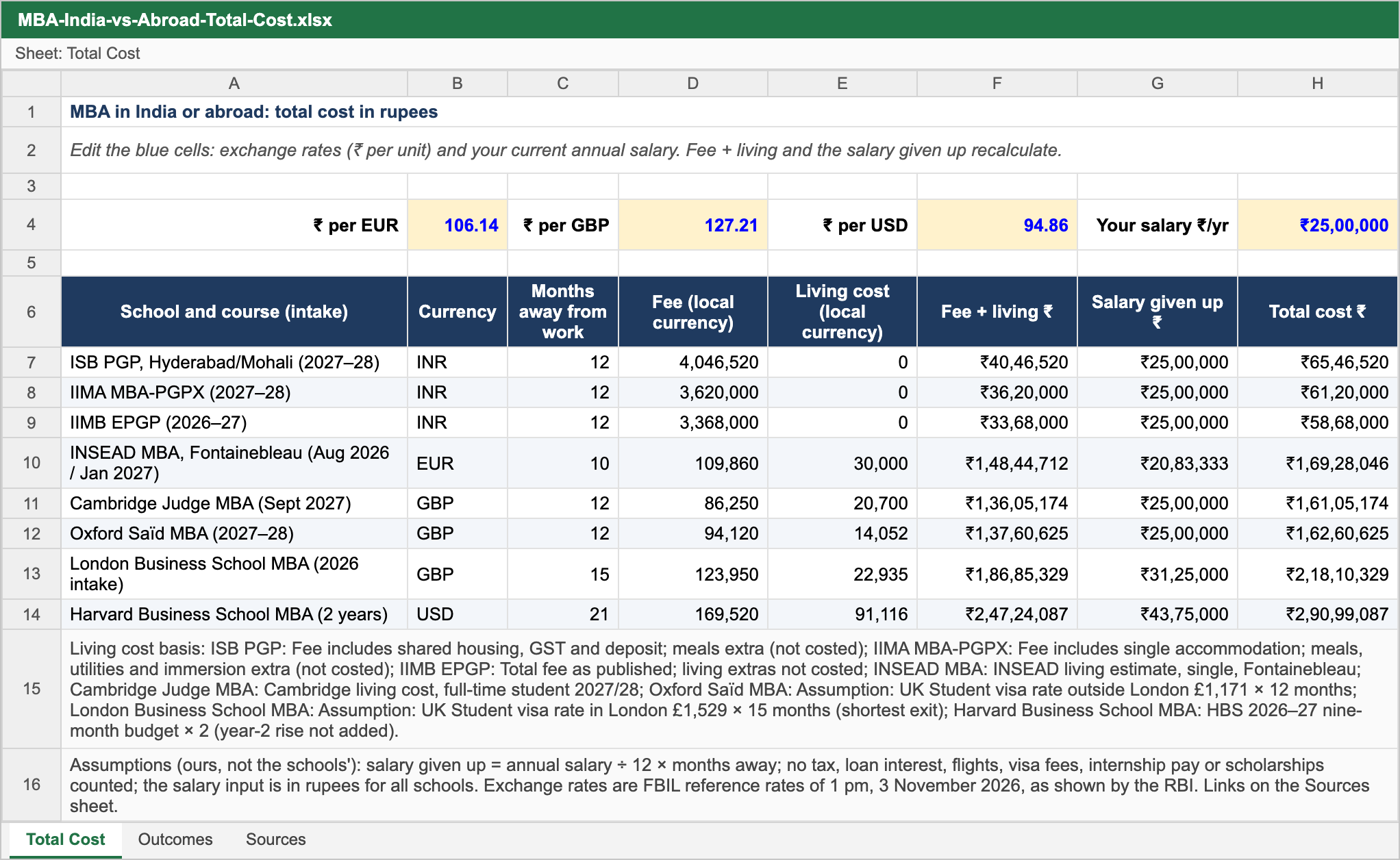
Two of the living-cost figures are assumptions, and they are marked as such. Oxford and LBS do not give a living budget on their fee pages, so the table uses the UK Student visa maintenance rate, which is £1,171 a month outside London and £1,529 a month in London. That rate is the minimum a visa applicant must show, so the real cost of living is likely to be higher.
The Harvard figure doubles the HBS budget for 2026–27, in which tuition is $84,760 and the single-student nine-month total is $130,318. The second year will probably cost more, and the summer internship between the two years usually pays a salary that is left out of these totals. The Indian fees also leave out meals at ISB and IIMA, so the Indian totals are slightly low.
The salary given up matters more for Indian courses than for foreign ones. At ₹25 lakh a year it adds about 40% to the ISB or IIM cost, but only 10–15% to the cost of a school abroad. You can enter your own salary and today’s exchange rates in the workbook, which is also listed among the Free Executive MBA Tools: ROI Calculator and Application Tracker. Fee details for Indian courses are compared in Executive MBA Fees in India: IIM and Top B-School Fees Compared.
What Graduates Earn After ISB, the IIMs, INSEAD and LBS
Graduates of the foreign schools report base pay about three times higher than IIM graduates, but the cost is about three times higher as well. Measured against its own headline pay, every school in this guide costs between 1.6 and 1.9 years of salary, so no route is a clear bargain on this ratio alone.
| School and course | Report (class) | Headline base pay | Measure | In ₹ lakh | Offers | Total cost ÷ pay (years) |
|---|---|---|---|---|---|---|
| ISB PGP | Class of 2026 | Not published by ISB | Median | Not published | Not published | Not published |
| IIMA MBA-PGPX | Finals 2026 (audited, IPRS) | ₹32,16,000 | Median | 32.2 | 134 of 139 seekers placed | 1.9 |
| IIMB EPGP | 2025–26 | ₹36,50,000 | Median | 36.5 | Not published | 1.6 |
| INSEAD MBA | Class of 2025 | €1,00,000 | Median | 106.1 | 81% had an offer at 3 months | 1.6 |
| Cambridge Judge MBA | Class of 2024/25 | £71,216 | Mean | 90.6 | 82% had a full-time offer at 4 months | 1.8 |
| Oxford Saïd MBA | Class of 2024/25 | £81,466 | Mean | 103.6 | 75% of seekers had an offer at 90 days | 1.6 |
| London Business School MBA | Class of 2025 | £91,928 | Mean | 116.9 | 88% had an offer at 3 months | 1.9 |
| Harvard Business School MBA | Class of 2025 | $1,84,500 | Median | 175.0 | Not used here | 1.7 |
Source: IIMA PGPX Finals 2026 IPRS report, IIMB Placement Report 2026, INSEAD employment statistics 2025, Cambridge MBA employment report, Oxford MBA employment report 2024/25, LBS MBA employment report 2025, HBS employment data. Total cost uses a ₹25 lakh salary.
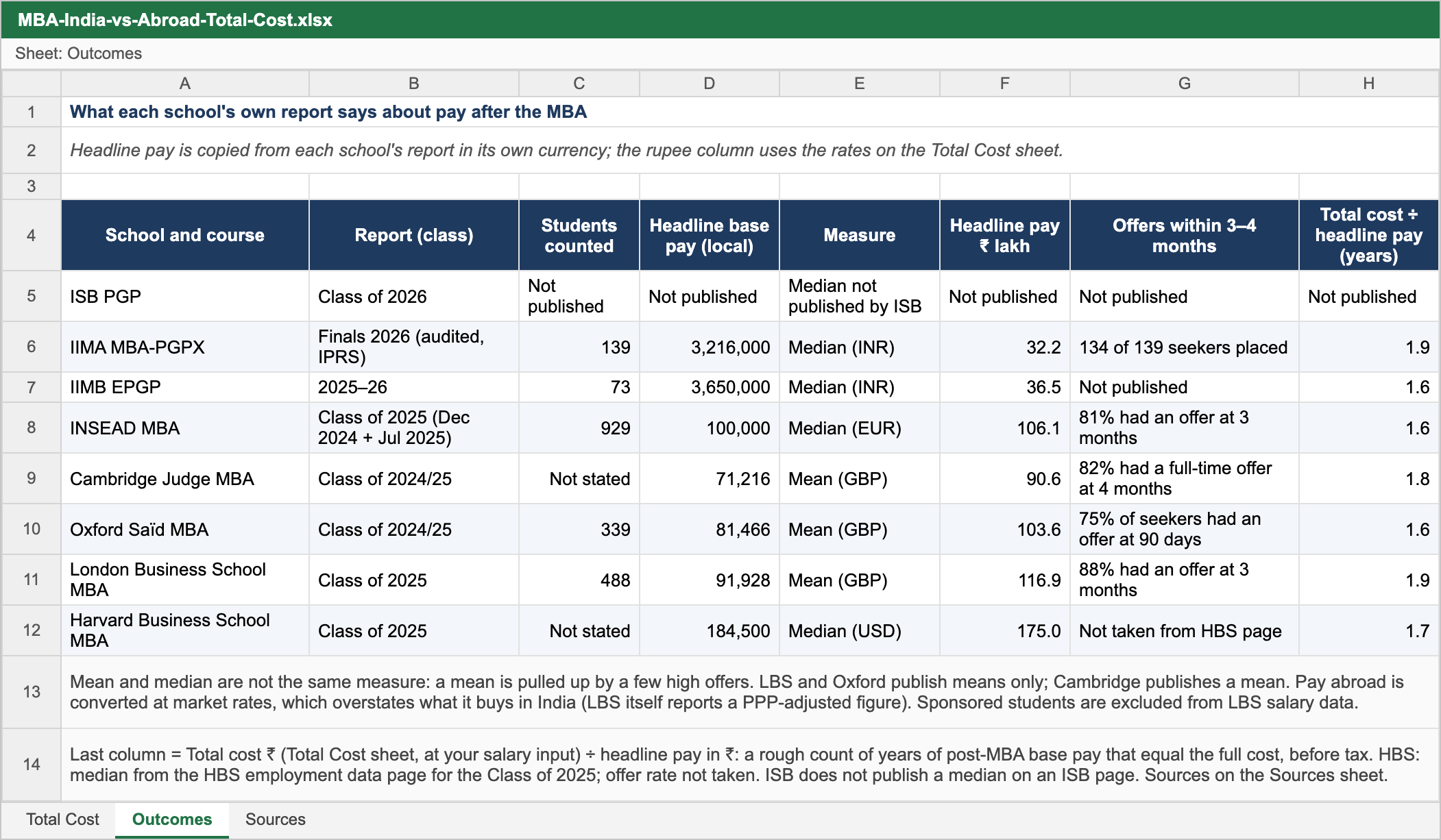
The figures are not measured in the same way, so they should be read with care. IIMA, IIMB, INSEAD and Harvard publish a median, while LBS, Oxford and Cambridge publish a mean, which a few large offers can pull up. IIMA’s PGPX report is audited under the Indian Placement Reporting Standards (IPRS), and its median counts fixed yearly cash only.
Converting a London or Paris salary into rupees at market rates also overstates what it buys in India. LBS recognises this in its own report, which adds a figure adjusted for purchasing power. The rupee column is useful for repaying a foreign-currency loan, but not for comparing living standards.
ISB publishes offer counts and an average through the press, but it does not give a median on an ISB page, so the table leaves its figure blank. The ISB placement picture is set out in ISB PGP (One-Year MBA): Fees, Eligibility, Class Profile and Placements, and the IIMA report is explained in IIM Ahmedabad PGPX (One-Year MBA) Placements and Salary.

ISB vs INSEAD: Which Helps More If You Want to Work in India?
ISB or an IIM helps more if you are sure you want to work in India, because the foreign schools send only a small share of graduates to Indian jobs. London Business School’s Class of 2025 shows this clearly: 16% of the class came from South Asia, but only 2% of graduates took jobs in South Asia.
The same LBS report shows how pay depends on where graduates work. The mean base salary was £1,43,262 for jobs in North America and £88,516 in the UK, but £68,417 for jobs in Asia. A graduate who returns to India therefore does not earn the headline average, while still repaying a loan of more than ₹1.5 crore.
INSEAD’s 2025 statistics place 23% of graduates in Asia Pacific and 18% in Africa and the Middle East, but the school does not list India separately. INSEAD and LBS graduates do work in India, and both reports name India among their job locations. The point for applicants is that the reported salaries mostly describe jobs in Europe, the US and the Gulf.
The Indian schools work the other way round. Their placement processes are built around employers hiring in India, and the IIM one-year courses report what those employers pay. For a career in India, the difference in cost of roughly ₹1 crore or more is hard to recover from any salary difference that the reports show. Test requirements for the Indian route are covered in GMAT Score for ISB and IIM One-Year MBA: Averages, Ranges and Cut-Offs.
Can You Stay and Work Abroad After the MBA?
Yes, but only for a fixed period and under each country’s rules, which have been tightening. The UK Graduate visa, the US practical-training rules and France’s job-search permit each give a limited window to find work, after which a regular work visa is needed.
| Country | Post-study route | How long | Main conditions | Source |
|---|---|---|---|---|
| United Kingdom | Graduate visa | 2 years if applied for on or before 31 December 2026; 18 months if applied for on or after 1 January 2027 | £937 application fee and a healthcare surcharge of usually £1,035 a year | GOV.UK Graduate visa |
| United States | Post-completion OPT, then STEM OPT extension | 12 months, plus a 24-month extension | The extension needs a degree on the DHS STEM Designated Degree Program List; not every MBA is on it | USCIS STEM OPT |
| France | Carte de séjour recherche d’emploi / création d’entreprise | 1 year, not renewable | Diploma at least equivalent to a master’s obtained in France; a job must relate to your studies and pay more than €2,800.53 gross a month | Service-Public.fr |
Source: official government pages linked in the table, checked 3 November 2026. Whether a particular MBA qualifies for the US STEM extension or the French permit should be confirmed with the school.
The UK change matters for timing. A professional starting a one-year UK MBA in September 2027 will finish after 1 January 2027 and so can expect the 18-month Graduate visa, not the two-year one. LBS also notes in its employment report that employment “is subject to meeting visa requirements”.
Coming Back to India After an MBA Abroad
Coming back to India after an MBA abroad is possible, but the loan is usually the deciding factor. A graduate who returns to an Indian salary has to repay a debt sized for a foreign salary, and the employment reports do not publish what returning graduates earn in India.
Applicants already working abroad face the same question from the other side. The Indian one-year courses accept GMAT or GRE scores, admit candidates with international experience and cost less than a year of many overseas salaries. IIM Ahmedabad says 36% of its 2026–27 PGPX cohort had international work or study exposure, and its average student is 31 years old.
Experience requirements also differ between the two routes. LBS’s Class of 2025 had an average of 6 years of experience and an average age of 28, and Oxford’s 2024/25 class also averaged 6 years. ISB’s Class of 2027 is younger, with an average age of 26, while IIMA’s PGPX cohort averages 7–8 years. Rules for each course are compared in Executive MBA Age Limit and Work Experience: What IIMs and ISB Require.
Which Route Fits Which Goal
The table below matches common goals to a route, using the official costs and visa rules above. The profiles are examples built on stated assumptions, not real applicants.
| Your situation (assumed) | Route that fits | Why |
|---|---|---|
| 5–8 years’ experience, ₹20–30 lakh salary, wants a senior role in India | ISB PGP or an IIM one-year MBA | Total cost about ₹60 lakh; placement reports show medians of ₹32–36.5 lakh |
| Wants to work in London or Europe for the long term | LBS, Oxford, Cambridge or INSEAD | Graduates mostly take jobs in the school’s region; UK Graduate visa gives 18 months from 2027 |
| Wants a US career and has a STEM-designated course offer | Two-year US MBA | Up to 36 months of work rights through OPT and the STEM extension; cost close to ₹3 crore |
| Already earns ₹40 lakh or more in India | Keep-your-job executive MBA | One-year Indian medians are below current pay; leaving work adds little |
| Wants a switch of function but cannot leave work | Blended or weekend IIM MBA | No salary given up; most such courses state that they offer no placement support |
A different comparison applies to a technical master’s abroad, which is covered in Executive MBA vs MS Abroad: Differences in Eligibility, Fees, Format and Outcomes. Professionals who already earn well in India should read Is an Executive MBA Worth It in India? Costs, Outcomes and Who It Suits before deciding to leave work at all.
Who an MBA abroad is not for
- Professionals who plan to return to India within a year or two. The loan is sized for a foreign salary, and the reports show that pay in Asia is well below the headline average.
- Applicants without a funding plan for ₹1.5 crore or more. The fee and living costs in this guide come before flights, visa fees and interest.
- Applicants who need certainty about a work visa. The UK Graduate visa falls to 18 months from January 2027, and the US STEM extension depends on the course being on the DHS list.
- Professionals earning above the published medians. A senior manager on ₹40 lakh gains little from any one-year placement process, at home or abroad.
The Desk’s take: For a professional who wants to build a career in India, ISB or an IIM one-year MBA gives a similar return on cost to the foreign schools at about a third of the rupee outlay. The case for INSEAD, LBS, Oxford, Cambridge or Harvard rests on wanting to work abroad, because the higher salaries in their reports are earned mainly by graduates who stay in Europe, the US or the Gulf.
The condition applicants most often overlook is the work visa. The UK window shortens to 18 months for applications from 1 January 2027, and a US MBA gives three years of work rights only if it is STEM-designated, so these rules should be confirmed before a deposit is paid.
Batch dates, the full fee schedule and the eligibility check for this course are on its course page. Apply now →
FAQs
Is an MBA from abroad better than an MBA from India?
An MBA from abroad is better only if you want to work abroad. The foreign schools report higher pay, but most of it is earned in Europe, the US and the Gulf, and the total cost is about ₹1.6–2.9 crore. For a career in India, ISB or an IIM one-year MBA costs about ₹59–65 lakh in total and reports medians of ₹32–36.5 lakh.
What is the total cost of an MBA abroad in Indian rupees?
At exchange rates of 3 November 2026, fee and living costs come to about ₹1.36 crore at Cambridge, ₹1.48 crore at INSEAD, ₹1.87 crore at LBS and ₹2.47 crore at Harvard for two years. Adding the salary given up at ₹25 lakh a year raises the totals to ₹1.61–2.91 crore. Flights, visa fees and loan interest are extra.
Can I return to India after an INSEAD or LBS MBA?
Yes, and both schools list India among their graduates’ job locations. LBS’s Class of 2025 report shows that only 2% of graduates took jobs in South Asia, and its mean salary for jobs in Asia was £68,417, against £91,928 for the class as a whole. Applicants should plan the loan repayment on the lower figure.
How long can I work in the UK after an MBA?
The UK Graduate visa lasts 2 years if you apply on or before 31 December 2026 and 18 months if you apply on or after 1 January 2027. The application fee is £937, and a healthcare surcharge of usually £1,035 a year is also payable.
Does a US MBA qualify for the STEM OPT extension?
Only if the specific course is on the DHS STEM Designated Degree Program List. A qualifying graduate can add a 24-month extension to the standard 12 months of post-completion practical training. Applicants should ask the school whether its MBA is STEM-designated before accepting an offer.
Keep reading
Last updated: 29 October 2026






Questions & answers · 4
Real decisions are rarely one-size-fits-all. Ask a focused question; applicants, participants and alumni answer here.
Will an 18-month UK Graduate visa be enough to get a job?
The Graduate visa lets you work without a sponsor for its full length, but you need a skilled-worker sponsor to stay longer. For one-year MBAs that end after 1 January 2027, the 18-month limit applies. Applicants should check the school's report for the share of graduates hired in the UK, such as LBS's 43% in 2025.
Is an MBA abroad worth it with a ₹35 lakh budget?
A ₹35 lakh budget does not cover tuition at any of the foreign schools in this guide, where fee and living costs start at about ₹1.36 crore. The budget is close to the fee of IIMA's PGPX (₹36.2 lakh) or IIMB's EPGP (₹33.68 lakh). A larger loan for a foreign MBA is reasonable only if you plan to work in the country where you study.
I work in the US and plan to move back. Should I do an Indian one-year MBA?
An Indian one-year MBA makes sense if you want a new role in India and your expected Indian pay is close to the published medians of ₹32–36.5 lakh. IIMA's PGPX cohort has an average age of 31 and many students with international exposure, so foreign experience is common. If your US salary is far above these figures, a direct move to an Indian role without an MBA may serve you better.
I have admits from ISB and INSEAD. Which helps more if I want to stay in India?
For a career in India, ISB is the better value, because its total cost is about ₹65 lakh against about ₹1.7 crore for INSEAD at current exchange rates. INSEAD's reported median of €1,00,000 reflects jobs mostly in Europe, Asia Pacific and the Middle East, and INSEAD does not report India separately. Choose INSEAD only if you are open to working outside India for several years.